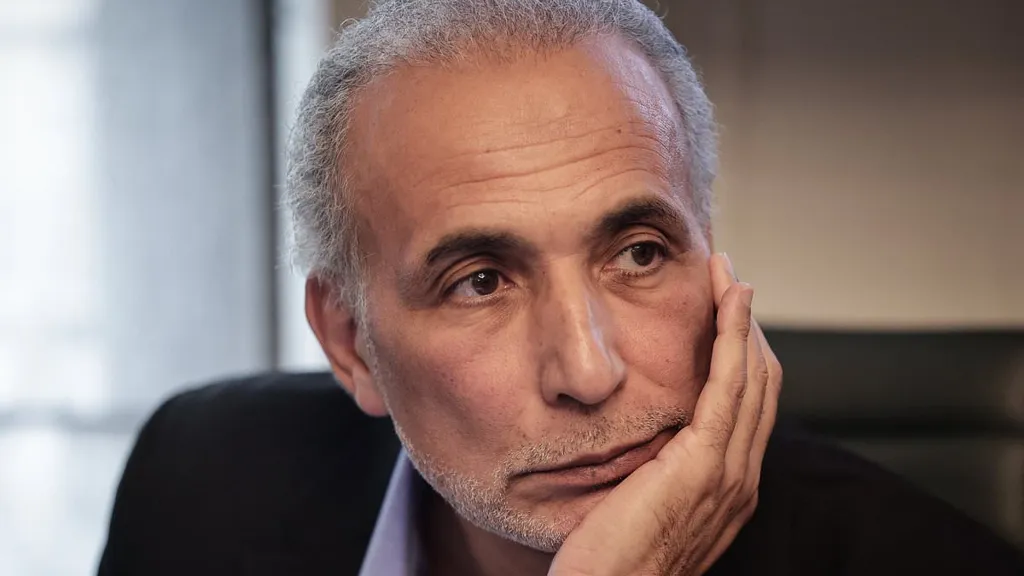
A former Oxford professor and Islamic studies scholar will face a rape trial in his absence in Paris next week after a court dismissed his claim he was too ill to attend in person.
Tariq Ramadan, 63, is accused of the 'aggravated rape' of three women in France between 2009 and 2016.
The Swiss has multiple sclerosis (MS) but medical experts found he was fit enough to attend the four-week trial.
Ramadan's case is one of the most famous to come out of the Me Too movement, which began in the US after women made allegations against Hollywood producer Harvey Weinstein in 2017.
The presiding judge in Ramadan's rape case, Corinne Goetzmann, issued an immediate arrest warrant and ordered the trial to go ahead after the medical opinion was delivered.
Ms Goetzmann had adjourned the trial on Monday - its first day - after Ramadan failed to appear and his lawyers said he was in hospital in Geneva because of his MS.
Philippe Courroye, a prosecution lawyer, said Ramadan was 'using every means available to avoid appearing and being tried'.
After Ms Goetzmann dismissed claims of ill health, the defendant's four lawyers left the room in protest and one, Ouadie Elhamamouchi, said: 'To stay is to accept this travesty of justice.'
Tariq Ramadan faces allegations of raping three women, a trial for which will now go ahead after his ill health claims were dismissed.
One of the women who accused Ramadan of rape is French writer and feminist Henda Ayari.
Ramadan, who previously advised British governments on Islam and society, denies all charges and said the women consented to having sex with him.
He was convicted in 2024 of raping a woman named Brigitte in 2008 and sentenced to one year in prison.
Ramadan is now accused of raping Henda Ayari, a French feminist activist, in 2012.
He will also be tried for raping 'Christelle', a disabled woman who said Ramadan assaulted her brutally in 2009, and a third woman who has not been named but said she was raped in 2016.
If convicted he faces a maximum 20 years in prison.
After multiple allegations of rape, assault and sexual harassment were made against him in 2017 Ramadan took a leave of absence from Oxford University, ten years after starting in the position.
He had been a senior research fellow of St Antony’s College but the university said at the time his leave of absence ‘implies no presumption or acceptance of guilt’.
In 2021 he left the university by mutual agreement, taking early retirement for ill health reasons.
Ouadie Elhamamouchi, one of Ramadan’s lawyers, left the court after the defendant’s ill health claim was dismissed and said: ‘To stay is to accept this travesty of justice’
At the time he said his MS meant he was unable to move without a walking frame, had ‘permanent headaches’, difficulty concentrating, memory loss and ‘intense’ pain.
Ramadan had been a prominent Islamic thinker, condemning extremist terrorism particularly after 9/11.
He was denied entry to countries including Tunisia, Egypt, Saudi Arabia, Libya and Syria because he had criticised their lack of democracy, he said.
In 2004 he was listed in Time magazine’s 100 most influential people in the world and the following year joined a government task force investigating the roots of extremism in Britain under then-prime minister Tony Blair.
Ramadan's grandfather was Hassan al-Banna, an Egyptian political and religious leader who founded the Muslim Brotherhood.