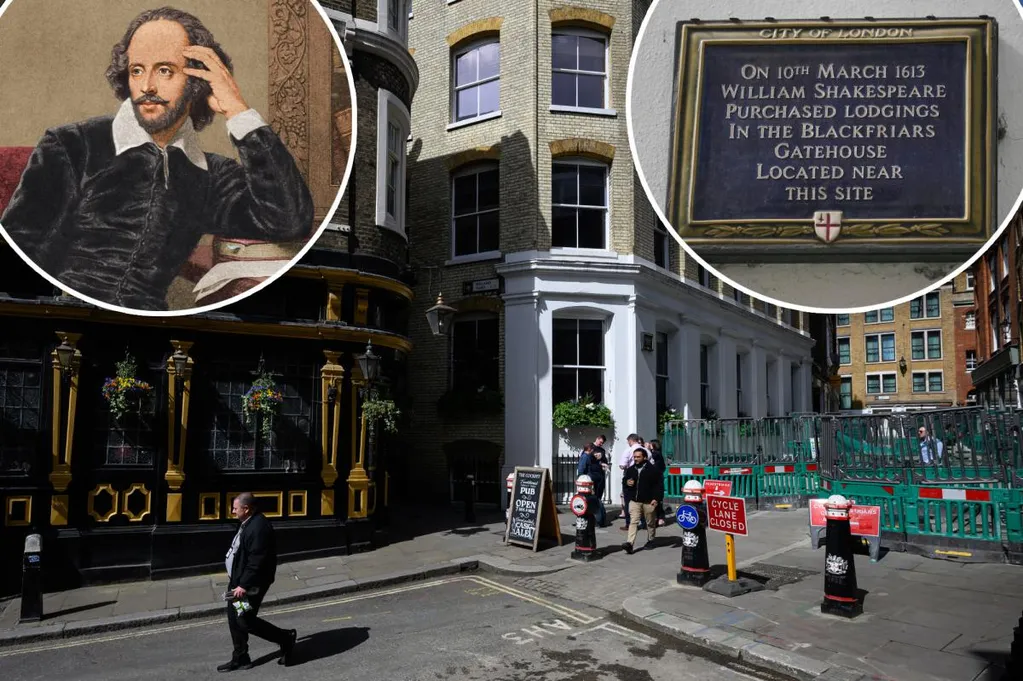
To be or not to be? That may be the only question left, as a longstanding Shakespearean mystery is now solved.
Curiosities about the exact location of the unparalleled playwright's "missing" London home have persisted for centuries, forcing fans and researchers alike to give up the hunt.
But Lucy Munro, a professor of Shakespeare and Early Modern Literature at King's College London, has just officially cracked the code on pinpointing The Bard's abode.
"I was doing research as part of a wider project and couldn't believe it when I realized what I was looking at," Munro said in a statement, "the floorplan of Shakespeare's Blackfriars house."
The expert unearthed three documents -- two from the London Archives and one from the National Archives -- offering detailed information on the site and size of the property, which Shakespeare purchased in 1613.
Prior to Munro's findings, academics reportedly believed that the home in Blackfriars -- located in central London -- was part of "the Great Gate" over the entrance to the Blackfriars precinct, a major 13th-century Dominican friary.
For years, a blue plaque honoring Shakespeare -- mounted to a building at 5 St. Andrew's Hill, a historic street in Blackfriars -- has read that the "Romeo & Juliet" author's residence was merely "near" the landmark.
However, one of the docs Munro's just uncovered features partial blueprints of the Blackfriars precinct, drawn up in 1668, two years after the Great Fire of London, confirming that Shakespeare's lodging stood in the exact spot of the precinct rather than in close proximity to it.
The part of the property that spanned the gate did not appear in the post-fire plan because it had no foundation. But the other part measured 45 feet from east to west -- 15 feet from north to south at the eastern end, and 13 feet at the western end, per the King's College London report.
The plan doesn't indicate its internal layout or rooms, but it was substantial enough to have been divided into two homes by 1645.
"This house was close to [Shakespeare's] workplace at the Blackfriars theatre," said Munro.
She went on to note that her triumph suggests Shakespeare may have continued living -- and working -- in London much longer than many had previously thought before he retired to Stratford-upon-Avon, located in the West Midlands of England.
"This discovery throws into question the narrative that Shakespeare simply retired to Stratford and spent no more time in the city," said Munro. "It has sometimes been thought that he bought his Blackfriars property merely as an investment, but we don't know that this is true, or that he never used it for himself."
"We know that Shakespeare co-authored Two Noble Kinsmen with John Fletcher later in 1613," she continued. "And this new evidence that the Blackfriars house was quite substantial makes it not inconceivable that some of it may have been written in this very property."
"These findings really help us tell the complete story of Shakespeare's Blackfriars house."
The other two documents she exhumed relate to the sale of the property by Shakespeare's granddaughter, Elizabeth Hall Nash Barnard -- the daughter of the icon's eldest daughter, Susanna -- in 1665.
The property covered what are now the eastern end of Ireland Yard, the bottom of Burgon Street, and parts of the late 19th-century buildings at 5 Burgon Street and 5 St Andrew’s Hill.
The breakthrough revelation comes just after explosive claims that Shakespeare's legendary writings were, in fact, penned by a black, Jewish woman -- an assertion made in the book "The Real Shakespeare: Emilia Bassano Willoughby" by Irene Cosset.
Earlier probes into Shakespeare's long-debated sexuality confirmed that the creative was "undeniably" bisexual.