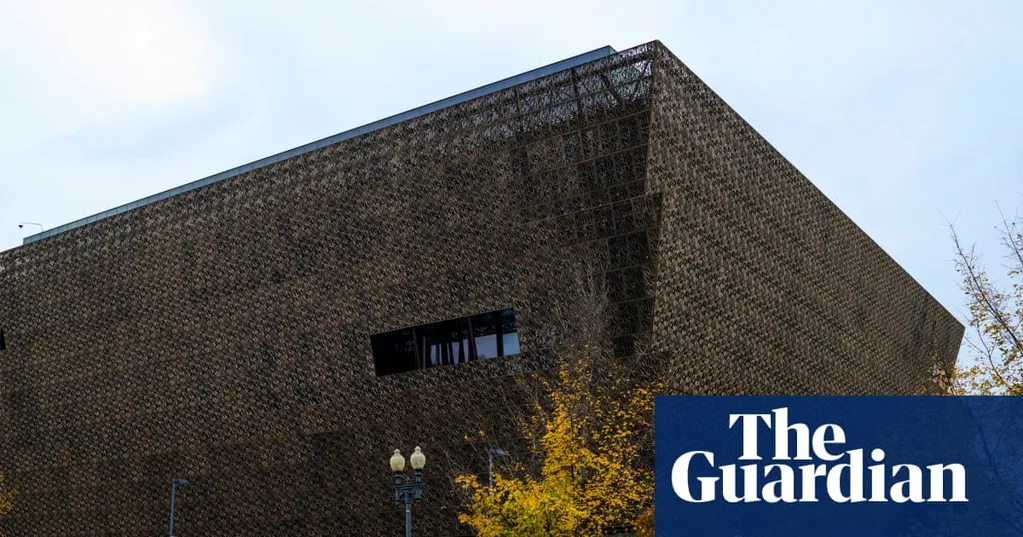
At a time when museums and colleges are facing uncertainty and there is a push to limit the acknowledgment of Black history, the Smithsonian's National Museum of African American History and Culture (NMAAHC) and its five partner historically Black colleges and universities (HBCUs) have launched a new exhibit to put Black history and Black archives at the forefront.
At the Vanguard: Making and Saving History at HBCUs, on view at the NMAAHC now through 19 July, was developed as a part of the History and Culture Access Consortium (HCAC). After "At the Vanguard" leaves the NMAAHC, it will go on tour to each of the universities along with other locations that request it.
The exhibit, which is made of archival materials and collections from each of the five HBCUs of the partnership - Jackson State University, Florida A&M University, Tuskegee University, Clark Atlanta University and Texas Southern University - is the culmination of years of work by the consortium. With more than 100 objects on display at the NMAAHC, the collection includes rare items, such as one of the only existing color videos of George Washington Carver, the agricultural scientist and inventor, from Tuskegee University.
Florida A&M University (FAMU) provided, along with many other items, a nursing cape and gown and a blood pressure machine from its nursing school. Jackson State University (JSU) contributed several items from the archives of Margaret Walker Alexander, the poet and novelist. And both Clark Atlanta University and Texas Southern University provided art, such as Frederick Flemister's The Mourners, a painting depicting a mother grieving her son who was lynched, and a ceramic bottle with glaze by the visionary sculptor and ceramist Carroll Harris Simms.
The HCAC has helped the included institutions digitize their archives and collections to make them more accessible to the public. The exhibit and subsequent tour are part of that work.
Though the first HBCU, now known as Cheyney University, was founded in Pennsylvania in 1837, most of these schools were founded in the years preceding, during, and just after the civil war. HBCUs were not just places for Black Americans and the wider African diaspora to gain a formal education; the institutions have also been sites at which Black arts flourished, political movements developed, and Black leaders found their footing. Alumni of HBCUs across the country include a myriad group of artists and politicians, including Chadwick Boseman, Nikki Giovanni, Kwame Nkrumah, Ella Baker, and Medgar Wiley Evers.
Timothy Barber, the director of FAMU's Meek-Eaton Black Archives Research Center and Museum, said that the efforts that people undertook to begin preserving Black history and culture show just how important they continue to be.
"Our founder, Dr James N Eaton, in 1976, decided to begin collecting this history, making sure that we're able to tell the story," Barber said. "The question is always asked: 'What do we tell our children? Who will be around to tell that story?' These museums, these archives serve as a catalyst for that story to be told. We're not interpreting history in our fashion; what we're doing is providing an opportunity for people to read and research history for themselves."
Some of FAMU's included items highlight the university's history as a land grant institution, which were federally funded colleges or universities that taught agriculture, military science and engineering as well as traditional liberal arts, allowing working-class people to attain a classical education. There are 19th-century wood carvings from Ghana, part of FAMUs Field Spirits of the Fante collection, which includes a group of large, wooden sculptures used for protection.
Also included in the exhibit are items like Tuskegee Institute pottery. Many of Tuskegee’s buildings were created by students, which is represented by four handmade bricks from the school’s collection. Photographs by Doris Derby, Chester Higgins, Earlie Hudnall Jr and PH Polk, all of whom were affiliated with HBCUs and who documented Black student activism and cultural movements are included, as are artworks collected by artists like John Biggers, Elizabeth Catlett, Robert Pruitt and Renee Stout.
Angela D Stewart, an archivist at Jackson State's Margaret Walker Center, wants visitors to understand the impact and importance of the people who contributed to HBCUs along the way. "The exhibit includes things such as a Jackson State yearbook that was actually dedicated to Margaret Walker," Stewart said. Walker was a professor of English at JSU, where she founded the Institute for the Study of the History, Life, and Culture of Black People. She was mentored by Black literary icons such as Richard Wright, WEB Du Bois and Langston Hughes and paid that guidance forward by mentoring Alice Walker, Sonia Sanchez and James Baldwin.
A first edition of Margaret Walker's only novel, Jubilee, is included in the exhibit, as are a 1942 print of her first published book of poetry, For My People; several of her personal journals; her typewriter; and other items.
An exhibit about HBCUs would be remiss without the inclusion of marching bands paraphernalia. An image of drum majors from The Sonic Boom of the South, Jackson State’s world-famous marching band, greets visitors of the exhibit, who can also view a drum major shako cap from FAMU’s legendary Marching 100 band and recorded albums of the college’s concert and marching band from the 1960s and 70s.
"It's one thing to hear about these stories," Barber said, "but it's another thing to really see first-hand primary source material that speaks to the excellence of education and activity that has been nurtured for so many years here in America for people of color. I always say if you don't know where you come from, you'll never know where you're going. These things allow people to be educated about their self-relevance and their place in this fabric of America."