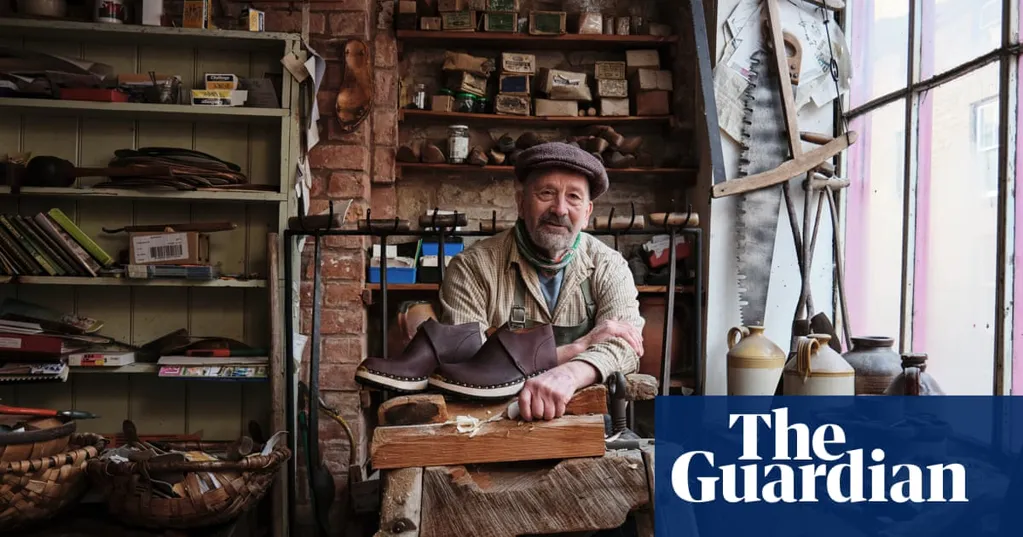
I cut small trees around Offa's Dyke, then shape the wood by hand.
I never wanted to be part of an unsustainable society. I've always tried to live as peaceful a life as I can, outside the big cities. Now I am the last person left in England making clogs by hand. I spend most days in my studio in Kington, Herefordshire, carving green sycamore wood that I collect myself, hand-dyeing the leather and making sure the soles are as near perfect a match to someone's foot as possible. I don't think you can have a more peaceful life than that.
I grew up in Ceredigion, surrounded by sheep. There were no jobs in the area and in 1976 I had to go on benefits. I developed extreme anxiety after breaking up with my first girlfriend. Convent schooling and boys' boarding schools weren't the best places to learn to develop relationships and I needed to find something therapeutic to do.
I met a craftsman in an adjoining village called Tregaron. He was a clog maker called Hywel Davies. I began training with him as an apprentice. I found the craft fascinating. Clog carving knives are dangerous, so the activity demanded my complete attention: it was the perfect therapeutic outlet.
I also taught myself to make other kinds of shoes, but I've always stuck by clogs. I can't say I had any natural aptitude for the craft, but it's mostly sheer will that gets you through.
British clogs are made of a combination of wood and leather, not to be mistaken for the more well-known European all-wooden footwear. Each pair takes about 15 hours to make. Women's and children's shoes are easier as they're generally smaller, but men make up most of my customers. Some of their feet are so big, I can only compare them to yetis'.
Once, when I was in my 20s, I managed to make almost two pairs in a day, but they weren’t very good. Now I’m in my 70s, it takes me a lot longer. Collecting the wood and shaping it by hand is also very tough on my back. I don’t know how much longer I have left as a maker.
I cut small trees myself around Offa’s Dyke, on the border between England and Wales. A man once told me he had a tree that needed felling, and asked if I could make him any clogs from the pieces. I made two pairs for him and a pair each for his wife and daughter.
My clogs have been sent around the world - as far as Tasmania - but my regular clients are mostly in the UK. I send customers the wooden soles to check they fit properly first. I wouldn't even be able to begin counting how many clogs I've made over the years.
Fifteen years ago, a client ordered seven pairs over a few months - he had more faith in my work than my longevity. He had flat feet and couldn't bend them without being in pain, so I carved a curve into his clogs to help him. People think they're difficult to walk in, but that's a misconception. I only wear clogs that I've made myself. I've made pairs for morris dancers who have said they were the first shoes they could comfortably dance in, and even keep on for the rest of the day.
I often get asked whether I'm worried about competing with machinery. Traditional clog making started dying out as early as the 1950s, and while I will never keep up with machines when it comes to quantity, my bespoke shoes will fit better.
I've advised film and theatre companies on the history of clogs. I made some shoes for Carey Mulligan, who played the lead in the film Suffragette. Initially they'd asked me to make a pair of clogs which would have been wrong for that era - I was then tasked with producing something that was historically accurate.
I have had to subsidise my income over the years, and have worked as a National Trails surveyor. But I have always returned to clog making, even writing a booklet about them. I've only successfully taught one person to properly and safely carve: now he works at a museum.
While I don't earn very much, that doesn't matter. It's not why I do it. I recently came across a trade journal from more than a hundred years ago, in which the author expressed surprise that clog carving was still being done by anyone. It's of its time - soon to be a thing of the past.