Experts have identified a complete list of dog breeds at risk of serious breathing problems, as they warn 'cute' flat faces result in a lifetime of suffering.
Researchers from the University of Cambridge said the popularised 'squished' faces of dogs can come at a price.
Their shortened skull shape, called brachycephaly, can cause horrific wheezing and difficulty breathing.
While previous research has focused on the three most popular 'flat faced' dog breeds in the UK - the Bulldog, French Bulldog and the Pug - they have now found a further 12 breeds at risk of serious issues.
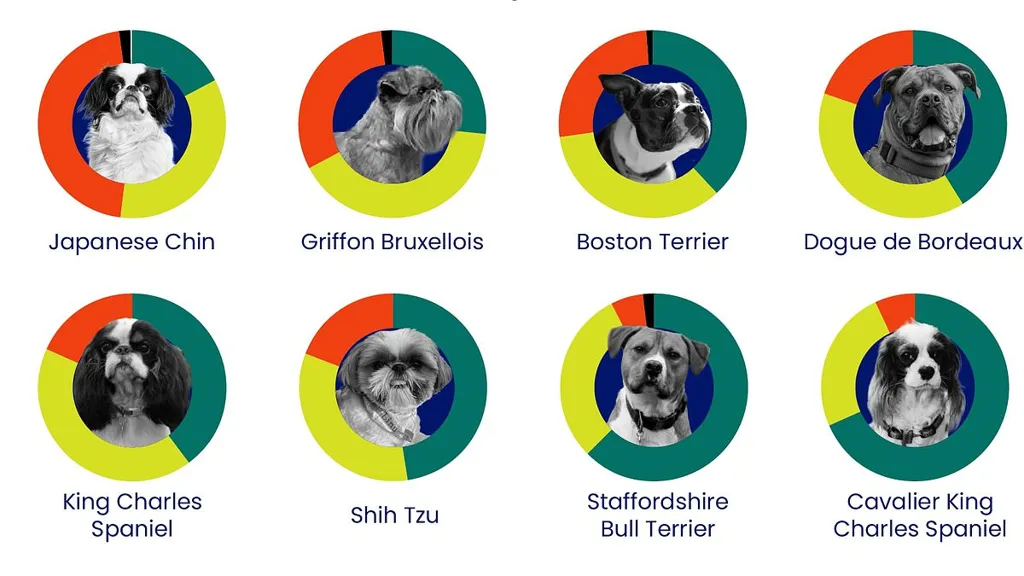
This includes the Pekingese and Japanese Chin breeds, which were found to be at highest risk of a serious breathing problem called Brachycephalic Obstructive Airway Syndrome (BOAS).
Meanwhile the King Charles Spaniel, Shih Tzu, Griffon Bruxellois, Boston Terrier and the Dogue de Bordeaux are all at moderate risk of the condition.
The Staffordshire Bull terrier, Cavalier King Charles Spaniel, Chihuahua, Boxer and Affenpinscher were all found to be at mild risk.
'BOAS exists on a spectrum,' co-lead author Dr Fran Tomlinson, from the University of Cambridge, said. 'Some dogs are only mildly affected, but for those at the more severe end, it can significantly reduce quality of life and become a serious welfare issue.'
The researchers discovered 12 new breeds at risk of breathing issues. The Pekingese and Japanese Chin were at highest risk of BOAS, while the King Charles Spaniel, Shih Tzu, Griffon Bruxellois, Boston Terrier and the Dogue de Bordeaux are all at moderate risk of the condition. The Staffordshire Bull terrier, Cavalier King Charles Spaniel, Chihuahua, Boxer and Affenpinscher were all found to be at mild risk. However the Pomeranian and Maltese were not found to be clinically affected by the condition.
Flat-faced dogs, like Pugs, suffer from debilitating health conditions. A dog's nose should be at least one-third the length of its skull in order for it to breathe normally, experts have said.
For their study, the team collected data from 898 dogs encompassing 14 different breeds.
They measured the animals' skulls and noses, bodies and necks, and checked them for symptoms of BOAS following a three-minute exercise test.
In the study they focused on the loudness and difficulty of the animals' breathing, but other symptoms can also include loud snoring, snorting, poor heat tolerance, exercise intolerance and even vomiting.
Of the 14 breeds, two were found to not be clinically affected by the condition - the Pomeranian and the Maltese.
However, the team discovered the remaining 12 all experienced problems on some level, meaning they join the likes of Pugs and Bulldogs in a comprehensive list of the breeds at risk of BOAS.
The study, published in the journal PLOS One, also found that the condition varies considerably within each breed.
Those with a very flat face, collapsed nostrils or a 'plump physique' were at especially high risk, they discovered.
The researchers hope that this study will lead to more 'flat-faced' dogs being tested and encourage greater engagement on BOAS and other health issues faced by these breeds.
89 per cent of Pekingese involved in the study were found to be at risk of BOAS, the researchers found.
The dogs were graded for BOAS on a scale of zero to three, with zero indicating few symptoms, and three meaning the pup had difficulty exercising and getting enough air.
The breeds at risk of serious breathing problems
High risk
- Bulldog
- French Bulldog
- Pug
- Pekingese
- Japanese Chin
Moderate risk
- King Charles Spaniel
- Shih Tzu
- Griffon Bruxellois
- Boston Terrier
- Dogue de Bordeaux
Mild risk
- Staffordshire Bull terrier
- Cavalier King Charles Spaniel
- Chihuahua
- Boxer
- Affenpinscher
Dr Jane Ladlow, who co-led the study, said: 'Being aware of risk factors can be useful for both breeders and prospective owners in selecting dogs which are less likely to be affected by BOAS.
'Knowledge of these risk factors can also help to inform judges in deciding which features are detrimental to health so that factors associated with BOAS are not rewarded in the show ring particularly as winning dogs can become popular sires.'
The team said that a breathing assessment remains the most accurate way to determine BOAS risk and therefore which dogs should be selected for breeding or whose welfare would benefit from veterinary intervention.
'While surgery, weight management and other interventions can help affected dogs to some degree, BOAS is hereditary and there is still much to learn about how we can reduce the risk in future generations,' Dr Tomlinson added.
In severe cases, BOAS can result in collapse or even death, they warned.
Last week, it emerged that dog shelters are being forced to euthanise flat-faced breeds amid a 'heartbreaking' rise in abandonments.
The shelters warned they are being overwhelmed by the sheer number of dogs with 'extreme conformations', with one reporting a 500 per cent increase since 2017.
Sarah Roser, head of operations at Hope Rescue in South Wales, told the Daily Mail: 'We're looking at a dog where nothing is functioning as it should be, and sadly, those are the animals that sometimes we have to make a euthanasia decision for. No matter what we do medically, we're never going to get them to a point where they're free of pain.'