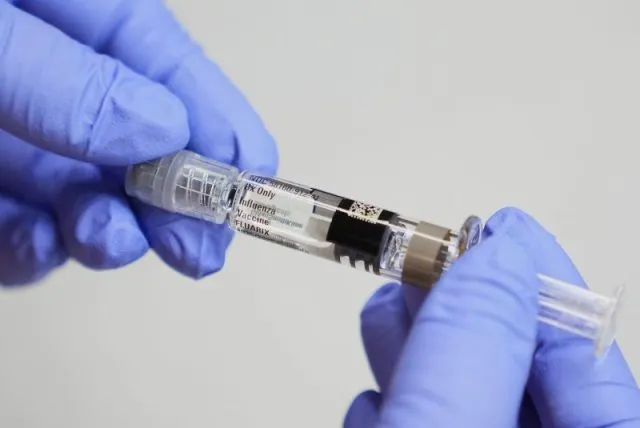
I had a baby in August. I had been going back and forth (just ask my husband) about what vaccines to give him. Some of them seemed obvious, others less so. For example, did my son really need the Hepatitis B vaccine, the requirement for which was only introduced in the 1990s?
On most of the vaccine recommendations, I followed the usual guidance -- only to find myself panicking afterward, going back and forth between feeling like it was absolutely the right decision and that I might have made a horrible mistake.
I'm afraid that today, such doubts are inevitable, even if I'm just overreacting to minimal risks. And I know whom to blame. This is what the public health establishment has done to moms everywhere. And if they don't fix our trust in them, I worry for the health and safety of our children.
I had an incredible newborn care specialist who told me some of the vaccines weren't really necessary and might not be a good idea. But my first pediatrician's office really pushed it hard and made me feel like a bad, crazy, or even MAHA mom, even though my son is not high-risk. To the extent that any conversation with the doctor was possible at all, I felt like I was being told that any concerns I had were invalid, because shut up.
In the end, my son got all of the vaccinations. Ten days after he got the rotavirus vaccine, the CDC changed its recommendations for it -- from "must get" to eh, maybe not so necessary at this point. Recommendations have in fact been adjusted similarly for seven of the 18 previously recommended vaccines. Suddenly, I felt like the worst mom ever. I found myself crash googling whether rotavirus and hepatitis B causes autism (to save you the Google, they don't).
I am a statistician. All these vaccine decisions are based in statistics. At every turn, we weigh the risk of something bad (rare vaccine reactions) against the opportunity for something good (broad protection against terrible diseases). This is literally my job. So if I can't figure some of the guidance out, how on earth do we expect other parents to do so?
There is no one I feel for more than moms (and dads) trying to make the decision about what vaccines to give and what not to give their babies right now. I am an academic. Scientific study is my entire profession, and I'm sitting right in the middle of the group of Americans who have lost trust in the U.S. public health system.
That trust declined from 72 percent to 40 percent in the last five years, and we all know exactly why. With the massive public heath failure of COVID (mask, don't mask, vaccinate, don't vaccinate, shut down, don't shut down) my own eyes were opened to the total incompetence of the public health system.
Many of the vaccines on the recommended list are not only important but integral to the health and future of our children. The thought that we are having a measles outbreak in 2026 is beyond my imagination when 26 years ago this truly dangerous virus had been eradicated. I have done the research for my own child and there is no question that measles vaccination is the right choice.
But why should you trust me when it's hard to trust or even have an honest conversation with your own pediatrician?
If you have found a doctor you trust without qualifications then I am jealous. You are incredibly lucky. But what are the rest of us supposed to do?
The American Medical Association released a statement which said as I Interpreted it that the CDC is now run by quacks. We need to evaluate "scientific evidence," the organization says, and you should still should give your kid all the vaccines. But this same organization had everyone wearing masks for years without any scientific evidence for it. As late as spring 2022 it was trying to get vaccinated people to wear masks outdoors.
The American Academy of Pediatrics is touting the CDC's change as "dangerous and unnecessary." But this group at first said schools should reopen in fall 2020 then let politics override its scientific judgment and backtracked. This organization still recommends that children as young as six months-old should be getting regular COVID shots. You can understand why a lot of fearful parents are not necessarily going to put their faith here.
So I then turned to someone whom I have regularly trusted and who I think does a great job -- Emily Oster of ParentData. She had the best explanation I could find as to why we have so many more vaccine requirements than European countries do. In short, America is richer and therefore has access to more vaccines than other countries. This means we are more likely to judge the costs as not outweighing the benefits. Europeans, facing higher costs, may feel otherwise.
But we also have worse access to healthcare than in European countries, and we visit the doctor significantly less often. So statistically, when people do find themselves in a doctor's office, it is smart for the doctor (and here comes all that medical school training) to deliver as much preventative care as possible in as few visits as possible. That could mean getting a whole lot of vaccinations at once. That makes a lot of sense to me.
In most cases -- and with most of the recommended vaccines -- there is really no more important or better protection you can give your children than vaccinating them. As someone who lost a lot of trust in public health, and who has done the research for her own child, I can promise you that. But when we have so much information lacking common sense coming out of the same bodies that we are supposed to trust, and no acknowledgement whatsoever of their prior failures, trusting them can feel overwhelming.
The academic community still thinks it enjoys the public's confidence. It just isn't so. It became so high on its own supply that it wouldn't deign to defend its own credibility by explaining the academic studies and answering fair questions.
They think it's enough to make concerned parents feel like they are kooks for wondering whether there is a connection between the practices of modern medicine and the 400 percent rise in autism and other neurodivergent syndromes such as Attention Deficit Hyperactivity Disorder.
Andrew Wakefield -- the charlatan whose faked data caused a panic over vaccines causing autism -- put the first few cracks into the public's trust. That's on him, and at least today we can learn his history and discard his lies. But and the public health establishment's failure to acknowledge its huge mistakes over COVID has made things much worse, and this breach of trust is harder to fix.
This shouldn't really be a debate at all. All of us just want to understand what is best for our children. We are concerned about the motives of big pharma, the Wakefields of the world and everyone else trying to make a profit from our babies -- including, frankly, many involved in the MAHA movement, who I don't think are all acting out of the goodness of their hearts.
Usually, when I write about data-driven evidence, I have a recommendation or an answer or a belief at the end. The only thing I can tell you is that the vaccines the CDC currently recommends for children are not only important for you own child but are in fact integral to the health and safety of every other child. The ones they don't recommend as strongly -- well, we still have some research to do. But I can tell you this: if our public health institutions don't get their act together; acknowledge their faults; do everything in their power to regain public trust then I feel lost; scared for American babies' health.
Liberty Vittert is a professor of data science at Washington University in St. Louis and the resident on-air statistician for NewsNation,a sister company of The Hill.