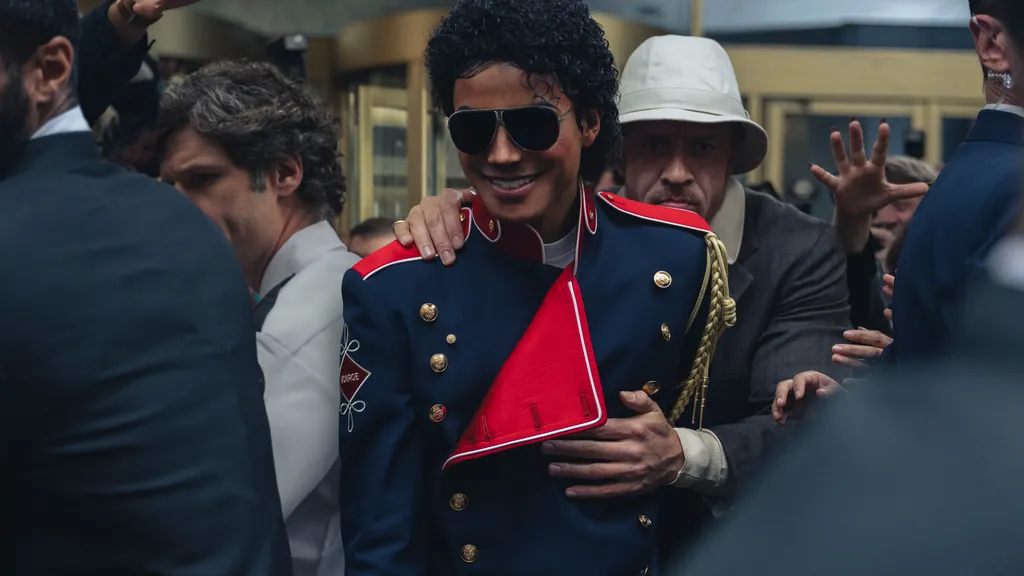
Here's how the new biopic about the pop star handles everything from major moments like the "Beat It" video to details like a pet giraffe.
"Michael," the new biopic about Michael Jackson's triumphant but traumatized life, underwent costly reshoots when Jackson's estate discovered a legal agreement from the '90s preventing the film from depicting a child who had alleged the star sexually abused him at the time. Instead, the movie's central conflict is between the Jackson 5 patriarch, Joseph Jackson, and the family group he drove to superstardom, particularly Michael, its dynamic frontman.
In this version of the story, what does the film fictionalize and what does it get right? Here is the fact check, based in part on research for my book "MJ: The Genius of Michael Jackson":
Did Joseph Jackson beat Michael with a belt when he was a little boy -- and call him "Big Nose"?
Yes, the beatings did occur, according to both of the Jacksons. Michael accused his father (played by Colman Domingo) of abuse from belts and "iron cords." Joseph told the BBC, "I whipped him with a switch and a belt. I never beat him -- you beat somebody with a stick." In the film, Michael's mother, Katherine, confronts Joseph: "What are you going to do, beat him? You gonna whup him?" But in a 2013 CNN interview, Katherine Jackson defended her husband: "I didn't think he was too tough," and added, "If you did something wrong, you got a scolding for it, and you also got a licking for it."
As for "Big Nose," it was Michael's brothers who gave him this cruel childhood nickname, according to J. Randy Taraborrelli's book "Michael Jackson: The Magic, the Madness, The Whole Story 1958-2009." Although The Guardian and other publications suggested Joseph Jackson called him this name too, Michael's father denied it.
Did Michael Jackson broker a truce between Los Angeles gangs?
Yes, in a way. He wanted a "West Side Story" dance concept for his "Beat It" short film, and instructed his manager at the time, Ron Weisner, to meet in downtown Los Angeles with Crips and Bloods -- with security present. The gangs agreed to participate, then arrived at the rehearsal warehouse in two buses. The dancer Popin Pete has recalled, "These people switched to the nicest people ever."
Did Walter Yetnikoff, head of Jackson's label CBS Records, make a threatening phone call to MTV that resulted in the artist's videos being played on the channel within hours?
Depends on whom you ask. In his autobiography, "Howling at the Moon," Yetnikoff, who died in 2021, said he made such threats with the support of producer Quincy Jones. Executives at CBS-owned Epic Records from that time agree: He called Bob Pittman, then MTV Networks chief executive, and referencing other CBS acts said, "'You know all those Bruce Springsteen and Cheap Trick and Charlie Daniels videos that you guys are playing over there?'" Ron McCarrell, a label marketing executive, has recalled. "'Pack 'em all up, put 'em in a box and send 'em back.'" But MTV executives from that era dispute this account. "It never happened," Les Garland, a network executive at the time, has said. "Folklore, man, folklore." Either way, Jackson's smash "Billie Jean" premiered on the influential cable channel in March 1983 and integrated what had been almost exclusively a format for white rock artists.
Did Michael Jackson fire his manager -- his father Joseph -- by fax?
No. Joseph said he hired Michael's early-'80s co-managers, Weisner and Freddy DeMann, and told them: "We don't really get what we need out of the record company, so I need some white guys to help me out." (This prompted an exchange in Billboard magazine in which Joseph referred to Weisner and DeMann as the "white help," and Michael said his father's statement "turns my stomach.") In March 1983, just as "Thriller" was taking off, both management deals expired, and Michael turned to Frank DiLeo, his friend and promotion man at Epic Records, to manage him until the early '90s.
Did Jackson's hair catch fire during the filming of his 1984 Pepsi commercial video with his brothers?
Yes. The "Michael" rendition of this event is largely accurate, as shown in a video of the incident posted by Us Weekly in 2009, including crew members extinguishing the flames from the top of his head. "He was literally standing in a ball of flames," a member of the lighting crew said.
The film depicts Jackson and his lawyer, John Branca (Miles Teller), discussing a seven-figure settlement with PepsiCo, which Jackson demands be donated to a burn center. The real-life number was $1.5 million, according to People magazine and other reports, and established the Michael Jackson Burn Center at what was then called the Brotman Medical Center in Culver City, Calif. The center closed in 1987, and the medical center is today the Southern California Hospital.
What the film doesn't show: After Jackson left the hospital, he began to take painkillers which, he said in a statement later, led to dependency.
Did Joseph Jackson say that without revenue from what became the 1984 Victory Tour starring Michael and his brothers, "we lose everything"?
Not exactly. But just as Michael's solo career was taking off, Joseph and the Jackson brothers were in financial trouble. Joseph met with concert promoters without Michael's knowledge and wound up working with boxing impresario Don King (played by Deon Cole), who guaranteed $3 million to the family—far higher than other promoters were offering.
Did Jackson live with his parents at their family home on Hayvenhurst Drive in Encino even after "Thriller" took off?
Yes. Although Branca helped Jackson buy a three-bedroom condo in Encino in the early '80s, the King of Pop could not bring himself to leave his mother so he remained at the family home until buying Neverland Ranch in Los Olivos, Calif., in 1988.
Did Jackson keep exotic animals including Bubbles the chimpanzee and a giraffe at the Hayvenhurst home?
Yes. The Jackson family accumulated peacocks, tigers, lions, ostriches, dogs and a parrot, as well as Bubbles, who wore OshKosh B'Gosh overalls and learned how to fetch Häagen-Dazs ice cream from the freezer. As for the giraffe, The Los Angeles Times reported that California game officials removed the six-month-old animal, who lacked a permit, from the Jacksons’ home in 1986.
Did Joseph Jackson intercept his son at home after Michael’s face was bandaged from his first nose job and say “Oh my God Michael”?
No. In his 2011 autobiography "You Are Not Alone: Michael Through a Brother's Eyes," Jermaine Jackson says it was him—not Joseph—who intercepted Michael. "What in the hell happened to you?" Jermaine recalled asking. While Michael didn't respond (or say it was for his sinuses as he does in the movie), Jermaine was later told his brother required rhinoplasty after falling in their family home.
The film makes Quincy Jones’s role in producing “Thriller” seem minimal. Accurate?
No. A prolific producer and bandleader, Jones was a crucial Jackson collaborator for his first three post-Motown solo albums: “Off the Wall,” “Thriller” and “Bad.” Although Jackson wrote “Beat It,” “Billie Jean” and other songs with help from his “B-Team” studio pros who worked with him at Hayvenhurst home; Jones’s “A-Team”—including “Thriller” songwriter Rod Temperton; members of rock group Toto; bass player Louis Johnson—were instrumental in creating sound blueprint all three albums. Jones and Jackson worked closely first two albums didn’t begin drift apart until they made “Bad” (1987).
Did Michael come up with the title for “Thriller” after a horror-movie binge?
No. Temperton—the “Off The Wall” writer—had been working on a song called “Starlight,” then woke up in his hotel room with the word “thriller” in his head. Although Michael loved horror movies—and later came up with idea for “Thriller” video because he wanted to portray a monster—Jackson and Jones settled on album’s title track after Temperton rewrote lyrics.