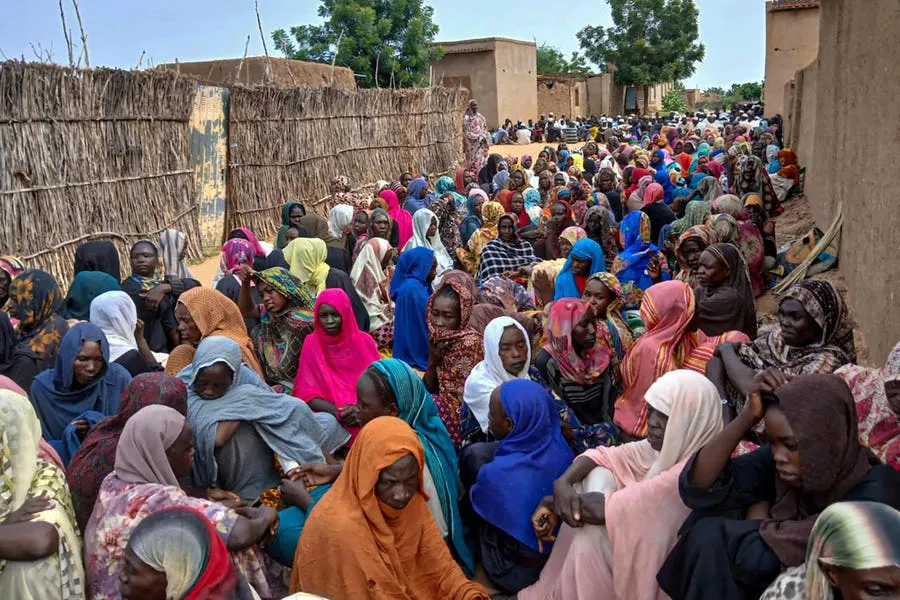
Famine in Sudan endangers about 25 million people. Nearly half the country is now experiencing severe food insecurity, which UN-backed analysts describe as "the most extreme hunger crisis globally." This crisis is not mainly caused by drought. It is driven by power struggles and conflict. Since April 2023, fighting between Sudan's army and the Rapid Support Forces has devastated the country. Cities have been bombed, markets and warehouses looted, and essential roads for food and medicine deliberately blocked -- a pattern confirmed in recent authoritative IPC reports.
UN human rights experts and humanitarian agencies have identified sieges and blockades that have trapped civilians without supplies. According to the Sudan Doctor's Union, in the Kordofan region alone, in the besieged city of Kadugli and the town of Dilling, doctors reported 23 children dying of malnutrition in a single month because food and medical aid could not get through. Sudan is not "sliding" into famine; large parts of its population are being pushed there.
International humanitarian law anticipated such crimes. The Geneva Conventions clearly stated that "starvation of civilians as a method of warfare is prohibited." The rule exists because, time and again, those in power have used hunger as a tool of control and dominance. However, this is not the first time famine has been exploited to subjugate a population.
History offers a grim list of precedents.
The Great Irish Famine of the 1840s was caused by potato blight during a period when, under British rule, Ireland exported food and adhered to rigid market principles that resulted in approximately one million deaths and forced many more to emigrate. Many historians now refer to the potato crisis as a classic example of a policy-driven famine influenced by British ideology and neglect.
During the Second World War, Nazi planners devised a "Hunger Plan" to divert food from occupied Soviet territories to Germany. The Nazis were fully aware that millions of Soviet civilians would face starvation. In other words, starvation was a intentional policy, not an accident. According to at least one estimate, over 4 million people died. This is not even count Jews and others who perished from hunger in Nazi concentration camps or in Nazi ghettos, another important example that included forced starvation.
In China under Mao, the Great Leap Forward involved forced collectivization, unrealistic grain quotas, and state procurement, which contributed to the Great Chinese Famine, widely acknowledged as one of the worst man-made disasters in history. According to the Encyclopedia Britannica, about 20 million people died.
In the late 1960s, during the Nigerian civil war, the federal blockade of Biafra was so severe that thousands of children died each day. Experts say that about 500,000 to 3 million people died in Biafra as a result.
More recently, during a developing situation following the October 7th, 2023 Hamas attack on Israelis, Israel announced a "complete siege" of Gaza with "no electricity, no food, no fuel" to be permitted. Severe restrictions on such essential supplies were imposed. In December 2024, Human Rights Watch accused Israel of using starvation of civilians as a method of warfare. In August 2025, a new IPC analysis confirmed that famine existed in parts of Gaza, where more than half a million people were trapped in conditions of extreme hunger.
Meanwhile, Russia's war on Ukraine is tightening the noose around Sudan's famine from two angles at once.
By blockading Ukrainian Black Sea ports when Russia launched its full-scale invasion of Ukraine in February 2022, then walking away from a later UN-brokered Black Sea Grain Initiative, and subsequently bombing ports and Danube terminals, Moscow has been trying to choke off millions of tonnes of grain destined for world markets, raising prices and squeezing African importers like Sudan. For example, in early 2024, through programs like "Grain From Ukraine," 7,600 tonnes of Ukrainian wheat flour arrived at Port Sudan - enough to feed about one million people for a month. However, the Russian naval threat persists to this day.
At the same time, Russian missiles, mines, and occupation have devastated Ukraine's farmland, silos, and power grid, enabling systematic theft of grain from occupied areas and crippling Ukraine's capacity to produce enough grain to feed itself and a hungry world. For Ukrainians, this is painfully familiar. In 1932-33, Stalin's Holodomor famine in Ukraine was engineered by seizing grain, sealing borders, and exporting food while villages faced starvation. Today's Kremlin may be using different methods, but its actions follow the same logic of turning food into a weapon. The outcome is that Sudanese families are now feeling the effects of decisions made in Moscow, just as Ukrainian villagers once did under Stalin, and now again under Putin.
All this takes place in a world of grotesque inequality. According to Oxfam's 2024 inequality report, billionaire wealth increased by about $2 trillion in 2024 alone, three times faster than the previous year, while global poverty has barely changed since 1990. A few states and corporations control grain, fertilizer, shipping, and insurance.
In a world as rich as ours, famine in Sudan is an indictment, not an inevitability. A global system that allows a few governments and corporations to profit while blockades, sieges, and deliberate destruction of farms push entire populations toward starvation is a system that has chosen its side. Sudan's famine is the latest warning that hunger is being used, once again, as a weapon. Whether this becomes another chapter in the long list of avoidable famines or the moment the world finally treats engineered hunger as intolerable depends on whether richer, safer nations are willing to prevent famine in Sudan or potentially in Gaza or Ukraine for that matter.