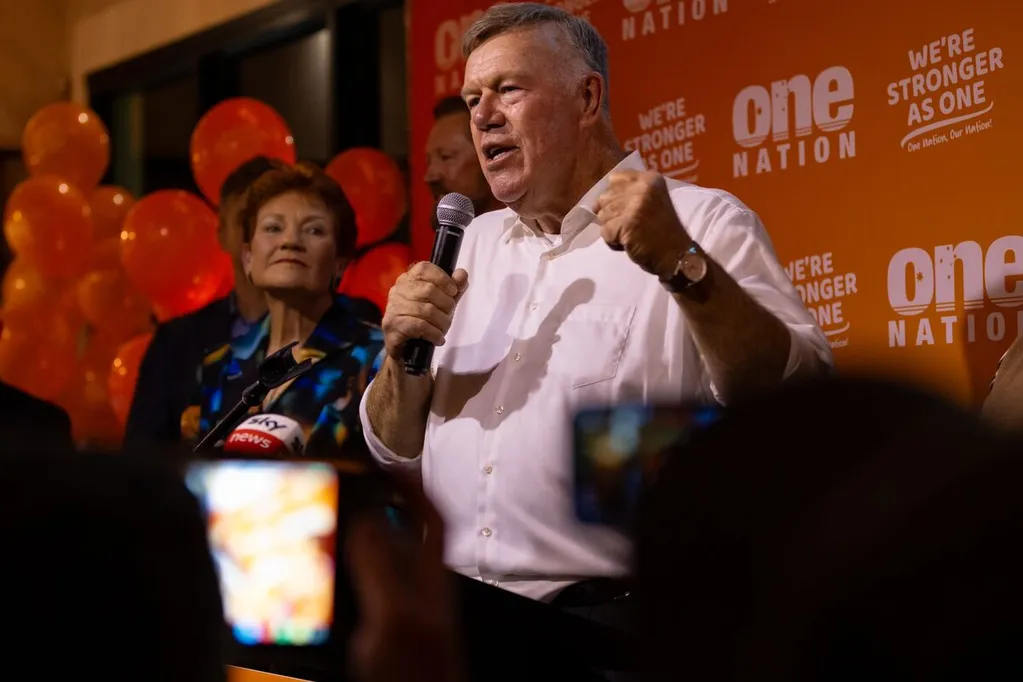
A far-right party won its first lower house election in Australia, with the victory underscoring the collapse in support for the center-right coalition that's governed for much of the post-war period.
One Nation's candidate David Farley easily won the seat of Farrer in the Saturday by-election, securing almost 60% of the vote, according to the Australian Electoral Commission. The seat had previously been held by former Liberal Party leader Sussan Ley, and had long been controlled by one of the two main center-right parties.
In his victory speech on Saturday evening, Farley criticized immigrants who "give us nothing" and vowed to target "damn net-zero programs," drawing loud cheers from supporters. Senator Pauline Hanson, One Nation's founder and leader, said her party would seek to win more seats throughout the country.
"You are not going to be the forgotten people any more. We are proud Australians. We want our country back and that's what One Nation is about," Hanson said following the victory. Her party has four senators in the national parliament, and already had one lower house member after a lawmaker defected from another party last year.
The collapse in support for the Liberal-National coalition mirrors the past two federal elections, where it has steadily lost seats and seen its vote slump, with urban seats taken by independent candidates campaigning on climate action. The loss in a rural electorate to a far more conservative movement underscores the party's difficulty in rebuilding support nationwide to challenge the center-left government.
"What we saw in Farrer wasn't a by-election - it was a bloodbath for the Coalition," Treasurer Jim Chalmers said in an interview Sunday. "What it tells us is that it will be almost impossible for the Liberals and Nationals to govern in the future without One Nation - this kind of three-ring circus of right-wing parties."
Chalmers said that the government will be announcing policies in this week's budget to address voter unhappiness about the status quo.
"We take very seriously the concerns that people have about our economy and about our society, which is driving people to consider some of these alternative political parties," both in Australia and overseas, he said, pointing to both the housing market and the tax system as two parts of the economy which are both "unfair and unacceptable."