The reporters reviewed dozens of pages of documents about this contract and analyzed other contracts awarded for similar projects.
To build his mammoth White House ballroom, President Trump last summer chose Maryland-based Clark Construction. Since then, Mr. Trump has repeatedly sung the company's praises, even saying he wanted it to refurbish projects all over Washington.
In January, government documents show, the Trump administration secretly gave the company a no-bid contract to do another job at a sharply inflated price.
The National Park Service wanted to repair two ornamental fountains in Lafayette Park, across Pennsylvania Avenue from the White House. The Biden administration in 2022 had estimated the work would cost $3.3 million. But Mr. Trump's government agreed to pay Clark $11.9 million to do it, and later added tasks that increased the contract to $17.4 million, the documents show.
The agency did so without considering offers from other firms, citing a rarely used "urgency" exception to normal open-bidding procedures usually meant for emergencies like war or natural disasters. By law, federal agencies are generally supposed to seek competing bids to find the vendor that provides the best deal.
Unlike the ballroom project, which Mr. Trump says will be funded by private donations, the bill for the fountain repairs is being paid by the government.
On Friday, Mr. Trump took credit for the repairs. "The first time Lafayette Park Fountains, opposite the White House, have worked in decades," he wrote on social media. "My Great Honor to have funded this project (and many others!), and helped."
This contract has not been previously reported. The Trump administration did not post it in public databases of federal spending, although agencies are typically supposed to report new contracts within three business days.
The New York Times obtained internal Park Service documents showing how the contract was awarded. Contracting experts said those documents revealed that the government had repeatedly used unusual procedures to bypass competition for the project and increase the price it expected to pay.
The Park Service, for instance, added more than $1 million to the contract's cost estimate by accounting for inflation. Twice.
"They just took the cover page of my estimate and just added a bunch of money onto it," said Stephen J. Kirk, an independent consultant who had estimated the cost of the fountain repairs for the National Park Service in 2022. "I didn't add those extra millions on there."
The Interior Department, which includes the Park Service, defended the contract but declined to answer specific questions about it.
"The way this contract was awarded is above board," Katie Martin, a department spokeswoman, said in a statement. "The urgency is to ensure this project is done well ahead of America's 250th anniversary."
Clark Construction has worked for the federal government for more than 80 years. In response to questions from The Times, the firm provided a short statement that did not answer specific questions about the ballroom or the fountain projects.
"Our track record reflects the quality of our work and our commitment to integrity," the statement said. "We bid on work we are qualified to deliver and we follow prescribed procurement processes."
Before last year, Clark had little overt connection to Mr. Trump, and had inked large contracts during Republican and Democratic administrations.
Then, last summer, Mr. Trump chose the firm to oversee one of Washington's largest and most secretive projects.
The president's ballroom plans call for a 90,000 square-foot structure on the former site of the East Wing. He has said it will be paid for by $400 million in private donations, and has declined to list the donors. The Times has identified some of them.
The president has also said that he chose the contractors and set their rates, believing the White House grounds to be exempt from contracting rules. But he declined to say how much he was paying them. There have been legal challenges to the ballroom, but a federal appeals court has allowed construction to continue, at least for now.
In January, Mr. Trump implied to The Times that Clark had offered to build the ballroom for free.
"They said: 'Sir, we'll do it for nothing. This is the greatest honor,'" he said.
This week, The Times asked the White House if Clark was indeed working for nothing. Taylor Rogers, a spokeswoman, said she had "nothing to add" to the president’s comments.
In fact, Clark is being paid for its work on the White House ballroom, according to a person who asked not to be named in order to discuss a sensitive matter.
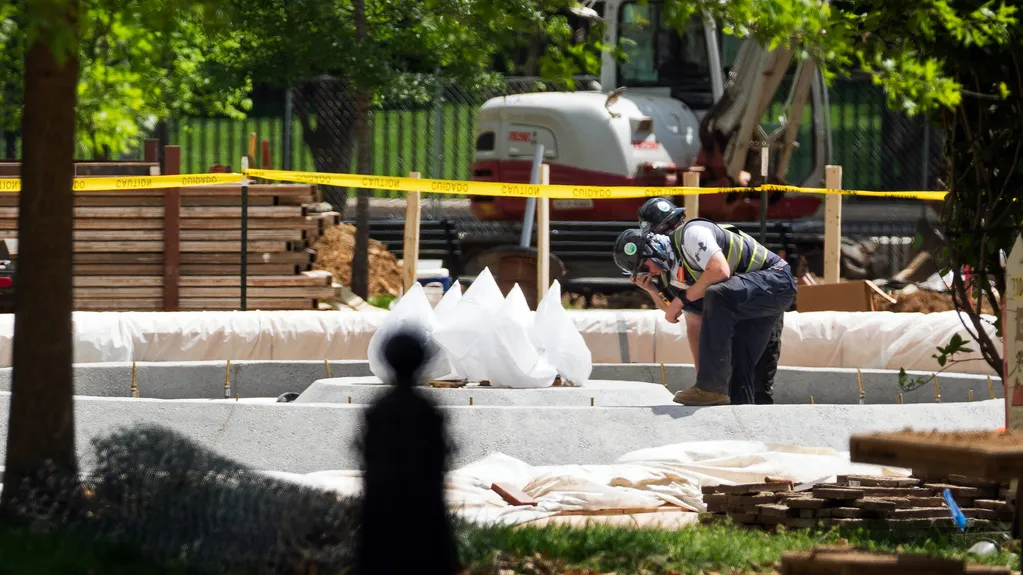
As the ballroom project was getting underway, the National Park Service sought to restart the two 1960s-era fountains in Lafayette Park. They had not worked for nearly a decade because of aging equipment.
In theory, this job was nothing like the ballroom project. It was outside the White House grounds, where normal contracting rules were supposed to apply.
But soon, government documents show that the Trump administration began taking actions to increase the contract’s price.
First, the Park Service estimated that the project would cost an additional 27 percent because of inflation. Then, puzzlingly, the service increased its estimate by another 24 percent, to again account for inflation.
By contrast, the best-known benchmark of broader inflation, the Bureau of Labor Statistics’ Consumer Price Index, rose by 16 percent in the same period. A narrower industry-specific index measuring construction prices rose by 21 percent.
Then the Park Service increased its estimate by another 50 percent. This time, it attributed the increase to a "schedule compression factor."
Contracting experts said that was unusual, too. They said that it is common to pay contractors more for going faster, but that it is usually done by asking for itemized costs -- extra overtime, extra equipment -- rather than adding such a large flat fee.
"I've never heard of such a thing," Mr. Kirk said.
At the same time, the documents show, officials were also building a legal justification to restrict who would be allowed to bid on the newly lucrative job.
They found that while Lafayette Park was usually open to the public, it was sometimes closed during White House state dinners, or when foreign leaders stayed at the nearby Blair House. Those occasional closures would stop the fountain repair work. So the Park Service said it would be necessary to hire one of the few contractors cleared to work inside the White House security perimeter.
That limited the pool of potential vendors to four, including Clark. The Park Service contacted all of them, according to two people familiar with the contract who asked not to be named because they were not permitted to speak publicly about the matter.
But then, Park Service officials reversed course and simply offered the job to Clark. In an internal memo, the Park Service justified that decision by invoking an exemption that allows agencies to bypass competition in urgent cases.
The service said the fountains needed to be revamped by May 2026 -- at that time, about five months away -- to be ready for the country's 250th birthday. Because Clark already had people and equipment at the White House working on the ballroom, the Park Service said that only that firm was in a position to go fast enough.
"The agency need for the supplies or services is so urgent that providing a fair opportunity would result in unacceptable delays,"
the agency found, in a memo signed by five Park Service officials.
The Park Service has rarely relied on that kind of urgency claim to award no-bid contracts. An analysis of Park Service contracting data by The Times found that over the past decade, less than 1 percent of the agency's contract spending relied on urgency exemptions.
Steven L. Schooner, a professor of contracting law at George Washington University, said that exemption was meant for cases with much more at stake than a birthday party, even one for a country.
"No one will die. No one's quality of life will be diminished. There is nothing urgent about this,"
he said. "Self-imposed deadlines aren't urgency. And lack of planning isn't urgency."
Earlier this year, The Times reported that the Trump administration had also used the urgency exemption to justify one of several no-bid contracts given to Event Strategies, Inc., which helped organize Mr. Trump's rally at the Ellipse on Jan. 6, 2021.
Experts said that contract, too, seemed to stretch the definition of "urgency." The administration wanted someone to provide services for an event celebrating the new "Trump accounts" investment vehicles. The work was urgent, the officials said, because they had decided to do it on short notice.
Documents seen by The Times show the Lafayette fountain contract was awarded to Clark in January. In the months after that, the government added new tasks, including landscaping, as well as the addition of new benches and a kiosk. The additions increased the price to more than $17 million.
That total makes the contract one of the dozen largest known, by amount paid out during Mr. Trump's second term, for the National Park Service.
In the past,the Park Service had posted details about other contracts related to Lafayette Park: building repair,tree care,andcleaning and waxingthe park's many statues.
But it has not posted any information aboutthe contract with Clark. The White House referredthe questiontothe Park Service,andthe Park Service declinedto say why.
In January,the Park Service announcedthat it was hiring contractorsto repair broken fountainsin nine places around Washington,including Lafayette Park. It treatedthe Lafayette Park contract differentlythanthe other eight.
The Park Service did not usethe urgency exemptionto rush any ofthe others along,even though they were all facing similar deadlines.Six ofthe other contractswere awarded after giving"fair opportunity"to other bidders,government records show,though only one company bid in each case. The other twowere given as no-bid contracts under an often-used program for small businesses owned by "socially and economically disadvantaged" Americans. None went to Clark.
The Park Service also posted all ofthe other contractsin public databases.Those records show thatthe other fountain repairshave each cost less thanthe Lafayette Park project's $17 million price tag.It is difficultto comparethe costs directly,because each contract involves different tasks.
Two other firms that have worked on Washington’s fountains told The Times that,amongthe city’s many broken water features,the ones in Lafayette Park were considered amongthe easiest to fix.
"As fountains go,it’s not a complicated fountain,”says Dominic Shaw,w whose Texas-based company,Waterline Studios,helped refurbishthe Lafayette Park fountains in 2007. “On the list of Washington’s fountains,” Shaw said,“it would be at the bottom in terms of complexity.”
Other D.C. fountains are decades older,
or require workers
to deal with complex arrays
of nozzles or lights,
slabs of hard-to-replace granite,
or long cascades of flowing water.
The Lafayette Park project consists of two oval-shaped pools,
each with two rings that spray a circle of jets upward and toward the center of the ring.
On the list of Washington’s fountains,
Mr.Shaw said,
“it would be at the bottom in terms of complexity.”
Kitty Bennett contributed research.