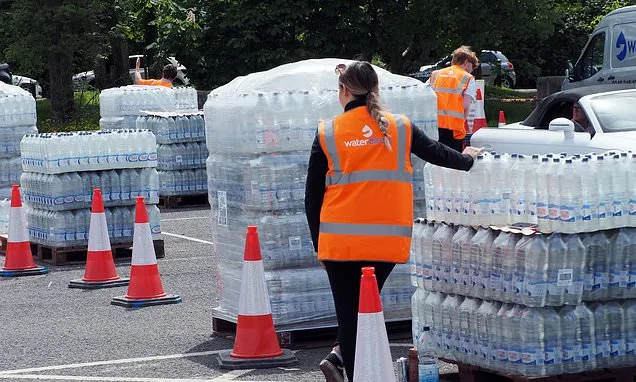
A water company admitted supplying water unfit for human consumption after a parasitic outbreak left residents vomiting and suffering diarrhoea.
There were more than 140 cases with residents in Devon infected with the diarrhoea type disease which caused stomach pains and vomiting leaving a number of people needing hospital treatment.
Around 16,000 households and businesses in the Brixham area were told by the water company not to use their tap water for drinking without boiling it first.
The notice, instructing them not to use tap water for drinking without boiling and cooling it first, remained in place for eight weeks for some households.
A water tank at Hillhead reservoir is thought to have contained the parasite which caused the outbreak which badly hit the area's summer tourist season.
South West Water face a large fine after admitting an offence under s70(1) of the Water Industry Act 1991 to supplying water unfit for human consumption during a hearing at Exeter Magistrates' Court.
The outbreak in May 2024 left some people in hospital and hundreds of others ill after contamination of the water supply by cryptosporidium, a parasite which causes sickness and diarrhoea.
The firm was prosecuted by the Drinking Water Inspectorate (DWI) and faces a fine when it is sentenced on June 2 at the same court.
There were more than 140 cases with residents in Devon infected with the diarrhoea type disease which caused stomach pains and vomiting leaving a number of people needing hospital treatment.
Around 16,000 households and businesses in the Brixham area were told by the water company not to use their tap water for drinking without boiling it first.
The court heard the incident centred on 'an air valve contamination issue' within the Littlehempston Water Supply Zone.
Howard Leithead, representing the DWI, had asked for the case to be sent to the crown court for sentencing as it is 'high-profile or exceptionally sensitive'.
'This was an extremely high-profile incident that occurred in 2024,' he said.
'Not only was this very high-profile, but this incident affected a significant number of people across a broad geographical area.
'It resulted in an adverse impact on the public confidence in the water supply in this area.
'Its effects were, some of the complaints say, long felt after the lifting of the boil water notices.
'There was, of course, local inconvenience, economic impact, and impact on education throughout this incident.'
The effects on some people were felt long term and after the lifting of the 'boil water notices' and had an economic impact as well as educational impact thoughout this incident.
The prosecution argued that the case should be sentenced in the Crown Court because of the exceptional sensitive nature and high profile of the case against a firm with a turnover of more than £250 million as well as adverse effect on human health.
In the public gallery were a handful of residents who had suffered ill health following the parasite outbreak in the water supply around the tourist area and fishing port of Brixham.
Lisa Horswill, of Ocean View Drive, Brixham - who lives near the site of the contamination - said: 'It was outrageous. My body started to attack itself.
'I started being ill at the beginning of May. I have struggled year after year.'
Her auto immune system was severely affected and she still suffers with pain and bloating.
'I am still suffering but there are no solutions or help,' said the 55-yearold mother.
Locals in Brixham, Boohay, Kingswear, Roseland and north-east Paignton in Devon were all told to boil water as a precaution
Her six-year-old daughter also fell ill during the outbreak and Mrs Horswill accused South West Water of 'moving the goalposts over cryptosporidium levels as they are there own regulatory body'.
She also claimed South West Water tried to 'bribe' her with an £80 fee to not reveal that 'chatty' engineers had said there was a problem with the 70 year old mains which are 'contaiminated with asbestos'.
Her husband Kris, 46, now has end stage renal failure and is on a kidney transplant list and dialysis and he said his health condition had been contributed to by the outbreak.
'We don't drink the water and will never will do again,' he said.
'We have two special filters to distill our water. And we are paying £600 a year in water rates.'
Mother Tanya Mitchell, of Brixham, was one of the first residents to raise the alert over the outbreak.
She is still suffering health effects and said at court: ‘I can’t use the water.
‘If I go away I take half a suitcase packed with bottled water with me. I cannot imagine turning the tap on. Before this I drank water but not now.
‘If I turn a tap on I check to smell any odour or see how cloudy it is. Someone has to be accountable for this.’
Imogen May, of Crediton, Devon, came to the court because she has refused to pay her water bill since 2019.
‘It is a basic human right to have clean water, we cannot survive without it,’ she said.
‘I am a single mother and have been for 20 years and money is important, but not to pay these guys to line their pockets.
‘I hope other people will do the same as me and not pay their water bills.’
Dominic Kay KC, representing South West Water, said the firm had pleaded guilty at the first instance and had submitted a basis of plea.
He said the case could be sentenced by a district judge in the magistrates' court.
‘We would respectfully submit that it isn't a complex case, and certainly not one of such complexity that this court cannot deal with,’ he said.
‘Factually there is not a huge amount between the parties, as I understand, matters.
‘The only real bone of contention, as the court has rightly observed, is often the case in these prosecutions, where the case sits on culpability.
‘This is precisely the sort of case that district judges should, and we say, do deal with on a very regular basis, and it's not simply in relation to environmental cases.’
District Judge Stuart Smith rejected the prosecution submission and said he would retain jurisdiction.
South West Water owner Pennon previously said the final bill for the outbreak reached nearly £40 million.
The supplier - which also owns Bristol Water, Bournemouth Water and SES Water - said it was facing costs of around £36 million for the supply contamination incident and its 'reshaping and transformation programmes'.
After the hearing, Caroline Voaden, Liberal Democrat MP for South Devon, said: 'This time last year, the former South West Water chief executive claimed customers were among the company's top priorities.
'Today, they have pleaded guilty to supplying water unfit for human consumption.
'This admission of guilt has been a long time coming. I am glad that SWW have owned up to their serious failures. This awful event should never have happened.
'But the mismatch between rhetoric and action plagues our broken water industry.
'Whether it is protecting customers or the environment, too many water firms say one thing, then do another.'
'I want to thank the Drinking Water Inspectorate for bringing the case and the many campaigners who worked tirelessly to ensure the anguish they felt during the cryptosporidium outbreak was not forgotten.'
'Last summer, the Government finally started to overhaul our water industry by promising to abolish Ofwat.'
'But progress has been glacially slow. They must go much further and faster - this industry must be properly regulated and held to account.'
Marcus Rink, chief inspector of the Drinking Water Inspectorate, said: 'The company's decision to plead guilty to the offences relating to the Brixham incident reflects the seriousness of the failings identified during our investigation.
'While such incidents are very rare, this incident had a significant impact on the public and the wider community.'
Water minister Emma Hardy added: 'Contamination of drinking water is rare but it is utterly unacceptable.
'The communities affected by this abhorrent incident in Brixham deserve answers and today's guilty plea is a crucial step toward accountability.'
How to tell if you've been infected with cryptosporidium
Commonly known as 'crypto', cryptosporidium can infect the digestive system of animals and people.
Once there it causes symptoms like watery diarrhoea, stomach pain, vomiting, a fever, and loss of appetite.
Medics technically call this disease cryptosporidiosis.
Sufferers often have to endure these symptoms for two weeks before it is finally clear from their systems, but bouts of illness can last even longer, particularly in people with weakened immune systems like cancer patients.
Victims can also experience periods of false hope where their symptoms clear for a few days, making them believe they are finally over the infection, only for it to return.
Most people aren't offered treatment for crypto and instead are told to drink plenty of fluids and minimise contact with other people while waiting until symptoms pass.
People are typically infected with Crypto via contact with faeces containing the parasite, either from humans or animals that then enters their mouth.
These infected faeces can contaminate lakes, streams, swimming pools and, as appears to be the case in Devon, water supplies.
Risk of water supplies becoming infected is higher following periods of heavy rainfall and when animals are giving birth, such as the lambing season.
People can also get it by caring for people infected with crypto, particularly young children.
This can occur when people change a nappy and then put their hands near or in their mouth without washing them thoroughly, for example.
Other possible sources of infection are contact with infected milk, or from vegetables that have been fertilised with infected animal manure and not washed thoroughly.
Those infected by crypto are advised to take several steps to minimise passing the parasite on to other people in their household.
- This includes washing dirty clothes, bedding and towels on the hottest setting, and not preparing food others until you have been symptom-free for at least 48 hours if possible.
- The infected are also advised to stay off work and school until they have been symptom-free for at least two days.
- As crypto can survive in faecal matter for long periods of time sufferers are asked not to go swimming until two weeks after their diarrhoea has stopped.
- This includes both natural bodies of water as well as swimming pools as traces of infected dried poo can wash off an infected swimmer's anus.
- Infected people can shed up to 100million cryptosporidium germs in a single bowel movement, according to the US Centers for Disease Control and Prevention (CDC).
- And swallowing just 10 is enough to get ill.