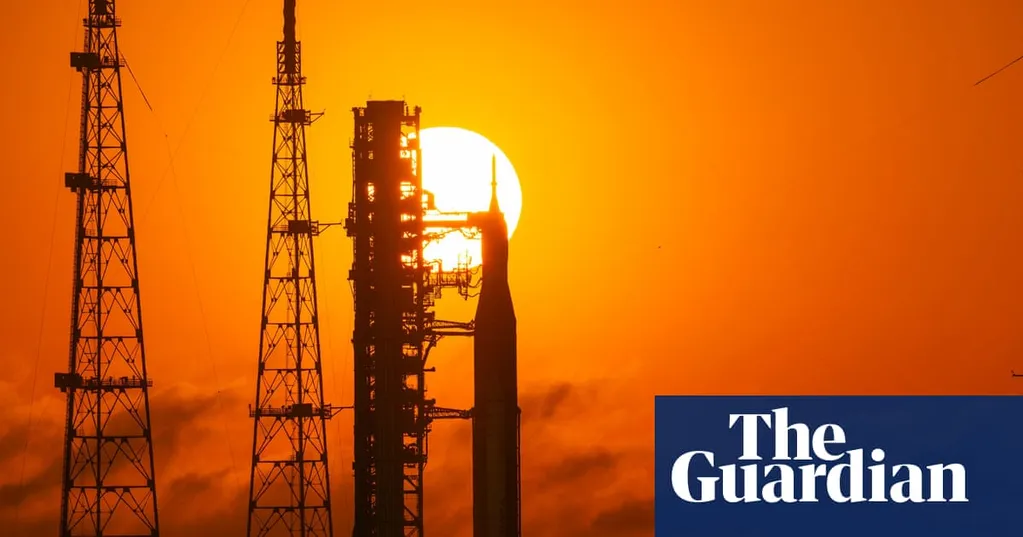
Almost six decades have passed since the space coast of Florida experienced an atmosphere quite like this. On its beaches and in cities, there is an air of anticipation, excitement and anxiety to match the final days of Nasa's storied Apollo moon program.
At 6.24pm ET on Wednesday at Cape Canaveral, subject to adverse weather and last-minute technical hitches, four Artemis II astronauts - three Americans and one Canadian - will become the first humans to blast off on a journey to the moon since 1972.
It will be a moment steeped in deep symbolism, given the rich history of America's space port and its generations of Nasa engineers, rocket scientists and visionaries who paved the way for this new adventure to the stars. It will also be a solid step forward for the space agency's newly announced ambition to build a permanent lunar base from which it plans future missions to Mars.
Beyond that, however, the liftoff will represent a celebration, not only for the achievement of finally dispatching humans back to the moon after years of delays and budget overruns in the Artemis program but for the culmination and confirmation of a more local renaissance 15 years in the making.
In 2011, after Nasa's 30-year space shuttle program was abandoned, the space coast was a region in steep decline. Thousands of workers at the Kennedy Space Center (KSC) lost their jobs, property prices collapsed, businesses folded and the local economy fell into a black hole.
Equally depressing for the US space program was the humiliation. Nasa no longer possessed a human launch capability of its own and had to hitch costly rides for its astronauts into lower Earth orbit with its Russian counterpart, Roscosmos. It would be another nine years until Elon Musk's SpaceX, then still a fledgling startup, would be ready to commence ferrying crews from US soil to the international space station.
Now, a drive around the space coast cities including Cape Canaveral, Titusville and Cocoa Beach reveals how much the Artemis program, announced in the government's 2017 space policy directive during the first Trump administration, has revitalized things.
For starters, at the Cape, Nasa's private space partners SpaceX and Jeff Bezos's Blue Origin have constructed, or are building, huge facilities employing thousands where both are contracted to build the landers that will carry Artemis crews to and from the lunar surface.
Both are also developing their own heavy-lift rockets, Starship for SpaceX and New Glenn for Blue Origin, which are planned to assume Artemis crew and cargo duties once Nasa’s own costly Space Launch System, the agency’s own expensive rocket system, is retired.
Space Florida, the state-private partnership that promotes aerospace development opportunities, reports a $6bn boost to the economy from space business last year, while other estimates say Artemis has accounted for 13,000 new jobs and an additional $3bn in annual spending.
Don Thomas, a retired Nasa astronaut who flew on four space shuttle missions between 1994 and 1997, has seen the rejuvenation first-hand on regular trips from his Orlando home to speaking to guests at the KSC visitor center, where he is a staple of its "meet an astronaut" attraction.
"I'd drive the Beachline Expressway from Orlando airport to here and it used to be no man's land," he said.
"You'd see a few cars, now it's heavy traffic in both directions. People are coming here, moving here, living here, all this construction is going on.
"You drive anywhere around here, Titusville, Melbourne, Viera, I just see new apartments going up, new schools,new shopping centers. It is really a boom going on, so it's almost like a renaissance in the space business."
Concurrently, pride is also back. Hotel marquees light up with "Go Artemis II astronauts!" messages; T-shirts with the Nasa logo are prevalent on beaches and in supermarkets; fast-food restaurants are selling out of moon burgers; you'll be paying through the nose for a hotel room during launch week if you can find one that still has availability.
Hundreds of thousands of spectators will pack the area's beaches and causeways on launch day, officials say, possibly even doubling the estimated 200,000 that witnessed the November 2022 launch of Artemis I, the first uncrewed test flight of the lunar program.
Many will congregate in Titusville, the waterfront Brevard county city directly across the Indian River from the launchpad and consequently offering some of the best views.
Back in the 1960s, Titusville styled itself as "Rocket City USA", epitomizing the macho, "right stuff" era of Nasa's early human spaceflight programs when astronauts in aviator sunglasses would swan into town in Corvettes they leased for a dollar a year from enterprising car dealers eager to exploit the moment.
These days, the city's billing is the far more tame "gateway to nature and space", which its mayor, Andrew Connors, says better reflects shifting attitudes, and focuses on the region's other shining attraction, seemingly endless acres of unspoiled wildlife habitat sheltering species from bald eagles to alligators.
One thing that has not changed, he said, is how deeply intertwined his city is with the space industry.
"If you look at the history of Titusville, it's risen and fallen around Nasa," he said. "Even in the early Apollo days, you know, families would be huddled around waiting to see the Nasa budget get released to see if dad still had a job.
"When the shuttle ended in 2011 we were in a pretty massive hole as a community because that had been in our DNA for 50 years. We are the families that do these missions live here work here raise families here.
"With Artemis and as we step forward into the future it's exciting to see how far we've come. Just 15 years ago we had a $140000-a-year budget to mow the front lawns of abandoned homes just to keep up appearances.
"Now here we are where maybe the motto of our city needs to change a little bit to 'the gateway to Earth'. I mean it's pretty remarkable when you think about Titusville really being at the doorstep of Mars; moon; where we're going in future. It really is very very exciting."
Gary Allgire is a Titusville resident and retired Nasa engineer who worked on the Apollo and shuttle programs and remembers well the dark days following the termination of both. At 80 he works part-time in the city's American Space Museum recounting decades of history and lived experience to visitors among a trove of artefacts and space memorabilia unrivaled anywhere except the space center itself.
"It started going downhill as soon as we landed on the moon. After Apollo 11 they started downsizing," he said.
"It got pretty desperate. Back in 1969 when we had the first round of layoffs especially for contractors you could go anywhere in county pick up homes nothing. You could get very nice Spanish-style house built back just year before $500 down take over payments."
Times were so bleak he said that many fired Nasa workers just left their keys on the doorstep or in their mailbox and simply walked away.
"It was a ghost town in those days. And our mayors at the time were anti-business and put too many restrictions on businesses coming back in to fill the ones that left, so that didn't help us at all. Now every year there's a new [space] company coming in, starting up," he said.
Allgire said the museum was busier with more questions coming up about the Artemis program and the moon.
Thomas,the retired astronaut,said his visitor center presentations drew a similar enthusiastic response,and that he considered the Artemis II lunar flyby as a beginning.
"It's like when I was a young boy watching the Apollo program,I wanted to see the Earth as that blue ball,and I'm green with envy they're going to have a spectacular view,and that's the excitement of Artemis for me," he said.
"And Mars is there waiting for us.The young kids today at the space center,the 10-year-olds,those are our future astronauts;our future Martians.I used to show a picture of Mars and two people walking on its surface,and I'd ask:'You know who those astronauts are?'They would always say 'you,'and I’d ask who else,and they’d say ‘Neil Armstrong.’
"Today if I show that picture to students and ask who the astronauts are on Mars they go:'That’s us!'That’s a great message we’ve gotten through to them.That’s your generation.They’re doing that.It’s an incredible breakthrough where they see their future instead of looking at somebody walking on the moon and assuming it’s going to be somebody else."