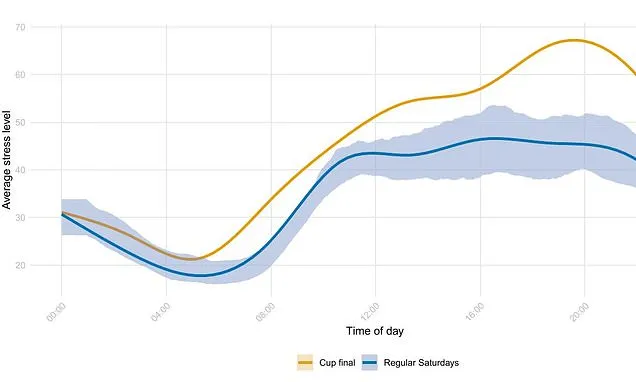
'Football fever' isn't just a case of too many pre-match beers, as a study shows that fans take on serious amounts of stress ahead of a big game.
Researchers from Bielefeld University, Germany, found that fans' stress levels are a whopping 41 per cent higher on match days.
A supporter's average heart rate jumped from 71 beats per minute on an average day to 79 beats per minute during an important fixture.
The effect was even more pronounced for fans in the stadium, where the average heart rate was 23 per cent higher than that of those watching on television.
Having a few drinks compounded the effect, with data showing that heart rates were five per cent faster among those who had consumed alcohol.
The authors warn that these effects can come together to cause serious health problems for the most excited fans.
A serious case of football fever, especially mixed with alcohol, could increase the risk of cardiac events such as arrhythmias.
In their study, published in the journal Scientific Reports, the authors write: 'Our study shows that exceptional events can trigger football fever in fans, manifesting as noticeable physiological responses.'
Scientists say that 'football fever' is a real condition, as fans' stress levels jump by 41 per cent on match days.
Researchers used smart-watch data from fans of the German club Arminia Bielefeld during the German Football Association's 2025 Cup final in Berlin to see how the emotional rollercoaster of a match would affect them.
As any lifelong fan will know, a football match can be an emotional rollercoaster.
However, science is only just starting to show just how intense this can be.
In their study, the researchers looked at fans of the German club Arminia Bielefeld during the German Football Association's 2025 Cup final in Berlin.
This was a massive game for Arminia Bielefeld, who had never made it to the final before, while the rival team, VfB Stuttgart, had already competed in seven finals.
The researchers looked at smartwatch data from 229 adult Aminia Bielefeld fans from the 10 days leading up to the match and the 10 weeks afterwards.
This data showed massive increases in stress and heart rate in the hours leading up to the match, peaking at kick-off.
This intense state of stress persisted all the way through the game and continued well into the night after the final whistle had blown.
While increased heart rate before the game could be explained by fans rushing to the stadium or packing into bars, the fact that these levels remain high suggests something other than physical exertion is at play.
The researchers suggest that fans' intense emotional involvement in the game and their social bonding with other supporters create a state of football fever.
Using the smartwatch data, the researchers were even able to track fans' reactions to the ebb and flow of the game.
Arminia Bielefeld fans' heart rates were highest in the first 15 minutes of the match, with the average reaching over 96 beats per minute.
However, spirits measurably fell as VfB Stuttgart scored three goals in quick succession.
The researchers observed a noticeable decrease in heart rate with every goal scored, until the average fell below 90 beats per minute at the beginning of halftime.
Excitement reached its all-time low in the 70th minute as VfB Stuttgart scored their fourth goal, dropping heart rates to a dejected 86 beats per minute.
However, the data shows that Arminia Bielefeld fans rallied along with their team as they scored two quick goals in the last 15 minutes, causing a 10 beats per minute jump in heart rate.
While these goals weren't likely to turn the tide of the game, the researchers note that the surge of excitement might have been caused by 'pride in the extraordinary event, the first scoring in a cup final by a third-division club.'
This study adds to a growing body of research that shows just how important football can be at a physiological and psychological level.
These elevated stress and heart rate levels are so intense that the researchers warn they could lead to cardiac problems such as arrhythmia.
Previous studies have used fMRI scans to see how football fans' brains react to winning or losing. Winning activated the reward areas of the brain, while losing lit up areas associated with introspection.