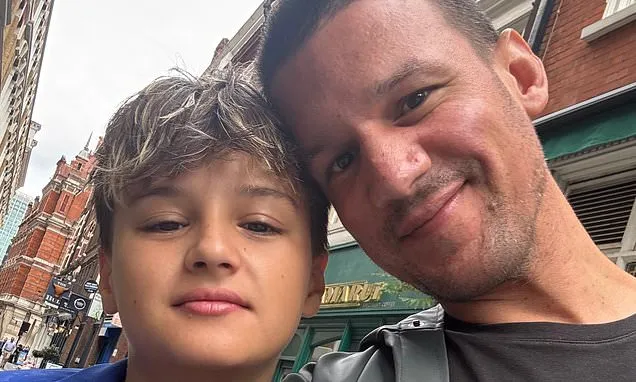
When Serdar Ferit first discovered blood in his stool back in February 2022, he convinced himself that it was nothing to worry about.
The father-of-one, from London, even believed it was just haemorrhoids.
But after months of symptoms that refused to go away, Mr Ferit's concerns grew and he decided to see a doctor that July, who referred him for a colonoscopy in September.
By then, however, it was too late.
He was diagnosed with stage four colon cancer - a type of bowel cancer, which affects around 40,000 Britons every year and is on the rise among young people.
Mr Ferit said he felt 'shocked, numb and lost' when doctors told him the disease had already spread to his liver and was beginning to show signs in his lungs.
Yet telling his young son, Jaxon, 12, was even more painful.
'Navigating that was the most challenging thing I've done in my life,' Mr Ferit said.
'I was advised to tell him somewhere that wasn't a place we went to regularly, as he might develop a negative association with it, so we went to the little green area behind a local church.
'I started with saying, "you know I've been going to the hospital lately, do you know what cancer is?"
'He was eight at the time, and he said, "do you have cancer?" and I said, "I have a type of cancer, yes".
'He burst into tears immediately. He was inconsolable and kept asking, 'why is this happening to me when I'm just eight-years-old?"
'He also kept asking, "but you're going to be OK right, you're not going to die? The doctors will help you"
'It's a really difficult position to be in, not to be able to reassure your child that everything is going to be alright. That was the hardest thing I've ever done.'
Today, after three-and-a-half years of gruelling treatment, Mr Ferit is now in a race against time to save his life.
He is one of a rising number of people under 50 to have been diagnosed with colon cancer - a form of bowel cancer that affects the large intestine - in recent years.
Bowel cancer is responsible for around 17,700 deaths in Britain every year, and is the second-most common cause of cancer death in the UK.
As more than 2,500 people between 20 and 49 are now diagnosed with the disease every year, experts are urging young people to get checked if they have symptoms.
These can include changes in bowel habits, such as looser stools, unusual diarrhoea or constipation. Needing to use the toilet more often, finding red or black blood in the stool, or bleeding from the back passage are also warning signs.
Other possible symptoms include stomach pain, bloating, a lump in the stomach, unexplained weight loss, fatigue, or shortness of breath - signs that may indicate anaemia caused by bowel cancer.
Mr Ferit says he has exhausted his options for treating the cancer through the NHS, having undergone more than 30 chemotherapy infusions with targeted drugs, 28 sessions of pelvic radiotherapy, and several painful ablations - procedures that use energy to destroy small areas of tissue - on his lungs and liver.
His chances of surviving beyond five years stand at just 10 per cent, and he says the thought of not seeing his son grow up 'crushes' him.
But Mr Ferit, who works as a documentary filmmaker and co-founder of an education platform called Lyfta, is not giving up.
He currently has seven small tumours in his lungs, which chemotherapy and targeted treatment are keeping stable.
But in mid-2023 he was warned the cancer is likely to become resistant to the drugs over time.
Now, he is seeking to undergo immunotherapy in Mexico.
Mr Ferit hopes the therapy can help his body do what chemotherapy cannot - continue recognising and destroying cancer cells over time.
The proposed treatment plan includes four personalised immunotherapy drugs: CAR-T therapy, two forms of cancer 'vaccine' and monoclonal antibodies.
He's doing it all for little Jaxon, who he hopes to see grow up.
Mr Ferit said: 'I want to spend as much time with my son as I can. I want to be here for him, and be beside him as he navigates this complex and messy world of ours.
'I want to see him grow from a boy into a young man, and I want to love him and support him as he does so.'
He also wants to be there for his 75-year-old father and 71-year-old mother as they grow older.
Mr Ferit continued: 'I'm three-and-a-half years into this journey and I genuinely believe that I'm going to be in that 10 per cent who live beyond five years.
'I believe that I'm going to live for many years to come. However, I know that that's not going to happen by chance, and that's not going to happen on its own.
'At this stage, the treatments available to me in England are not very likely to prolong my life for a significant amount of time.'
After discovering the Mexican clinic, Mr Ferit travelled there to meet the medical team and is now fundraising to return for a two-year treatment plan.
He estimates the cost of travel, treatment and insurance at a staggering £290,000, and he has already raised more than £258,000 through GoFundMe.
Despite everything he has endured, Mr Ferit describes himself as 'one of the happiest stage four cancer patients in the world' because of the love he has for his family, friends and life itself.
He continued: 'Honestly, most of the time I am very happy. I am trying to have as much joy as I can with friends and loved ones. I am saying yes to more experiences.
'I have always been a positive person, but my perspective has shifted dramatically over the last few years and I am really loving life.'
'I just hope I can live for a while longer so I can really enjoy this new outlook on life for a good number of years.'