WASHINGTON -- Former senior US diplomat Gordon Gray, who served as deputy assistant secretary of state for Near Eastern affairs under President George W. Bush, says indirect negotiations between Washington and Tehran are likely to continue despite what he described as significant pain and pressure on both sides.
The latest exchange comes after Tehran reportedly sent a proposal via Pakistan seeking an end to military operations across the region, sanctions relief, and guarantees for maritime security, including the reopening of the Strait of Hormuz.
President Donald Trump responded on May 10 by rejecting the Iranian position, while signaling continued frustration with the slow pace of diplomacy.
RFE/RL spoke with Gray, who also was US ambassador to Tunisia and deputy chief of mission in Egypt and now is a professor of Gulf and Arabian Peninsula affairs at the Elliott School of International Affairs at George Washington University, about the latest state of Iran peace talks.
RFE/RL: Iran has now responded to the US proposal. Does this feel like a breakthrough moment?
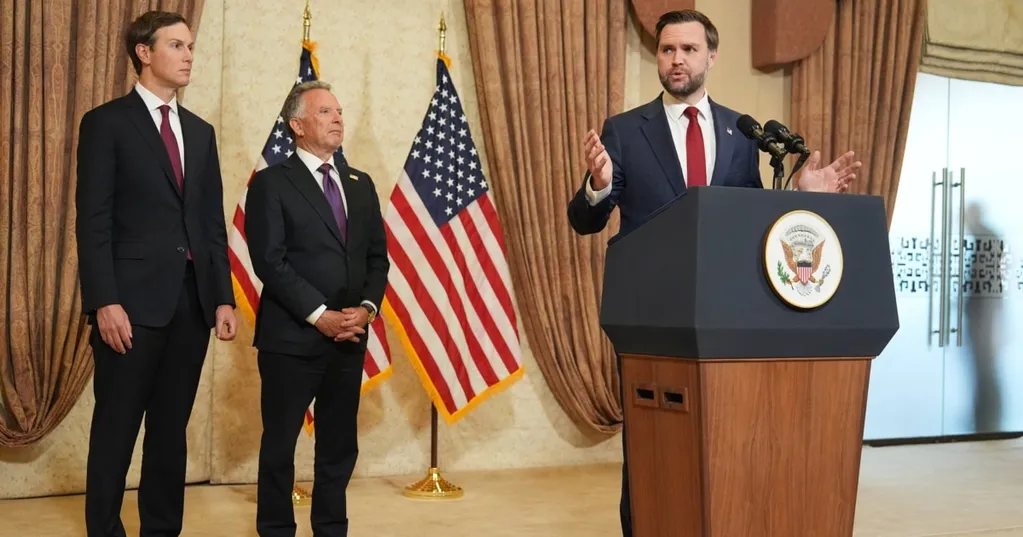
Gordon Gray: I don't believe it is as much a breakthrough as it is a continuation of the process that began in Islamabad when [US] Vice President [JD] Vance met with the speaker of the Iranian parliament. Even though those talks did not result in a breakthrough, as many had hoped they would, what is important was that the two sides kept speaking indirectly through Pakistani mediators, but also, perhaps more recently, through the Qataris as well.
I note that the Qatari prime minister was in Miami two days ago, where he reportedly met with Mr. [Steve] Witkoff and Mr. [Jared] Kushner.
RFE/RL: President Trump said earlier that a deal was very possible. What is the real obstacle today -- Washington's demands or Tehran's red lines?
Gray: They're both. It's like any negotiation: Both sides have demands, both sides have red lines. In this case, both sides are suffering from the actions of the others, and that gives them motivation to seek some sort of agreement.
RFE/RL: Based on reports from Tehran and mediators that Iran is seeking sanctions relief as a precondition for deeper nuclear negotiations, does this leave the White House facing a choice between compromise or further escalation?
Gray: I don't know that I would put it that way. I think Washington's decision will be based on what the Iranian response is to the US proposal and whether it meets at least minimal US demands.
I don't expect that the Iranian response will completely address all of the issues. The reports I've seen -- and they're very initial since the Iranians just handed over their response -- suggest there may be a short-term cease-fire and reopening of the Strait of Hormuz in exchange for time to allow the other issues to be successfully negotiated.
If those reports are accurate, I wouldn't call that a compromise if Washington decides to accept it. I'd call it part of the negotiation process.
RFE/RL: Do you think Tehran is negotiating because it wants relief, or because the pressure campaign is working?
Gray: I wouldn't say the pressure campaign is working so much as it is creating an incentive for Iran to seek a diplomatic solution. Of course, it wants relief, but it wanted relief from sanctions before February 28 as well.
RFE/RL: Iran's economy has been hit hard by sanctions and isolation. How much strain is the regime really under right now?
Gray: It's under tremendous strain. Infrastructure has been destroyed. Inflation is high. The Iranian currency is virtually worthless. There's tremendous economic mismanagement and tremendous corruption.
Because of the Internet blackout, for example, a lot of unemployment is going up because many businesses are laying off workers. So the regime is under tremendous strain.
But that being said, it's also responded with tremendous brutality when people rose up to protest in January. It's not a democracy, and it has shown that it's willing to use brutal repression to stay in power.
RFE/RL: Some analysts suggest that even if an agreement is reached, the Strait of Hormuz could remain a potential flashpoint for renewed tensions. Do you agree with that assessment?
Gray: It certainly has the potential to be because Iran has shown it has the ability to act in an asymmetric way to close off the Strait of Hormuz.
The issue is not simply the free flow of energy through the Strait. It's also the confidence of insurers, shipping companies, and those making medium- and long-term contracts to buy oil. Iran does not have to do much to shake that confidence.
RFE/RL: The proposed framework would reportedly halt uranium enrichment for at least 12 years. Would that fundamentally change the nuclear threat?
Gray: It depends how you assess the nuclear threat to begin with.
President Trump has given conflicting statements on whether he wants Iran to turn over the uranium enriched to 60 percent. Sometimes he says it has to be turned over; other times he says it’s buried, so it doesn’t matter. The US position on that is unclear.
RFE/RL: How significant are the reported concessions involving underground enrichment and long-term restrictions?
Gray: I’d have to see the details. There are too many reports right now, and the devil is in the details. I’d also want to see what impartial nuclear experts conclude after reviewing any agreement carefully.
RFE/RL: Despite the military pressure, have Iran’s core nuclear red lines changed?
Gray: I don’t think so. I think they are going to insist on what they perceive to be their right as a signatory to the Nuclear Non-Proliferation Treaty to enrich uranium.
This is not simply the position of the Islamic republic. It was also the position of the shah of Iran, who began the Iranian nuclear program.
RFE/RL: If President Trump rejects Iran’s conditions, are we looking at diplomacy breaking down or a much wider war?
Gray: No, I don’t see diplomacy breaking down. I think there will be a continuation of discussions.
That doesn’t mean there won’t be military strikes by one side or the other, but at the end of the day both sides have an incentive to get out of the situation they’re in because the other side has created sufficient pain and therefore sufficient incentive for some kind of resolution.
RFE/RL: Gulf nations initially appeared united against Iran. What is your assessment of the current state of the regional alliance?
Gray: I think the regional alignment against Iran is probably stronger than it has been before because Iran made a strategic miscalculation in striking Gulf Arab economic and civilian infrastructure.
That being said, there are reports of a Saudi-Emirati rift, but that rift predated February 28.
RFE/RL: And in terms of the endgame with Iran, do regional allies remain united?
Gray: I think they all have similar objectives. They want a cessation of Iranian attacks against their countries, and they want the Strait of Hormuz open again so they can export energy and import goods they need, including foodstuffs.
RFE/RL: From the perspective of ordinary Iranians, what would be the best possible outcome right now?
Gray: There would be two best outcomes.
One would be a cessation of military strikes against their country because civilians have lost their lives and infrastructure has been severely damaged. I think we can all hope for that outcome.
The second would be a transition to democratic governance. But unfortunately, I don’t expect that for a very long time.
RFE/RL: Given the current circumstances, how long could it realistically take to bridge the remaining differences and sign an agreement?
Gray: Diplomacy takes time. You can look at other arms-control negotiations outside the Middle East as well.
The United States and the Soviet Union did not reach the Strategic Arms Limitation Treaty in 30 or 60 days. These negotiations are complicated. So, it's going to take a long time because there are a lot of complicated issues.
In the short term, I could see an agreement leading to a cessation of hostilities, a reopening of the Strait of Hormuz, and possibly sanctions relief or assets being unfrozen.
But if you're talking about resolving the nuclear issue, that is sufficiently complicated that reaching an agreement there is going to take quite a long time.