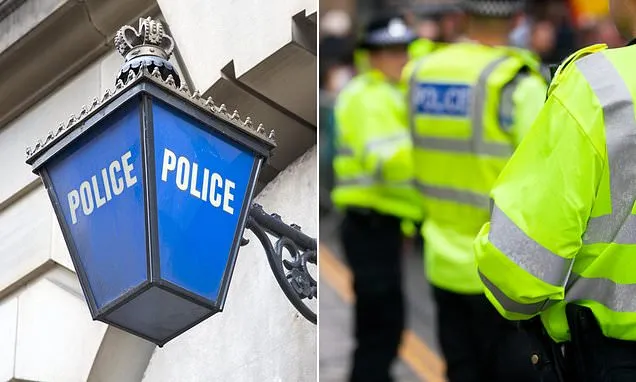
Forty-three police forces in England and Wales are set to be merged into just 15 in the biggest shake-up of policing in half a century, The Mail can reveal.
The more centralised model will mirror a move made in Scotland more than a decade ago, which saw the creation of a single 'Police Scotland' unit made up of eight former forces.
Those in favour of integrating forces hope it will make way for a more joined-up approach to tackling crime and see resources and intelligence better shared across the country.
They say it could also help police target organised gangs and terrorists, who work across borders, and address 'chronic harms' such as violence against women and online fraud.
Sources suggest computer systems, artificial intelligence tools and CCTV analysis could be centralised, for example, which would free-up more officers to police the streets.
The proposals are set to be outlined at the end of this month in the government's Policing Reform White Paper.
On Saturday night, two of Britain's most senior police officers - Sir Mark Rowley, Commissioner of the Metropolitan Police, and Gavin Stephens, Chair of the National Police Chiefs' Council - backed the plans and said policing structures in England and Wales had been crying out for an overhaul, having remained largely unchanged since the 1960s.
Writing for The Mail, the two chiefs have argued for a reduction of police forces south of the border to anything between '10 to 15', amid fears the current 43 operating in England and Wales are regularly duplicating work.
'We run 43 forces, overlaid with regional collaborations and a thicket of national units and bodies creating inefficiency.
'We need around 10 to 15 fully capable forces, large enough to sustain vital specialist functions like murder investigations, firearms operations and serious and organised crime work.'
The two chiefs added: 'Rationalising support services and specialist functions would eliminate duplication, release capacity equivalent to thousands of officers and staff, and provide a platform for exploiting modern technology.'
Sir Mark and Mr Stephens, a Chief Constable who has been an officer for over 30 years, said organised crime, terrorism and systemic problems such as violence against women and online fraud could be better policed if capabilities across the country were shared.
They said: 'These threats affect us all locally, but they can't be tackled locally. We need a strong national and international response.'
Although police leaders and ministers have proposed creating fewer, but bigger, police forces before, this is the first time that the government will propose the move in a White Paper.
The current 43 police forces in England and Wales were created under the Police Act 1964.
It is believed that smaller forces will be the most affected, and bigger forces such as The Met - which serves over eight million residents in London - left unchanged.
Scotland's eight police forces were merged in April 2013 to create Police Scotland.
Police insiders have insisted any changes would not result in job losses for rank-and-file officers; however, it is understood the proposals will recommend greater use of artificial intelligence as a way to reduce number of hours officers spend behind desks.
AI is already used by some forces in cameras which use live facial recognition technology; however, its roll-out is hampered because all 43 forces are having to test the software individually.
'Now, where it works with one force, it will be rolled out to all instead of all trying them individually,' a source said.
On Saturday night, the police chiefs reflected: 'The aims are simple: resilient local policing making people feel safer; a national force that is better able to meet the full range of complex threats; reduced waste; a service empowered by the best of modern technology; and a workforce supported for today's challenges.
'Sixty years on from the last major changes we must act swiftly or slowly fail.'