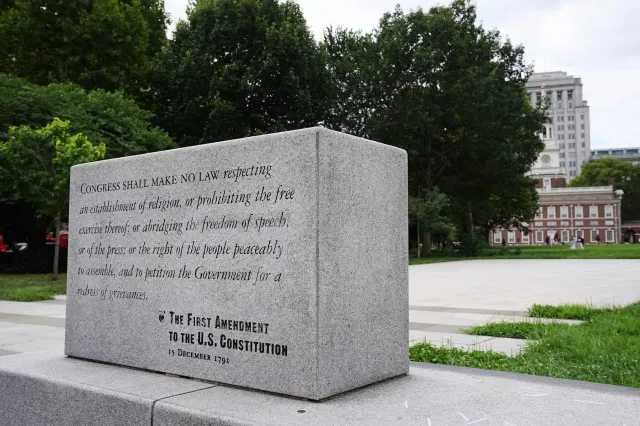
The First Amendment to the U.S. Constitution, part of the Bill of Rights, guarantees each person the freedom to speak out, untethered by government, in addition to freedom of the press. Yet our society has morphed into a segregated form of free speech that erodes the very essence of such freedom.
Terms like "hate speech" and "racism" are viewed negatively in our society. They describe beliefs and phenomena that are critical of certain groups of people based on personal traits, color of skin, or race. Yet if freedom of speech is truly a right, should people have the opportunity to make statements that may be interpreted by others as hate speech or racism?
The answer is yes, given that the Supreme Court has consistently protected hate speech under the First amendment.
Yet all speech today is filtered. The key difference is what the filters are.
University campuses, often viewed as bastions of free speech as well as centers for healthy discourse and debate, are often caught in what some may believe to be a contradiction. The ACLU argues that all speech is protected, provided it does not lead to harassment or involve threats. People may not agree with what a person says, but that of itself does not mean that it should not be said.
The president has argued that there is a lack of free speech on campuses. Yet his focus is on speech that he disagrees with and what contradicts his ideological beliefs.
Universities in general are liberal-leaning and in many cases suppress conservative views. This is consistent with the assessment by the Foundation for Individual Rights and Expression, which noted that nearly 65 percent of the top schools in the nation earned an "F" grade for free speech friendliness. Universities have gone so far as to create "free speech zones" as isolated areas on campus where anything may be said. Yet are such zones really needed? To maintain order and reduce risk, universities create communication codes that effectively inhibit free speech and the associated debate.
On the flip side, when conservatives are given free speech rights, they employ the same suppression tactics used by their left-leaning brethren.
If speech is to be truly free, one must separate the content of the speech from the person delivering the speech. When the two are mingled inextricably, as naturally happens, it is impossible to assess whether limitations on free speech are rooted in what is being said or who is saying it. This shines a bright light on perspective and bias that inherently colors speech.
For example, when students on campuses around the country protested the actions of the Israel Defense Forces in Gaza in 2023, this was viewed by some as antisemitic, including the president. Other viewed it as support for a suppressed group of Palestinians living in Gaza. How one interprets all such actions are based on one's ideological beliefs and world views.
Of course, if free speech leads to intimidation and physical violence, the speech may be protected, but the hostile actions are not.
The well-known principle often attributed to Voltaire -- "I wholly disapprove of what you say -- and will defend to the death your right to say it" -- captures what the freedom of speech should be. Yet in today's ideologically bifurcated society, the exact opposite is now true.
Freedom of speech is inherently fraught with bias. When one speaks openly about an issue that they support, free speech justifies such actions. When another speaks about issues that one abhors, labelling it as hate speech or racism is an easy default reaction.
If freedom of speech is to exist on college campuses, a forum for productive dialogue and peaceful disagreement is necessary. But this also must occur everywhere that people who disagree come together.
Marjorie Taylor Green once called for a "national divorce," whereby people with diametrically opposing views are split apart into two countries. Yet even within conservative or liberal groups, there are signs that each one would eventually emerge with the same types of schisms that exist today.
Instead of finding ways to break apart, what is needed are ways to come together, despite our differences. Such differences make us stronger. If we were all the same and interchangeable, the redundancy would make us less effective. And with uncensored free speech, we can continue to remain together, even with all such differences.