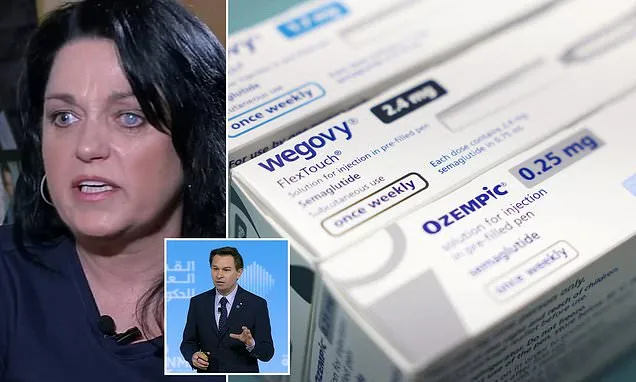
A top health expert has issued a fresh warning over a life-changing side effect from weight-loss drugs like Ozempic: blindness.
Several studies have linked the medications to conditions that cause inflammation and block blood flow to the eye, causing severe and sometimes permanent vision loss.
The drugs were first linked in 2024 to a rare irreversible eye condition called non-arteritic anterior ischemic optic neuropathy, which leads to permanent vision loss (NAION).
Last year, researchers detailed nine new reports of US patients who went blind after taking semaglutide or tirzepatide, the active ingredients in Ozempic and Mounjaro, respectively. They found seven patients were diagnosed with NAION.
One woman injected one dose of semaglutide for her diabetes and woke up the next morning blind in her left eye.
This prompted her to stop the medication for two months before her diabetes forced her to go back on it. Two weeks after restarting, she lost vision in her right eye as well.
Another woman who had been taking semaglutide for a year woke up one morning with a 'painless shadow' over her left eye. Testing revealed blood vessels in her retina had become damaged, leading to blindness.
And another patient suffered bleeding in his left eye after taking tirzepatide for a year.
Data suggests that tirzepatide has now overtaken semaglutide as the most popular weight loss drug in the US.
The researchers wrote in a study published in JAMA Ophthalmology last year that it's not clear exactly what could be causing the side effect.
The experts said while the exact cause is unclear, drugs like Ozempic rapidly lowering blood sugar levels could damage blood vessels in the eyes, leading to vision loss.
Estimates suggest about one in 10,000 GLP-1 patients experience this side effect.
Dr David Sinclair, a Harvard genetics professor, said this week at Dubai's World Governments Summit that he is working on a potential anti-aging treatment that may be able to restore vision in people blinded by GLP-1 weight-loss drugs such as Ozempic, Wegovy and Mounjaro.
Sinclair referred to the condition as an 'eye stroke,' warning people can wake up suddenly blind. He also said there is three times the incidence of the condition today than a decade ago because of the rise of GLP-1s.
But Sinclair said his anti-aging research has the potential to restore vision after a person experiences an eye stroke.
He said: 'There are genes that can rejuvenate a cell back to a stem cell, back to age 0, which we use all the time now in the lab and increasingly in therapies.
"This shows you can rejuvenate cells, make them young again, and even regrow the tissue. This regeneration works in the damaged optic nerves in a mouse.
'We were able to show that using this method, we could cure blindness in animals for the first time.'
Sinclair added: 'We believe we can treat every tissue, and eventually do a whole body reset to be young again, and it takes about six weeks.'
The professor's declaration comes just as the UK's Medicines and Healthcare products Regulatory Agency updated product information regarding the risk of NAION when taking semaglutide.
When the complication was first linked by experts, Novo Nordisk, the maker of Ozempic and Wegovy, said that blindness was not 'a known adverse drug reaction'.
But now, MHRA health officials have acknowledged the existence of the complication and are urging weight-loss shot patients who notice vision changes to immediately seek medical attention.
In a statement, the government organization said: 'Patients taking semaglutide who notice a sudden change in their eyesight, such as sudden impairment to their vision, or if eyesight gets worse very quickly in one or both eyes, should urgently attend eye casualty or A&E.'
Dr Alison Cave, MHRA's chief safety officer, added: 'While the potential risk of NAION for patients prescribed semaglutide is extremely small, it is important that patients and healthcare professionals are alert to the associated symptoms.'
In the general population, NAION occurs in about 6,000 Americans every year, and it's most common in patients with diabetes, high blood pressure, and sleep apnea, as these conditions can damage blood vessels.
In the 2025 study investigating the eye complications, the average patient age was 57, and the majority (56 percent) were women.
The patients were from Utah, Minnesota, New York, West Virginia, and Ohio.
One woman in her 50s developed NAION the day after her first semaglutide injection.
She woke up the morning after the injection with 'painful vision loss' in her left eye.
Tests revealed swelling in her optic nerve and damaged blood vessels in her retina.
The women stopped taking semaglutide and her insulin, and her vision had gone back to normal two months later.
Two weeks after restarting semaglutide to control her diabetes, the vision loss returned. She was diagnosed with severe optic nerve swelling, and her vision returned to normal seven months later.
It's unclear if she stopped semaglutide a second time.
A man in his 60s started experiencing painless blurred vision in his right eye 10 months after starting semaglutide for diabetes.
He had optic nerve swelling and flame hemorrhage, bleeding into his retina. Though his symptoms resolved within a few weeks, he lost vision in his left eye as well.
About 10 weeks after stopping semaglutide, vision in both eyes returned to normal.
Another woman in her 30s suffered swollen optic nerves and hemorrhages in both eyes three months after starting semaglutide.
Most patients with NAION noticed their vision improving within days or weeks of stopping semaglutide.