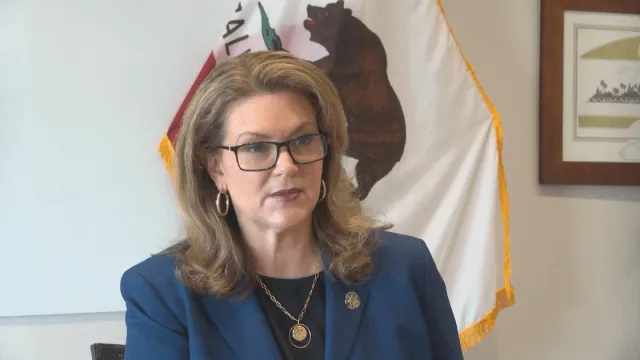
FRESNO COUNTY, Calif. (KSEE/KGPE) - The Fresno County District Attorney has joined a list of prosecutors calling for change to the state's mental health diversion program.
Lisa Smittcamp is now endorsing Assembly Bill 46. It's legislation that would allow judges to have more discretion on when the mental health diversion should be used.
"There is a place for those kinds of people who commit crimes because of their mental health issues. But the way the law is currently written, it just sort of envelops all of these crimes and all these people who really do not have serious and substantial mental health issues," Smittcamp said.
She and a growing list of DAs from across the state believe the proposed legislation would provide much-needed reform to California's current mental health diversion program.
As the law stands now, through California Penal Code section 1001.36, certain offenders, who don't commit violent crimes like murder, can receive mental health treatment rather than prison time. But Smittcamp said it's not working.
"If they don't take the responsibility to really engage in that mental health counseling, there's no improvement. And then we find them coming back and sometimes committing more violent, more serious crimes," she said.
Smittcamp said if passed, A.B. 46 will give judges more discretion to decide if a defendant poses a risk to the public and if they should be treated through the program.
"I think the most important thing that AB 46 will do is if somebody doesn't already have a diagnosed mental health condition, then they're not eligible. Right. So it's really to prevent people from coming in after the fact and saying, 'Oh, I committed this crime, but I have a depression. Oh, I committed this crime. But I have anxiety;' because those are, you know, those are diagnosable mental conditions; but there are mental conditions that a lot of people suffer from that don't cause people to actually commit crimes," she said.
And it's that line in the bill that criminal defense attorney David Mugridge has questions about. He said many of his clients have been treated through the current program. He said many of them were undiagnosed at the time of their alleged crime.
"If you are going to require that there be a diagnosis before the commission of a crime, I think that's wrong," he said.
Smittcamp pushed back.
"I think that there will be a lot of pushback to say, 'Oh, people aren't, you know, able to get diagnosed and people aren't diagnosed.' And I think that that's going to be a small portion of that population because there are so many resources for people," Smittcamp said.
"I don't think that we're going to see a huge population of people that have just said, you know, 'I am so poor, I am so uneducated, in where I can get resources that I've never been involved in anything' because the schools have resources, right? The county has resources; the cities have resources. There's tons of health care opportunities," she said.
Still, Mugridge said he supports giving judges more discretion and said it's good for voters who would then have more information on the judges they're looking to elect.
"What that bill proposes to do is to give the judge more clear, definitive discretion, if you will, to make a decision himself as to whether or not this individual really is a threat to the community," he said.
The Senate Public Safety Committee will discuss the bill on Tuesday. Mugridge said lawmakers should carefully consider the full text of the bill.
"I don't necessarily call this a tough-on-crime law. I think this is more like a reevaluation of how we get to where we get, and what the judge is going to do. Let the judge have the ability to make a decision. But at the same time, it takes into consideration the mental state of somebody that is accused of the commission of a crime," he said.
Smittcamp said she believes California residents are looking for changes like this from lawmakers.
"It's not just about punishment. It's about accountability and responsibility more than punishment," Smittcamp said.