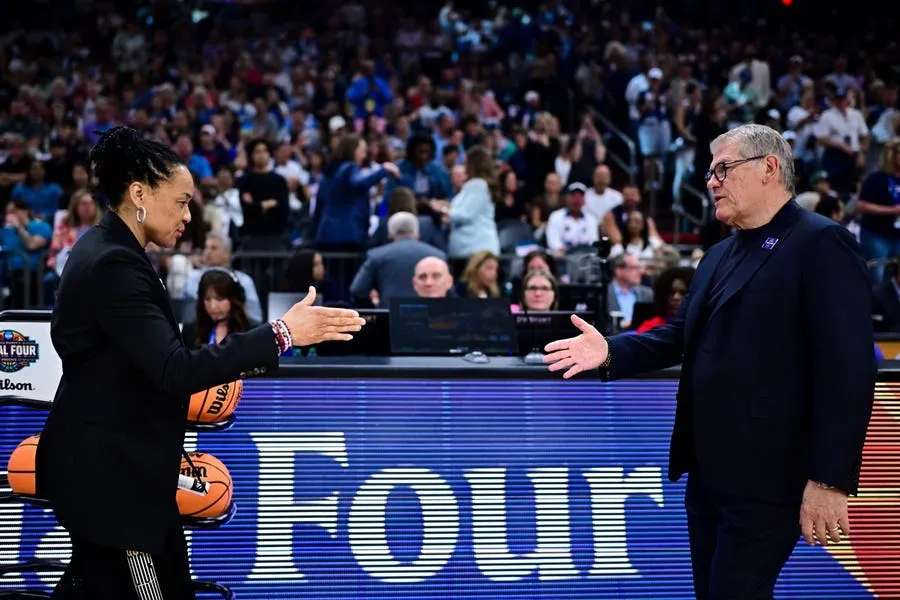
Geno Auriemma apologized for his post-game conduct, but his omission of Dawn Staley's name highlighted a problematic gender double standard. The article argues his "passion" was entitlement, especially towards a Black woman coach. Research shows women coaches face harsher scrutiny for emotional displays, while men's are lauded. Staley's composed response exemplifies the unfair burden on women to remain professional.
Geno Auriemma issued a statement Saturday apologizing to the South Carolina staff and players for how he handled the end of the Final Four game on Friday night, calling his behavior, "uncalled for in how I reacted." He did not mention South Carolina Head Coach Dawn Staley by name. The woman he yelled at on national television, the woman who had to compose herself across the post-game coverage, the woman who had to remain measured while Auriemma made her team's biggest win of the season about his feelings and his ego. Apparently, she didn't warrant a name in his apology.
A Tantrum Is Not Passion
Anyone rushing to frame Auriemma's actions as displays of passion rather than entirely problematic are making a familiar argument, one that decades of research concerned with leadership and gender has been consistently dismantling. Role congruity theory tells us that women who display the same behaviors as men in leadership contexts, especially those that tend to be men-dominated spaces, are evaluated more harshly because those behaviors conflict with the communal traits society expects of women. Assertiveness reads as aggression, emotion reads as instability, and directness reads as hostility.
For men in the same position, the inverse is almost always true. When men display those same behaviors, they are framed as intensity, drive, competitiveness, and passion. Auriemma's rant on live television during a Final Four game is passion, but Staley working the referees on the sideline is pegged as hysteria and aggression.
Auriemma even closed his postgame press conference by saying he wanted to make sure "there's not a double standard" in how officials respond to sideline behavior. And, Auriemma is not wrong that double standards exist in officiating-he was just profoundly wrong about who they actually disadvantage.
Gender Matters
Any argument that gender is irrelevant here ignores the core of what happened between Auriemma and Staley, as well as how it could be implicitly received by viewers. A 72-year-old man, the most decorated coach in the history of the sport, felt entitled to yell at a Black woman coach on the sport's biggest stage over a handshake dispute that video evidence did not support. He felt entitled to do it in front of a national television audience. He felt entitled to double down on it in a press conference. He felt entitled to issue an apology that erased her name.
If Dawn Staley had done any fraction of what Auriemma did Friday night, the word used would not have been passion. The research on this is not ambiguous. Studies on leadership and gender in sport consistently show that women coaches are held to higher standards of decorum, punished more severely for emotional displays, and evaluated through a lens of communal expectation that their men counterparts are never asked to meet. That is the double standard Auriemma should be worried about. It is just not the one that disadvantages him.
Stereotype threat compounds this all further. The persistent culture stereotype that women do not belong in positions of authority, especially within industry segments build by men for men, has not disappeared simply because women's sport has experienced significant growth. Research tells us these sentiments can actually intensify in moments where women, especially Black women, are the most successful. When a woman wins, the implicit mechanisms that protect men's dominance in a space they feel entitled to do not quietly yield to that woman.
Instead, they push back. What we witnessed Friday night was a man visibly struggling with the fact that a Black woman head coach has built something capable of beating him, on women's sports biggest stage, in front of the world. Framing that response as passion is the stereotype being protected in plain sight.
Coach Staley Remains Focused
And yet, on Saturday in Dawn Staley's press conference that was standing room only, she walked in and said what she needed to say. "I had a praying mother. I grew up in the projects of North Philly. Nothing, nothing can derail us or me from staying with the task at hand." She noted her team is, "...focused on winning a national championship."
This is exactly what the research predicts. Women in sport leadership, and particularly women of color in positions of authority, are evaluated more harshly in moments of conflict and because of this judgment, they are expected to absorb those moments without complaint and move forward as though the incident has already been resolved. The burden of professionalism lands entirely on the woman who did nothing wrong. The standard has never been the same, and women in sport are still the ones expected to prove they can handle whatever double standards come their way.