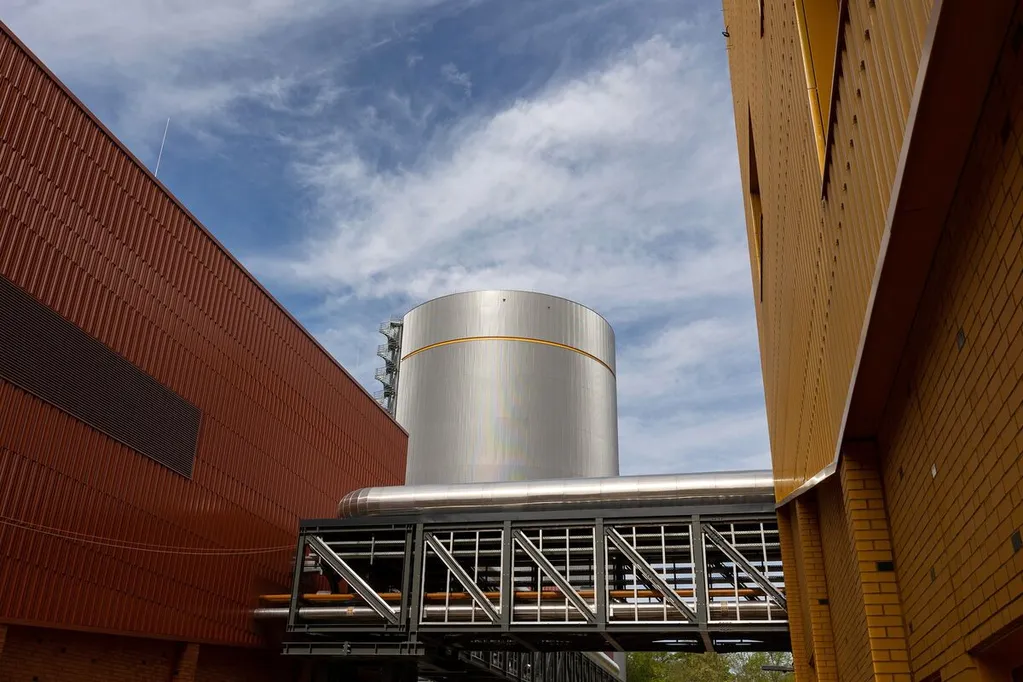
The economy ministry is exploring the emergency reserve instrument to protect against exogenous shocks, with the reserve expected to be built up next year and be operational in winter 2027/28, and paid from the nation's budget with annual running costs of up to €165 million.
Germany is detailing plans to build up a strategic natural gas reserve to keep supplies running in a worst-case crisis scenario, as the shock caused by the Iran war underscores Europe's continued vulnerability to sudden disruptions.
Emergency reserves should have a size of around 24 terawatt-hours or about 10% of the nation's gas storage capacity, according to an economy ministry document seen by Bloomberg. That would secure supply for households and businesses for around two weeks in a normal winter -- or for one week in a very cold winter -- if all imports were cut off.
The fleshed out plan comes after German government officials have publicly and privately commented on the possibility of strategic gas reserves in recent months. European Union member states currently have legally-binding targets for commercial gas stockpiling, but have struggled to meet them in recent years. That's sparked a rethink on how effective such rules are, and what safeguards must be in place if states leave regular preparations for winter in the hands of market participants.
Winter gas stockpiling works most efficiently when it is purely market-based and not hampered or distorted by government intervention, the economy ministry document said. The market does not, however, prepare adequately for rare and serious exogenous shocks, such as significant import disruptions due to infrastructure sabotage.
The ministry pegs one-time costs for emergency reserves between €500 million to €1.5 billion ($584 million to $1.8 billion) and expects annual running costs of up to €165 million, paid from the nation's budget. To not disturb this season's stockpiling -- which is likely to face strains from disruptions linked to the Middle East conflict -- the reserve should only be built up next year and be operational in winter 2027/28.
A spokesperson confirmed the ministry is currently exploring such an instrument "to protect ourselves against exogenous shocks," and that it is in talks with stakeholders and other parts of the government.
Europe's largest economy lost its pipeline flows from Russia in 2022 and now depends on imports from Norway and a number of global LNG suppliers, including the US. While it didn't receive notable LNG volumes from the Middle East prior to the Iran war, the plan shows that the government is taking severe supply threats such as sabotage or unexpected geopolitical crises more seriously.
The ministry paper states the emergency instrument is not meant to be a mechanism to reduce prices, as the gas reserve -- unlike the strategic oil reserve -- cannot ensure Germany's supply over a longer period. It also clarified that it won't intervene in the regular market to refill storages, and dismissed demands by energy company Uniper SE to introduce subsidies for stockpiling.
Current EU rules for gas stockpiling will expire in March 2027.