The next time Donald Trump tries to push America's traditional allies into line, the German government intends to be better prepared.
Officials in Berlin have started mapping vulnerabilities in US supply chains to identify points where Germany and its European Union partners could apply pressure, according to people familiar with the effort. Their goal is to create a consensus among EU nations on how they can use their leverage, if and when they get drawn into another dispute with the White House.
The initial findings suggest ways to target the massive US tech firms with close ties to the White House, the officials said. Other options could aim for the AI investment boom that has helped to drive US stocks to record highs this year or push up drug prices for American voters, an issue the president has already shown he's sensitive to.
"By sticking together, Europeans can prove to Trump that they are prepared to match him," said Tobias Gehrke, an expert on economic statecraft at the European Council of Foreign Relations. "If Europe can credibly demonstrate that intimidation tactics don't work, this could, over time, weaken those forces in Washington that support Trump."
The German exercise is part of an urgent European effort to build a geopolitical framework to manage the increasing hostility of the US and the growing power of China. Yet it's also a process that is fraught with jeopardy: across the EU, senior officials are painfully aware of how exposed their companies would be should reprisals with the US spiral out of control.
The officials cautioned that no decisions have been taken on activating the plans and their preferred outcome is to rebuild relations with the White House. A spokesperson from the German economy ministry said that trade is increasingly being used to advance nations' own interests.
"The federal government is closely monitoring these developments with a focus on critical supply chains and dependencies," the spokesperson told Bloomberg. "It considers not only its own dependencies but also those of countries of origin and countries that import goods from Germany and the European Union."
Tensions between the US and Europe will come to the fore on Thursday when Group of Seven foreign ministers gather near Paris to discuss the fallout from the American-Israeli attack on Iran which has triggered a surge in energy prices around the world.
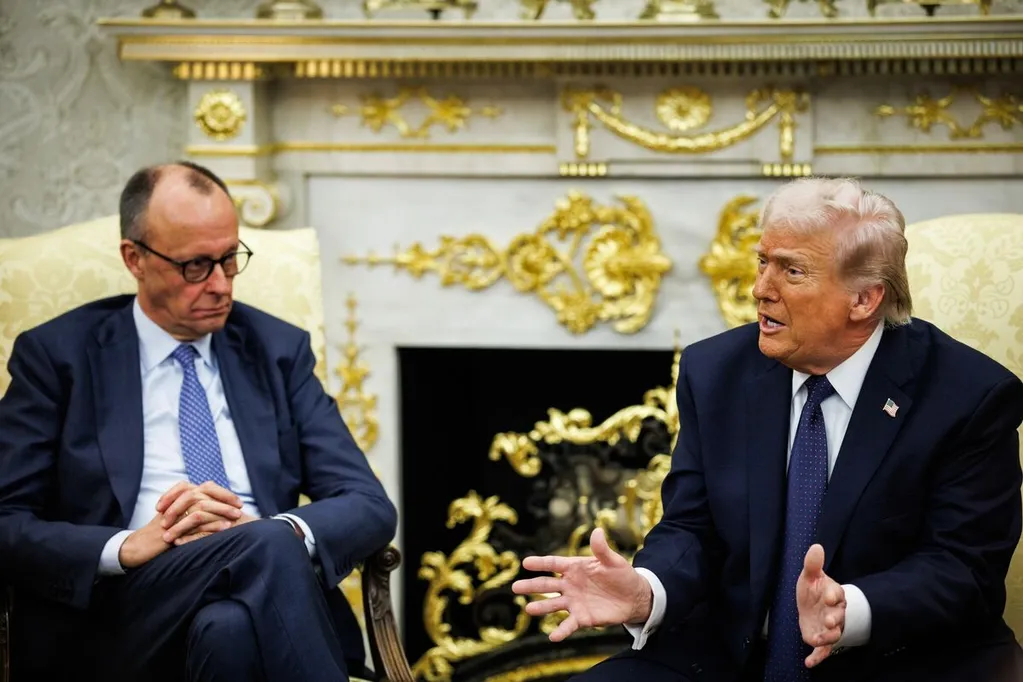
German Chancellor Friedrich Merz told German lawmakers last week that Europe needs to learn that the dependencies that emerged during the high period of globalization aren't all on their side. Other nations rely on the EU for critical supplies, he said, and the bloc should be ready to use that leverage.
"We are identifying our interests," he said, "and at the same time the means to defend them."
Trump's push to take Greenland from Denmark in January changed the thinking in Europe's capitals, the officials said. For many, that episode proved decisively that the era of mutual transatlantic commitment has run its course. While the US remains a partner in some areas, the people said, it's also a security risk that Europe must be prepared to counter.
"There will be no going back to the way things were," German President Frank-Walter Steinmeier said Tuesday. "The rift is too deep."
The work in Berlin is at a relatively early stage, with staff compiling data on European ties to the US, according to government officials. There's also a parallel initiative taking place in Brussels, where the European Commission is mapping EU vulnerabilities ahead of a new security strategy and, as part of that process, officials have been discussing how the bloc could leverage its choke points over rival powers.
European officials are also discussing compensation mechanisms to support member states that are more exposed to US retaliation should that take place. Everyone is aware that the US still holds the upper hand.
"Germany, as an economic power, cannot afford to hide its own tools of influence," said Cornelia Woll, president of the Berlin-based Hertie School. "However, such threats should not be used lightly because in an interconnected world -- such actions always result in costs for both sides and can potentially set off a downward spiral."
US Pressure Points Identified by Berlin:
The Single Market
Europe's biggest point of leverage is the market power of its 450 million affluent consumers, according to officials involved in the discussions. Restricting access or tightening regulation on American firms represents the bloc's most potent economic weapon. The major tech firms aligned with Trump and Vice President JD Vance are particularly sensitive to EU efforts to regulate social media.
New taxes, fines or operational constraints on Alphabet Inc., Amazon.com Inc. or Meta Platforms Inc. could deliver a meaningful economic hit to profits and, in the Digital Services Act and Digital Markets Act, the EU already has legislation on the books that would allow it to target US tech firms, according to Antonio Barroso, a senior geo-economics analyst at Bloomberg Economics.
Data Centers
Another pressure point lies in supply chains running artificial intelligence. US companies -- from OpenAI and Anthropic to Microsoft Corp.'s AI units and Elon Musk's X ventures -- depend in part on European industrial inputs for their data center rollout, according to analysis by German officials. Those components include specialized equipment from firms like Siemens AG, the officials said.
Europe is already adapting its industrial policy to the more confrontational global environment. Through measures like the Industrial Acceleration Act, the EU is prioritizing domestic firms in public procurement and pushing for greater use of European components -- going some way to shield its manufacturing base and sideline US and Chinese competitors.
Semiconductors
Export controls would prove to be even more painful weapons against the US, the German officials said. Washington remains reliant on European firms for chemicals used in semiconductor manufacturing and Dutch firm ASML and its German suppliers, Zeiss and Trumpf, produce advanced lithography machines essential for cutting-edge chip production.
In recent years, the US has been pressuring European governments to restrict those same companies' sales to China in an effort to prevent Beijing from securing its own access to the most advanced chips.
Drugs, Chemicals and Machine Tools
European companies supply the active ingredients for nearly half of all brand-name drugs sold in the US and 90% of the insulin that Americans use every day, according to the American Chamber of Commerce in Brussels. They also provide over a third of chemical imports that help supply a range of US industries.
Drilling down into the details of the global supply chain, the Chamber of Commerce identified almost 300 different categories where US firms rely on European suppliers for 100% of their imports. There are more than 700 where reliance is 90% or more.
European Investment
The EU is the largest source of foreign direct investment in the US. While governments can't dictate where European firms choose to allocate their capital, they could adjust regulatory frameworks or withdraw export incentives to steer European money away from the US market. The previous government in Berlin used similar tools in an effort to curb the amount of FDI heading to China.
Pressure Points That Are Most Likely Off the Table:
US Assets
European governments and investors hold about $10.4 trillion in US equities, roughly 15.3% of the market, according to the Chamber. They also hold $3.4 trillion of US government securities and $2.9 trillion of US corporate bonds. That represents nearly half of all foreign-owned US stocks and roughly a third of foreign-held Treasuries and agency securities plus 57% of corporate debt held outside of US.
George Saravelos global head FX research Deutsche Bank AG suggested European investors might consider selling significant portion holdings transatlantic relationship deteriorates further. Berlin officials still collecting data this area people familiar matter.
But it would be risky move use such blunt tool according Bloomberg Economics' Barroso. Coordinating large-scale asset sales difficult global dominance US markets dollar means move inflict significant collateral damage Europe itself.
US Airbases
German officials looking role European military bases play US's ability project power around world people said value highlighted strikes Iran. Chamber Commerce estimates cost US $100-$200 billion year fill gap wasn't NATO.
But US military presence plays fundamental role guaranteeing EU's own security difficult imagine EU leaders doing anything jeopardize especially war Ukraine demonstrating threat Russia.
"This not about confrontation; mutually defining interests," German Defense Minister Boris Pistorius said last week asked Berlin looking exploit US pressure points. "Fact things always 100% aligned true every marriage whether good bad."