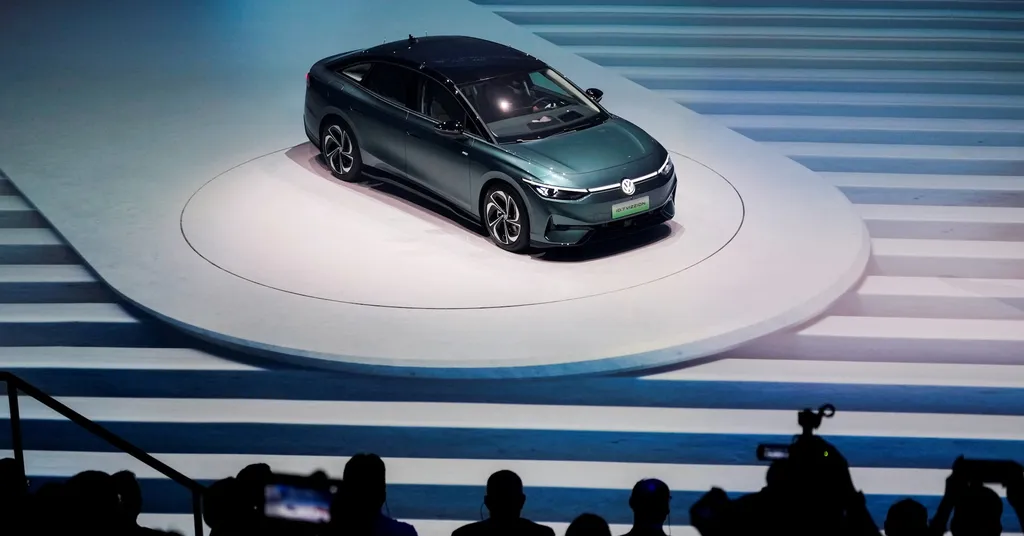
BEIJING, April 21 (Reuters) - More than 40 years after Volkswagen (VOWG.DE) stole the show at its first Chinese auto fair, it has lost its cutting-edge status in the country, with homegrown brands setting the pace for a younger generation of tech-hungry drivers.
The combustion-engine heritage of "Made in Germany" no longer holds as much sway in what has become the world's largest car market, where local automakers are rolling out flashy, affordable electric vehicles that are essentially mobile phones on wheels.
"Maybe some younger customers perceive us as the brand for the parents," the Volkswagen brand's China CEO, Robert Cisek, told Reuters.
Blindsided by the meteoric rise of Chinese brands, sales at Volkswagen, along with its Porsche and Audi units, and rivals BMW (BMWG.DE) and Mercedes-Benz (MBGn.DE) have all tumbled, leaving them scrambling to staunch the bleeding in a market that used to account for a third of their sales.
After spending a quarter of a century as China's No. 1 automaker, Volkswagen was overtaken by EV heavyweight BYD (002594.SZ) in 2024 and knocked into third place by Geely in 2025.
The transformation of China's auto market for these companies - from growth driver to battleground - has been "beyond imagination," Cisek said.
FROM MARKET PIONEERS TO EV LAGGARDS
When Volkswagen attended its first Chinese auto show in Shanghai in 1985, locals were impressed by the quality of the German automaker's marketing materials.
"We were met by an unimaginably huge crowd and our brochures flew off the shelves," then-CEO Carl Hahn, who oversaw the company's entry into China, wrote in his memoirs. "For people at that time, it was enough simply to marvel at the quality of the paper and print and to dream about owning a car."
Now, the German auto group needs more than just glossy paper to stage a comeback at this year's Beijing Auto Show, which kicks off on Friday.
Having dominated combustion-engine car production, automakers like Volkswagen find themselves racing to catch up in a market where more than one in four new cars is fully electric.
As China's car market grew and local brands launched a plethora of consumer-friendly EVs, German carmakers lost ground. Collectively, their sales fell by a quarter over a five-year period to 3.9 million vehicles in 2025, according to S&P Global Mobility data.
The challenges have intensified this year as Chinese brands make inroads in the premium segment, targeting wealthier consumers who once coveted German quality, analysts said.
Sitting thousands of miles away in their headquarters in Wolfsburg, Stuttgart and Munich, German car executives underestimated the ability of Chinese automakers to dominate EV development so quickly.
"They didn't see this big change coming, and they didn't see the speed at which it came," automotive consultant Felipe Munoz said.
Germany's legacy automakers must turn their China businesses around or lose relevance in a country that is viewed by executives like Volkswagen CEO Oliver Blume as a training ground for building the cars of the future.
Under Blume, Volkswagen Group plans 20 so-called "new energy vehicle" launches in China this year, including all-electric models, plug-in hybrids and EVs with small combustion engines known as range extenders.
The company will premiere four new EVs in Beijing on Tuesday ahead of the car show's opening, including mass-market hopefuls developed with Chinese partners FAW and EV maker Xpeng as well as the latest China-only AUDI, a new brand where the premium marque’s all-caps name replaces its world-famous rings. It was jointly developed with China’s SAIC.
THE BURDEN OF LEGACY
Yale Zhang, managing director at Shanghai-based research firm Automotive Foresight, said German brands are being "murdered" by their own legacy and a resistance to rapid change.
"You can't really rely on your chrome metal strips, your Napa leather seats and your 'one-hundred-year' history to convince the consumers," Zhang said.
German automakers have also at times been reluctant to embrace technology from new Chinese rivals.
Now, Volkswagen, Mercedes and BMW are increasingly leaning on Chinese suppliers to catch up, including autonomous driving leader Momenta and in-car software developer ECARX.
While "Made in Germany" remains an internationally trusted hallmark, young consumers - including in China - are more likely to avoid German cars, according to a consumer survey conducted by Berylls by AlixPartners in January.
"The good thing is, of course, there is this credibility when it comes to the Volkswagen's safety, reliability and quality," Cisek said. "At the same time, it's also a little bit of a burden."