Welcome back to The Forecast from Bloomberg Weekend, where we help you think about the future -- from next week to next decade.
Gerrymandering's Dirty Hands Are Getting Dirtier
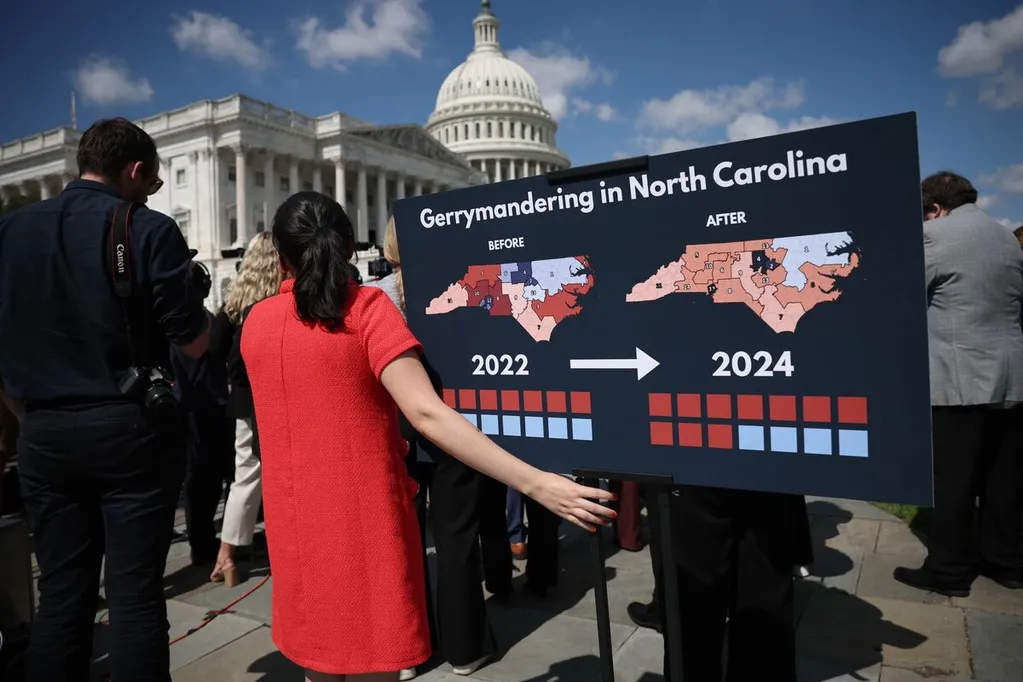
The redistricting fights breaking out across the US mark the culmination of a trend toward bare-knuckled politics that is producing increasingly gerrymandered maps on both sides.
Gianni Sarra saw it coming.
"I've always been interested in American politics," said Serra, a political philosopher at King's College in London. "It's a good source of moral dilemmas if you're interested in moral dilemmas."
Sarra watched with interest as the Great Redistricting War of 2025-2026 reached a new high point last week. The Florida legislature adopted a map designed to give Republicans a chance to win four more US House seats. That same day, the Supreme Court all but eliminated the use of the Voting Rights Act to ensure that racial majorities can't get gerrymandered out of fair representation, spurring Louisiana and Tennessee to do some last-minute map-making. Meanwhile, a new Virginia map drawn by Democrats got tied up in court.
Sarra anticipated what he calls "retaliatory gerrymandering" back in 2022, when he became interested in the moral dimension of drawing districts for partisan advantage. He came to it as a case study of the "dirty hands" problem -- in this case, the moral dilemma of using anti-democratic ends to achieve a more democratic result.
That was years before Democratic states like California and Virginia temporarily abandoned their constitutional safeguards against mid-cycle partisan gerrymandering to respond to Republican attempts to tilt the map and secure control of the US House.
Sarra saw how partisanship and technical advancements in map-making were leading to an escalating redistricting arms race in the US, and thought it would lead to retaliatory gerrymandering after the next census in 2030. "The stakes rose much more quickly and much more chaotically than I expected," he said.
For much of the past 60 years, redistricting followed a more restrained playbook. Maps were rarely neutral, but divided government often forced bipartisan compromise, and line-drawers tended to protect incumbents of both parties. Just as important, they had to think beyond the next election -- maps were built to survive a full decade of political and demographic change.
The new reality puts Democrats at a disadvantage. Democratic voters are inefficiently concentrated in dense, like-minded districts, diluting their voting power. And Democratic states like California, New York and Colorado have previously adopted redistricting reforms that tie their hands in a partisan redistricting war.
The end result is that even when Democrats have an advantage in the nationwide popular vote -- they're up by almost 6 percentage points in the RealClearPolitics average of generic congressional polls -- those votes don't necessarily give them more seats.
Hence the quandary: Is gerrymandering OK if it's in response to someone else gerrymandering first? Who was the aggressor, anyway? (Republicans argue that they were responding to gerrymanders in Democratic states like Illinois and Maryland; Democrats say President Donald Trump's demand that Texas provide five more Republican seats between census cycles started the current war.) Or are anti-democratic maps always bad, period? Ultimately, Sarra argues that the only thing worse than widespread, pervasive gerrymandering is asymmetric gerrymandering.
But where does it end? Serra said both parties need to acknowledge that gerrymandering is wrong and that neither side has completely clean hands. So far, though, there's no off-ramp in sight.
"I'm much more pessimistic now than I was a week ago, and I was pretty pessimistic a week ago," he said. "Eventually a lot of incumbents will be elected on the current system, and so why would they want to destroy it?"
Gerrymandering has drawn the attention of a wide array of academics -- from mathematicians to geographers to neuroscientists to physicists -- all looking for Solomonesque solutions to a seemingly intractable problem.
Sarra's contribution is a reminder that all those solutions have tradeoffs, and that the current cycle of tit-for-tat mapmaking is taking an increasing ethical toll. As he writes in his 2022 paper, "If a set of rules that is corrupting or incentivises and encourages abuse creates a perpetual cycle of retaliation, the costs from initially minor infractions will grow and grow."
Predictions
- More middle powers will seek nuclear weapons. "If Iran ultimately acquires a nuclear weapon, other Middle Eastern powers -- including Saudi Arabia, Egypt and Turkey -- may follow. That could trigger an exodus from the [Non-Proliferation Treaty]... Polls in South Korea show support for getting a nuclear weapon at record highs, and the subject is no longer taboo in Japan." -- Daniel Ten Kate, Bloomberg Weekend
- OPEC is facing an existential crisis with the UAE's departure. "When the conflict is over, Abu Dhabi, free from the OPEC constraint, would be able to pump at will, providing the world with the barrels needed to rebuild those inventories, in effect putting a lid on prices." -- Javier Blas, Bloomberg Opinion
- The closure of the Strait of Hormuz will create a biofuels boom. "Since the Iran war broke out, major biofuel producing countries Indonesia, Malaysia, Thailand, Vietnam and Brazil have moved to allow more biofuels to be mixed into transport fuels." -- Anuradha Raghu and Elizabeth Elkin, Bloomberg News
- "Keir Starmer's governing Labour Party is set to lose 1,850 seats in a crunch set of local elections next week, according to analysis by an expert in UK local voting, signaling an outcome that may put the premier's position in peril." -- Joe Mayes, Bloomberg News
- Malls will survive by catering to the well-off. "The Mall at Short Hills, nestled in one of the most expensive real estate enclaves in [New Jersey], is bustling with window shoppers evaluating Rolexes, waiting for their appointments at Hermès and raving over the newly-opened Pura Vida Miami cafe. Luxury retailers like Louis Vuitton and Chanel boast such long lines that shoppers are corralled by velvet ropes." -- Nacha Cattan, Bloomberg News
- India -- home to all of the world's 50 hottest cities -- is bracing for an especially blistering summer. "Above-normal heat [is] already straining power grids at a time when the country is grappling with energy shortages." -- Rajesh Kumar Singh and Pratik Parija, Bloomberg News
- Potty training will start earlier. "In 1957, 92% of children in the US were reported to be toilet trained by 18 months; by 1999, about 96% were not trained by the same age... [But] a large body of empirical evidence... suggests that children can potty train early without harm." -- Saabira Chaudhuri, Bloomberg Weekend
Keep an Eye On
Most Prediction Market Traders Lose Money
Over 100,000 accounts lost at least $1,000 on Polymarket since the beginning of 2025, according to a Bloomberg News analysis. That's almost twice the number that made at least $1,000.
Among the winners, a majority of the profits were raked in by a tiny slice of what look to be automated bots, based on the Polymarket trade records compiled by the data firm Dune. Everyone else, in aggregate, lost $131 million.
What Are the Chances...
The Kentucky Derby's Tradition of Longshot Wins
When Golden Tempo navigated past 17 other horses around the final turn to win the Kentucky Derby on Saturday -- passing morning-line favorite Renegade and going off at 23-1 -- it was another reminder that, from a gambler's perspective, the Derby is an odd event. Random things happen. Brilliantly talented horses flop. And longshots have been a cash-minting machine.
I recently ran the numbers on every horse that started in the Derby at odds of over 30-1 this century -- 167 in all. If you followed a simple rule and blindly placed a win-wager on all 167 of them, you would have turned a profit of 50%. That’s the result of four lightning-in-a-bottle upsets: the 80-1 shot Rich Strike in 2022; a 65-1 winner a few years earlier; and a pair of 50-1 bombs in the aughts.
Survey Says...
Last week we asked whether you thought robots would pass the "coffee test" -- preparing coffee in an unfamiliar kitchen -- before or after 2034, the year the median AI expert predicts the test will be passed. Clearly, Forecast readers are pretty bullish on robots: 75% of you said a robot would pass the coffee test sooner than the median expert anticipates.
Week Ahead
- Sunday: OPEC+ holds its monthly meeting; the Milken Institute Global Conference begins in Beverly Hills.
- Monday: Palantir reports earnings; India releases CPI as well as results of its state assembly election; the Met Gala is held in New York; Pulitzer Prize winners announced.
- Tuesday: HSBC and AMD report earnings; Australia's central bank may raise rates; Indonesia reports GDP.
- Wednesday: Uber and Disney report earnings.
- Thursday: Mexico reports CPI and its central bank is expected to cut rates.
- Friday: The US reports jobs data; Mexico CPI; Banxico cut interest rates; the ASEAN Summit begins in Cebu, Philippines.
Have a great Sunday and a productive week.