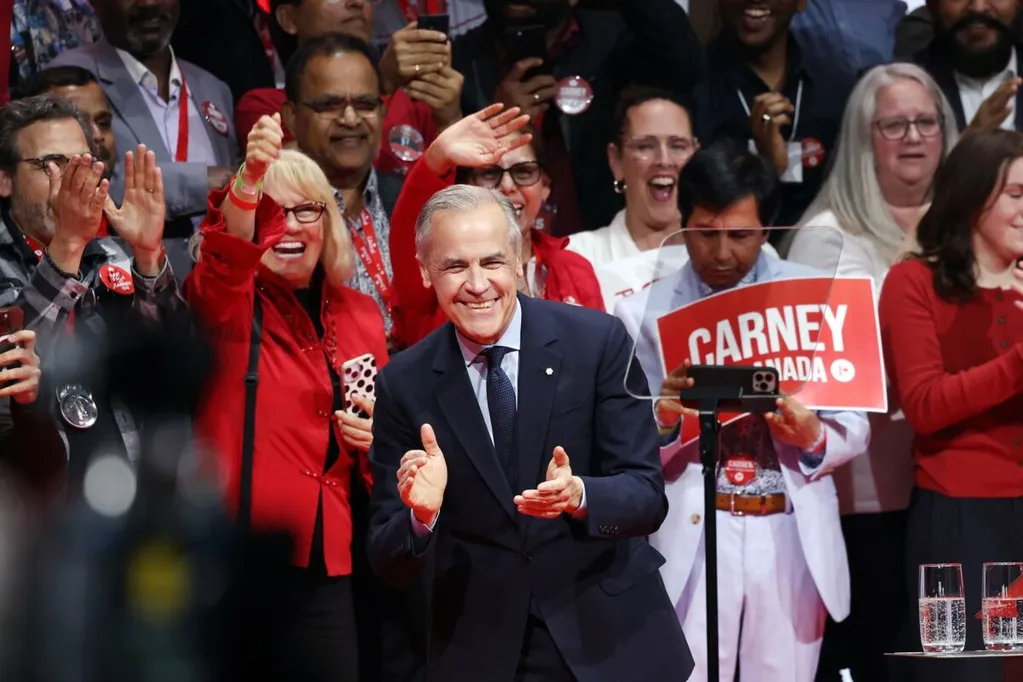
Standing in a desolate, snow-covered field 200 miles above the Arctic Circle, Mark Carney looked at ease. He chatted with Germany's chancellor and Norway's prime minister as they observed a NATO exercise -- troops on cross-country skis and snowmobiles zipping across the ice to battle a simulated Russian threat.
The former central banker came to power a year ago touting his experience at handling crises. At the time, Canadians were in shock over Donald Trump's tariffs and threats against the country's sovereignty. Carney promised to shield them from those pressures and won an election. He announced a rapid increase in military spending, partly to bolster the country's fragile Arctic defenses.
Carney's attendance at Friday's NATO exercise in Bardufoss, Norway, was a small demonstration of his foreign policy in action. But the limits of his influence were also evident. The Trump administration had just launched another tariff probe targeting 60 economies, including Canada, and eased sanctions on Russian oil, a move opposed by Carney and other allies.
Speaking at a news conference alongside Germany's Friedrich Merz and Norway's Jonas Gahr Støre, Carney insisted the US remains a trusted partner in northern security. But Canada will stand on its own two feet. "We will do that by very large investments," he said, and "in partnership with our closest allies, very much including Norway and Germany."
Carney's first year in office has been a feverish period of globe-trotting, including trips to Mexico, China, India, Japan, South Korea, Australia, South Africa, Singapore, Malaysia and Ukraine, as well as a meeting with Trump at the White House. He's visited the Gulf states and nearly every major European country.
The constant travel is aimed at expanding Canada's trade alliances in response to Trump's punishing tariffs on autos, metals and lumber, and at rebuilding ties with countries that Justin Trudeau's government pulled away from.
Nothing Carney did in his first year of diplomacy had quite the global impact of his speech at the World Economic Forum in Davos in January, where he urged countries to stop pretending the rules-based order remains intact. "Middle powers must act together because if you are not at the table, you are on the menu," he said in a speech that raised hackles at the White House.
The Davos address also punched through at home. About 81% of Canadians agreed with the sentiments in the speech, according to a poll by Nanos Research conducted for Bloomberg News in early March. The effect has been to strengthen Carney's hand domestically. Surveys show his Liberal Party has opened up a double-digit lead over the Conservatives. In last year's election, the Liberal margin of victory was a little over two points.
David Coletto of the pollster Abacus Data said he has "no doubt" the Davos speech boosted Carney's support. "You could draw a line just before and after, and you see a significant three to four point bump in his approval, in the Liberals' numbers -- and even optimism about the direction of the country," he said.
Still, that success comes with a mixed record on some of the issues that helped bring him to power. Carney won the election by convincing people he was the best leader to square off with Trump. He promised he could reach a broad new deal with the US covering security as well as trade. Yet he's been unable to get even a limited agreement to lower any of the tariffs that are crushing parts of Canada's manufacturing sector.
The economic fallout may be arriving. Trade data released this week showed Canada's exports of motor vehicles and parts falling to the lowest level in more than four years. In February, the country recorded its largest monthly job loss since January 2022. "No sense sugar-coating this one -- this is simply a brutal result," Bank of Montreal chief economist Doug Porter wrote of the jobs report.
Carney's promised economic transformation is progressing slowly despite his pledge to build projects "at speeds not seen in generations." He's spoken approvingly of big plans -- a new oil pipeline to the west coast and a massive carbon capture system, among other things -- but most haven't advanced beyond the planning stages.
Conservative leader Pierre Poilievre is making the case that the prime minister's economic diversification strategy is failing.
"Mark Carney's idea that he's going to replace the American market with China or other overseas markets for automobiles is an illusion," Poilievre said Friday in Windsor, Ontario, a border city that hosts a Stellantis NV assembly plant and a Ford Motor Co. engine plant. "Almost all of our automobile exports go to the United States. There is no replacing that market."
Carney, speaking to reporters Saturday in Norway, said he never promised to get US tariffs removed. "I promised the best deal for Canada." Mexico and Canada have relative low effective tariff rates on their goods going into the US because of an exemption for most things shipped under the continental trade agreement known as USMCA.
Coletto, the pollster, said public opinion shows Canadians generally place the blame for economic turmoil on the US president, not Carney. When asked who's best placed to deal with Trump, the Liberals score a 40-point advantage over the Conservatives in Abacus Data's polling.
"It's the one issue out of everything where they have an overwhelming advantage over the Conservatives right now, and they've had that basically since the day Mark Carney got this job," Coletto said.
The sense that Canada and the world are in a state of crisis has also helped Carney solidify the Liberals' position in parliament. Since November, he's convinced four opposition lawmakers -- three Conservatives and one New Democrat -- to "cross the floor" and join his Liberals, an unusual feat in modern Canadian politics.
Next month will see three special elections to fill vacant federal districts. If the Liberals win at least two, they'll hold a majority of seats in the House of Commons, giving Carney and his cabinet more latitude to govern as they want -- and a longer runway before they have to face voters again.
"He enters his second year with an incredible amount of political capital, and a lot of wind behind his back -- even as, to keep that analogy, there's incredible headwinds facing Canada," Coletto said.