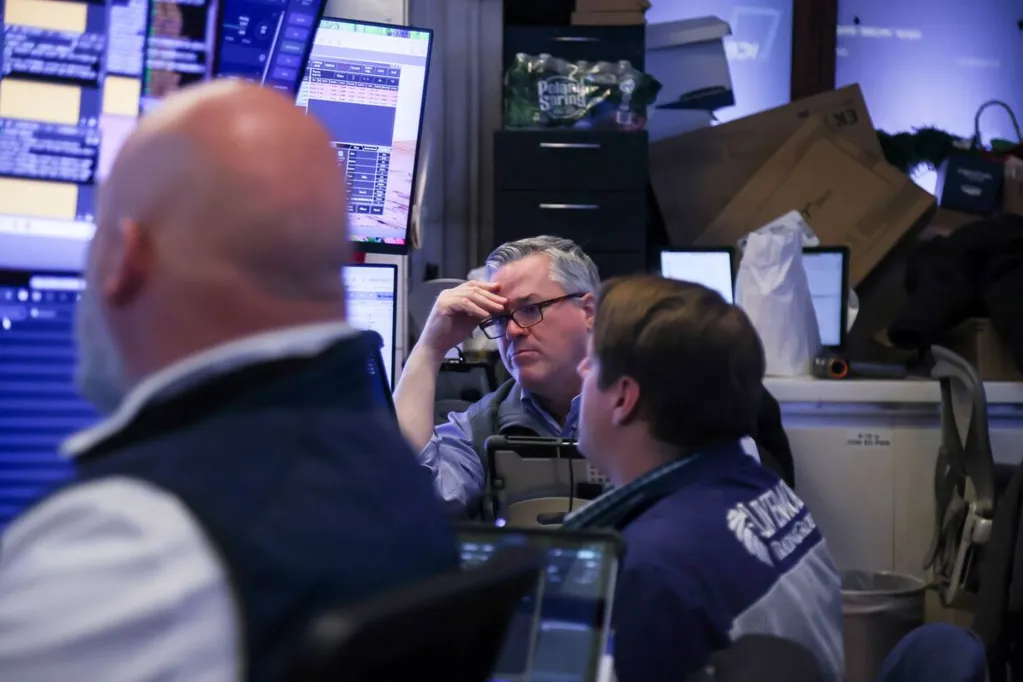
Thin liquidity and 'short gamma' positioning will keep the market choppy, potentially magnifying swings in either direction as dealers buy into rallies and sell into drawdowns to balance their positions.
After rebounding Friday to nearly erase a brutal mid-week slide, US stocks are facing more selling this week from trend-following algorithmic funds, according to Goldman Sachs Group Inc.'s trading desk.
The S&P 500 Index has already breached its short-term trigger that prompted Commodity Trading Advisers, or CTAs, to sell stocks. Goldman expects these systematic strategies -- which follow the stock market direction rather than fundamental factors -- to remain net sellers over the coming week, regardless of market direction.
A renewed decline could trigger about $33 billion of selling this week, according to Goldman. If pressure continues and the S&P 500 falls below 6,707, it could unlock up to $80 billion of additional systematic selling over the next month, the bank's data show. In a flat market, CTAs are projected to unload roughly $15.4 billion of US equities this week, and even if stocks rise, the funds are expected to shed about $8.7 billion.
Investor stress was running high last week. The firm's Panic Index -- which combines one-month S&P implied volatility, VIX volatility, S&P one-month put-call skew and the slope of the S&P volatility term structure -- most recently stood at 9.22, a level indicating markets are not far from "max fear" on Thursday.
The S&P 500 surged 2% on Friday, ending a volatile week with its biggest gain since May. The rally followed a sharp early-week drop in both the S&P 500 and Nasdaq 100, triggered by the launch of a new AI automation tool from Anthropic PBC that wiped billions of dollars off software, financial services and asset-management stocks as investors reassessed disruption risks.
Positioning across the so-called systematic strategies was the most common question among Goldman's clients Friday, underscoring the demand for a view of financial flows.
On top of the CTA selling, thin liquidity and 'short gamma' positioning will keep the market choppy, potentially magnifying swings in either direction as dealers buy into rallies and sell into drawdowns to balance their positions.
S&P top-of-book liquidity -- the volume of buy and sell orders available at the best bid and lowest ask price -- has deteriorated sharply, falling to about $4.1 million from a year-to-date average near $13.7 million.
"The inability to transfer risk quickly lends itself to a choppier intraday tape and delays stabilization in overall price action," Goldman's trading desk team including Gail Hafif and Lee Coppersmith wrote in a note to clients Friday.
Option dealer positioning has also flipped in a way that may exacerbate moves. After sitting in an area of so-called long gamma that helped prevent a break above the 7,000 level, dealers are now estimated to be flat to short gamma. The dynamic that becomes more pronounced when liquidity is scarce.
"Buckle up," the traders added.
Other systematic cohorts retain meaningful room to de-risk. Risk-parity positioning sits in the 81st percentile, looking back over a year, while volatility-control strategies are in the 71st percentile. Unlike CTAs, these funds respond to sustained changes in realized volatility, suggesting their impact would be more pronounced if volatility remains elevated. S&P 500 realized volatility is on the rise, but the 20-day gauge is sill below levels seen in November and December.
Seasonality offers little relief. February has historically been a weaker and choppier month for both the S&P 500 and the Nasdaq 100 as supportive January flows -- including retirement contributions and peak retail activity -- fade.
Retail behavior is also showing signs of fatigue. After a year of relentless dip-buying, the latest two-day net retail imbalance showed roughly $690 million of selling last week, demonstrating less willingness to "buy all dips." Popular retail trades tied to crypto and crypto-linked equities have been hit particularly hard, raising the risk that any broader rotation out of US stocks would mark a notable shift from last year's trading patterns.