Democrats and Republicans on Capitol Hill are scrambling to respond to the fast-developing conflict with Iran that has embroiled several U.S. allies in the Middle East and caused energy prices to surge, posing domestic political risks to both parties.
Republicans are struggling to say what President Trump's ultimate objective is in Iran in the wake of the elimination of Iran's Supreme Leader Ayatollah Ali Khamenei and the prospect that the conflict, which has already claimed the lives of six U.S. service members, could drag on for another four to five weeks.
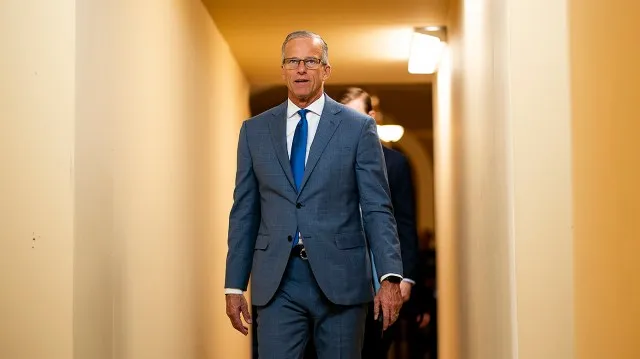
Senate Majority Leader John Thune (R-S.D.) told reporters Monday that he hopes the mission will wrap up soon when asked about the surge in oil prices, which could soon push up gas prices.
"I think there will be, hopefully, a cessation to this in the not-too-distant future, at which time my assumption is that will stabilize a bit," Thune said when asked about rising energy prices.
Asked what the Trump administration's objective is at this point, Thune said "it's using ... American air and naval assets to -- not completely eliminate -- but diminish the capability that Iran has in terms of ballistic missiles, as well as naval threats as well in the region."
"We'll get a fuller glimpse on that, I think, from the briefings we get today and tomorrow," he added.
Republicans have generally backed Trump on the strikes, though there have been some notable exceptions in the broader MAGA movement.
Former Rep. Marjorie Taylor Greene (R-Ga.), who broke sharply with Trump last year, called the strikes an "absolutely unnecessary" operation.
Trump's refusal to rule out the prospect of putting "boots on the ground" in Iran also has made it slightly tougher for some Republican senators to take a position against a bipartisan war powers resolution that will come to the Senate floor this week to restrict Trump's use of military force without congressional authorization.
Sen. Josh Hawley (R-Mo.), who has been critical in the past of the United States getting entangled in prolonged military actions, said Monday that he would insist on congressional authorization for boots on the ground.
He noted that the administration is "in compliance" with the War Powers Act because Secretary of State Marco Rubio submitted an official notification to Congress of the military strikes, giving the administration 60 days before having to come back to Congress for authorization.
"The political risks for Republicans are if this becomes an extended conflict, if it ends up with boots on the ground, Republicans are going to have a hard time explaining prior positions where they said they were not for any extended conflicts and wars," said Brian Darling, a GOP strategist and former Senate aide.
Democrats, meanwhile, are on the defensive over their blockade of funding for the Department of Homeland Security (DHS) at a time of war, when Republicans warn there's greater risk of terrorist attacks.
Senate Republican Whip John Barrasso (R-Wyo.) called the 17-day shutdown of the Homeland Security Department "completely irresponsible."
"Counterterrorism is a part of Homeland Security. We are in a much worse position in terms of national security and terrorism today because the Democrats have continued to not fund the Department of Homeland Security," he said.
Law enforcement officials are investigating whether the man who shot and killed two people and wounded 14 others at a bar in Austin, Texas, was motivated by the Iran strikes. The shooter was wearing a shirt with a design similar to the Iranian flag.
Sen. Chris Murphy (D-Conn.), the ranking member of the Senate Appropriations Subcommittee on Homeland Security, was pressed during an interview with CBS's "Face the Nation" about the optics of Democrats blocking DHS funding when the nation could face heightened terrorist threats.
He argued that Democrats are justified in holding up funding as long as Immigration and Customs Enforcement (ICE) officers are "terrorizing" American communities.
"I don't have any obligation to fund the Department of Homeland Security that is violating the law every day, just like I don't have any obligation to support this war that is illegal, as well," Murphy said Sunday.
Other Democrats sought to push back on Republican criticisms that they are putting homeland security at risk by refusing to fund key agencies, such as the Transportation Security Administration and the Coast Guard.
Senate Democratic Whip Dick Durbin (Ill.), a senior member of the Appropriations Committee, said the nation is safer when federal law enforcement officers have proper training, something Democrats say the Trump administration has failed to provide to ICE and Border Patrol authorities.
Asked about concerns about heightened domestic terrorism risks, Durbin asked if Republicans are "suggesting moving the ICE troops out of Chicago and Minneapolis" and deploying them to more vulnerable areas of the country.
Democratic lawmakers are also wrestling over how hard a line to take against Trump's military strikes against Iran, given that many of them agree Iran's regime has long posed a serious threat to U.S. allies and bases in the Middle East.
Centrist Sen. John Fetterman (D-Pa.) said he was "baffled" that some fellow Democratic senators are not supporting military action against Iran given what he called the consensus in Washington that Iran should not be allowed to acquire a nuclear weapon.
"Every member in the U.S. Senate agrees we cannot allow Iran to acquire a nuclear weapon," Fetterman said Monday on the social platform X.
"I'm baffled why so many are unwilling to support the only action to achieve that. Empty sloganeering vs. commitment to global security -- which is it?"
Other Democrats have been careful to couch their criticism of the Trump administration by pointing out the president's failure to fully brief members of Congress before launching the attacks instead of arguing that Iran didn't pose any real threat to the United States.
"We can't allow Iran to get a nuclear weapon," Sen. Mark Kelly (D-Ariz.) acknowledged Sunday in an interview on NBC's "Meet The Press."
Kelly said his main gripe with the administration is that it was his "sense" that "they did not go into this with any kind of strategic plan."
Senate Democratic Leader Chuck Schumer (N.Y.), who hardly ever misses a chance to condemn Trump and his administration for its actions, had taken a more circumspect approach to the Iran strikes.
Speaking on the floor Monday, Schumer, a staunch ally of Israel, criticized Trump for launching America "into a full-scale conflict" without "an endgame" and "without authorization from Congress."
But he also hailed the death of Khamenei, telling colleagues "I will not shed a tear" for Iran's supreme leader who "called for the destruction of Israel and America."
Other Democrats have used much stronger rhetoric in condemning Trump's strikes.
Murphy, who is eyeing a presidential bid, called the attacks "dangerously illegal and a mistake of a staggering scale."
Sen. Ed Markey (D-Mass.), who faces a primary challenge in this year's election, called the attack "illegal and unconstitutional" and warned the president's actions "raise the threat of escalation into a wider regional war with grave risks for U.S. troops and civilians in the region."