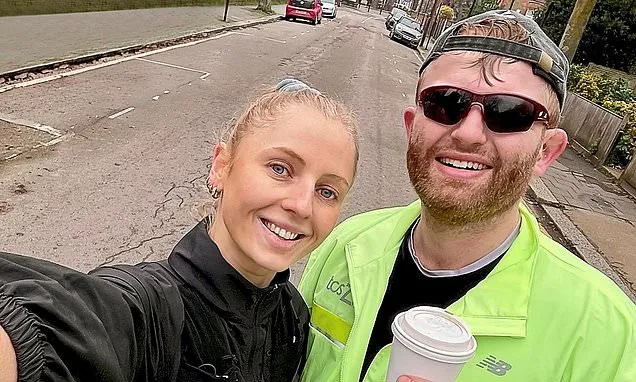
It's 9am on a Saturday and I'm running laps around my local common in Southwest London. But unlike the swathes of fitness enthusiasts I plod past, I am strapped to a man: my 6ft 3in, 115kg big brother, Chris Hunt-Skelley.
We're training for next Sunday's London Marathon; striding in sync, arms swinging in unison and linked at the wrist by an official yellow British Blind Sport tether, because Chris is visually impaired and I am learning how to be his guide runner.
This is my third marathon and I can confirm putting one foot in front of the other for hours takes courage, slight madness and a lot of blister plasters. Around 60,000 runners will take part next week but only 230 of them will be blind or partially sighted because to run all those miles, without seeing where you're putting your feet, is another test entirely.
'Taking in my surroundings is hard enough. To do it at speed when you can't see is risky and very taxing,' Chris says.
It was after his 17th birthday that Chris, who wasn't born visually impaired, began to notice his eyesight slipping away. We didn't know it at the time, but he had oculocutaneous albinism, a vicious genetic condition characterised by a lack of pigment in the skin and hair and which causes nystagmus (rapid and uncontrollable eye movements), photophobia (extreme sensitivity to bright light) and failing vision. One of the rarest forms of albinism, it's estimated one in 40,000 people worldwide have it. Sadly, Chris wasn't given this critical diagnosis in the UK, and he went through hell to get it.
At first his sight loss was subtle. He struggled to read bus numbers and kept edging closer to the TV. But it escalated in a matter of months and he began needing a magnifying glass to work as an apprentice car mechanic. When his depth perception shrank and he almost fell into the garage pit, it became clear something was going horribly wrong.
Our GP referred him to a consultant neurologist. Being extremely fair haired and pale skinned, Chris asked if his lack of pigmentation could be related to his eye condition. The consultant laughed and told him it would be 'highly unlikely'.
From there it was an endless cycle of NHS appointments and, when no cause could be found, a psychiatric nurse eventually put his sight loss down to mental health problems.
With no job and the medical profession not treating his visual impairment as a reality, Chris's mindset deteriorated. He didn't tell me at the time to protect me, but years later he admitted contemplating suicide. 'I was utterly heartbroken. I didn't know what was happening to me and I couldn't see a clear path ahead,' he says now.
Living in a world without my gentle big brother is unthinkable. Growing up we shared a love of baking, Star Wars and pranking our family. Despite me being two years younger, we called ourselves The Twins. Anything I couldn't lift, he would carry. Any time I was scared, he would calm me.
The irony that an incorrect psychological diagnosis caused his mental decline makes my blood boil. Now 32, many hours of therapy have revealed Chris has PTSD from his teenage torment.
With his world falling apart, judo became his saviour. From the age of five, Chris had attended Haltemprice Judo Club in Hull, run by the late coach Jeff Brady, and this childhood hobby became the one constant Chris could cling to. Brady took him under his wing and thrust him into more training camps and competitions. By this point Chris’s eyes were so light-sensitive that he had to wear Polaroid sunglasses inside. But these are banned from the judo mat, so Brady blindfolded him instead: Chris adapted to fighting in the dark, feeling for his opponents and - to everyone’s surprise - he was winning.
Aged 18, Chris was asked by British Judo to join the Paralympic Pathway. This led to his 15-year career competing internationally for the Paralympic Judo Team. Paralympics GB also introduced him to Polaroid contact lenses, so Chris could hang up his blindfold.
In the meantime, he finally got his diagnosis. In September 2013 our dad’s boss, the CEO of Carbon Holdings, Basil El-Baz, an alumnus of Harvard, heard of Chris’s predicament and organised a trip to the US to find some answers. In Boston, Dr Guy Rochman gathered a multi-specialist team from Mount Auburn Hospital, a Harvard teaching facility, to assess Chris over five days.
After years of not being taken seriously by doctors in the UK, in a matter of weeks Rochman’s investigation revealed Chris had oculocutaneous albinism type 2 (OCA2) and Bell’s phenomenon, which causes the eyeballs to roll up at night, blocking out all light and meaning he could no longer dream. An incurable condition, Chris’s eyes deteriorated further but have now stabilised, and today he has a small percentage of sight left.
'It was the greatest relief. Having a firm diagnosis helped me build the life I lead now,' says Chris.
Next Sunday, Chris will stand on the London Marathon start line having secured a Paralympic gold medal at Tokyo 2020, a bronze medal at Paris 2024 and an MBE.
Training alongside him today for a major marathon feels nothing short of a miracle. It only felt appropriate that we race to support Fight For Sight, a charity that funds medical research into the diagnosis and treatment of eye diseases. If we can help other people like Chris through the uncertainty of visual impairment, it will be well worth it.
Our first tethered run felt alien and there was a lot of jostling and shoulder barging until we found our stride. The 20-inch tether is stiff not stretchy, with a loop at each end for our hands to fit through. It keeps us connected side by side so I can be his eyes, giving Chris the freedom to run on any terrain.
'I can't anticipate uneven surfaces,' he says, 'so my body must adapt quickly. But I feel safe on the tether. It's an honour to run for a cause so close to my heart.'
Meanwhile, I carry the worry that if Chris falls, I'm responsible. And considering his size and our proximity, I'll be going over with him. Touch wood, we've stayed upright so far!
To add another challenge, Chris was born hearing impaired and lives with 30 per cent audio ability, so we’ve had to account for communicating without sound in noisy scenarios.
Inspired by the rules of Visually Impaired Judo, where signals are drawn on the palms of deaf players to communicate changes in the game and points scored, we’ve developed our own tactile signals. A pushing swipe of his arm to the right signals a right-hand bend in the road; a downward arrow drawn on his palm means reduce speed; obstacles ahead. You really don’t appreciate the true rise and drop of a speed bump until you’re sprinting over it at great velocity with a partially sighted Goliath of a man.
Holding hands is for veering him over to family and friends along the barriers. I would give anything for Chris to see the faces and places we will run past on the day. But I know he will feel all the cheers in his chest instead.
There’s no signal for cobbles. Our contingency plan is ‘BRACE! COBBLES! BRACE!’ Similarly, there will be some fumbling while we traverse all the plastic bottles that pile up at water stations. Our tops will state BLIND RUNNER and GUIDE RUNNER so that our fellow participants can give us a wide berth.
It turns out the key to running without two of your senses is to have a large sense of humour instead - and luckily Chris’s is the size of a bucket.
He wouldn’t tell you he is brave. But training alongside Chris has given me a whole new appreciation for the nerve it takes to navigate a busy, bustling and sometimes hostile world you can’t see.
Running is a great coping mechanism for us both: a quiet and cathartic time for unpacking the life-changing events we have faced. And, as we count down to race day, I’m already mourning losing these hours together chatting, laughing or moving in silence with the tether swinging between us. Perhaps we will do a triathlon next...
But no matter how uneven the road gets, I realise there has been an unbreakable tether between us all along.