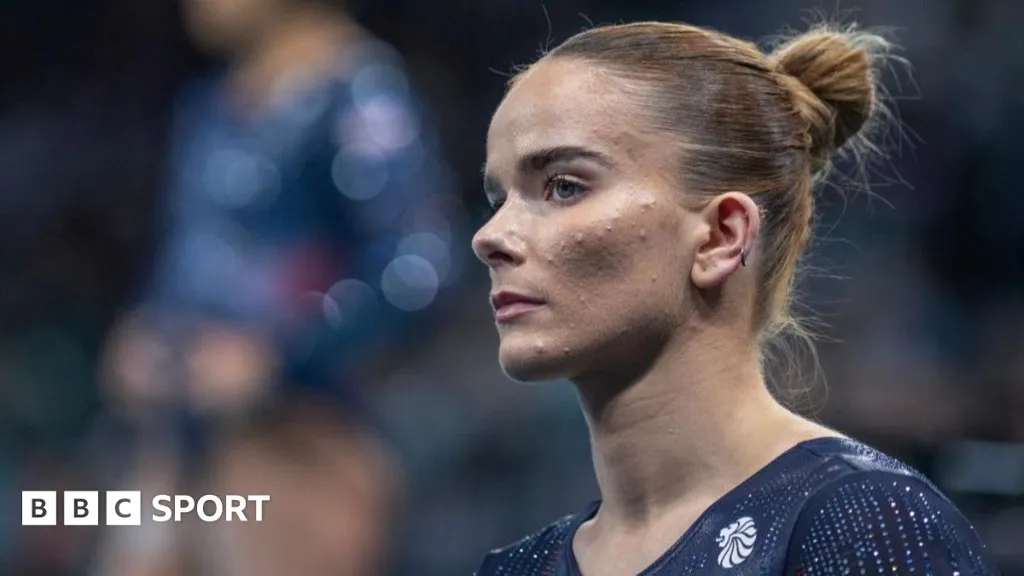
Pioneer gymnast Kinsella's rare return to elite competition after baby
What gymnast Alice Kinsella is trying to do is so rare that it is the subject of a university research paper.
When she walks into the gym at the home of British Gymnastics in Lilleshall, it is not her who her team-mates and coaches rush over to greet.
It is her son Parker, who at just a few months old is in his Christmas babygrow and loving the fuss.
But their eyes soon turn to Kinsella.
She might not be inventing a new gravity-defying move but she is breaking new ground in a different way as she seeks to become the first British artistic gymnast to return to elite competition after giving birth.
There are many examples of mums returning to the top of their sports but this is not the case in gymnastics, where pelvic floor and core strength - both weakened during pregnancy - are so vital.
Kinsella, who won Olympic bronze in the team event at Tokyo 2020 and is a two-time European champion, remarkably had only "about three or four weeks off" after having Parker in the summer.
The 24-year-old sat down with BBC Sport to discuss her progress and how she has managed it.
Ten-time European medallist Kinsella said she always knew she wanted to be a parent while still competing at elite level, but finding "the right time" in between Olympic cycles was key.
After finding out she was pregnant at the beginning of 2025, Kinsella stopped training on bars, floor and vault "straight away" because of the risk of her falling on her stomach and her training plan was altered by the medical team.
She stuck to her normal diet, give or take a few pregnancy cravings, and did strength and conditioning training throughout her pregnancy, stopping "a week or two before" giving birth.
Strength and conditioning exercises target core, upper and lower body strength and power, flexibility and mobility.
British Gymnastics senior conditioning coach Ben Young said they "used it as an opportunity to address some limitations she had had in the past, like ankle stability, shoulder strength and grip strength".
Anything that was "high intensity, high stress and high impact" was ruled out, but it was "a whole-body approach" to safely maintain as much of her strength as possible.
Kinsella believes her gymnastics background has played a big part in her being able to return to physical exercise so quickly postpartum, but acknowledged that it may not have been possible if she had had a caesarean section.
"When I got back [to training], my strength had obviously dropped a little bit, but it was still kind of there," she said. "I didn't feel too bad in myself.
"I thought if my body is telling me it is OK then why not try and give it a go."
NHS advice says "if you had a straightforward birth, you can start gentle exercise as soon as you feel up to it" but that "it's usually a good idea to wait until after your six-week postnatal check before you start any high-impact exercise".
It adds: "If you exercised regularly before giving birth and you feel fit and well, you may be able to start earlier. Talk to your midwife, health visitor or GP."
Like most new mothers, Kinsella's body changed during pregnancy and after.
"My hips are wider and I haven't tried on a leotard yet," she smiled. "And I don't think I am going to any time soon!"
In addition to the physical changes, Kinsella said "it was a weird feeling" knowing she no longer had the same stomach power as before because of her abs separating.
According to the NHS website, during pregnancy the uterus pushes the muscles apart, making them longer and weaker.
They usually go back together within two months, but as a gymnast Kinsella is having to work hard to regain that core strength to get back on the apparatus.
She is currently training three days a week thanks to having "a lot of help" with childcare from her partner Will and her mum, and is also grabbing naps when Parker sleeps in the daytime as she is being woken up at night.
Kinsella does not want to put a timestamp on her return but hopes to be "back fully" by the end of 2026, with the World Championships taking place in Rotterdam, the Netherlands, in October.
Next year's Worlds in China are qualifiers for the 2028 Los Angeles Olympics and follow a busy summer for the sport with European Championships and Commonwealth Games within weeks of one another.
"I am taking it day by day at the moment," Kinsella said. "I am feeling very positive about it."
"If I am back before then [Worlds], that is great, but if not then I won't be too stressed."
Senior conditioning coach Young said "the biggest challenge we have at the moment is actually holding her back a little bit".
He added: "She is making huge gains. Faster than we probably anticipated, but that is probably a tribute to the elite athlete that she is."
Young hopes Kinsella "can be a pioneer to other gymnasts to return back to elite sport, or any other physical sport" after childbirth.
Trampoline gymnast Laura Gallagher, with whom Young also worked, is the only other Briton to return to gymnastics after childbirth.
There are a handful of women worldwide who returned to the sport before the 2000s and Russian Aliya Mustafina achieved it post-Millennium - although she never competed at another Olympics after suffering several injuries.
British Gymnastics is working closely with Dr Julie Gooderick, who is leading the research at the University of Kent for a paper titled 'Returning to sport postpartum: a case study of an elite gymnast'.
Dr Gooderick told BBC Sport: "For athletes, mid-career maternity leave is still not normalised, and there is a real lack of research around best practice for returning to sport postpartum."
"The research team from Kent will be tracking Kinsella's data as she builds back towards returning to competition, with the aim to present a successful example of a holistic approach to a return to elite sport."
"We will track physical testing data including jump tests, trunk capacities and force production as well as tracking changes over time in other aspects such as sleep, hormonal profiles via blood tests and psychological factors."
"This holistic approach may allow us to present key time points in the return to sport process to firstly ensure Kinsella receives the best support possible throughout this process and secondly,to help guide other practitioners through this process in the future."