Traditional life goals used to involve getting married and having children - but not any longer, according to a new study.
A survey of 13-16-year-olds - who are part of 'Generation Alpha' - reveals only half now say tying the knot is important to them.
Meanwhile just 56 per cent say they really want to have children.
Instead, they have turned their sights towards securing financial independence, building a network of close friends and getting on the properly ladder.
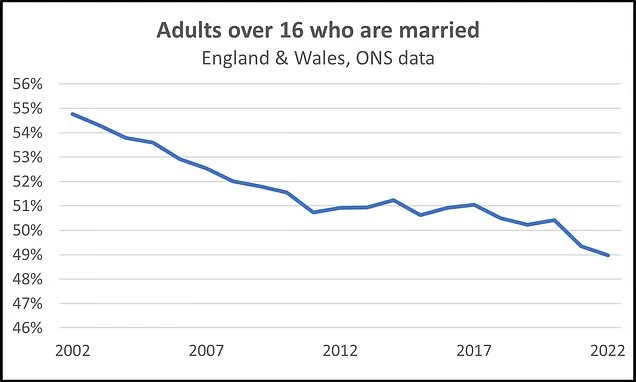
It comes as both marriage and birth rates in the UK are steadily declining - with some experts warning of a 'tipping point'.
Despite a clear vision for their future, only half of Generation Alpha teenagers said they feel ready for adult life, the poll found.
Dr John Allan, head of impact & breakthrough learning at PGL Beyond, said: 'Generation Alpha, many of whom are now approaching adulthood, are clear about what they want from their future.
'But our research shows many don't yet feel ready for what comes next, particularly when it comes to the confidence, independence and practical skills needed to navigate life after education.'
It comes as marriage rates in the UK are steadily declining, with campaigners warning of a 'deeply troubling' fall-off in matrimony.
There has been a rise in young people in the UK declaring that they don't want children, with many taking to social media to explain why they don't want kids.
For the survey, nearly 700 13-16-year-olds were asked questions about what they wanted to achieve in life.
Just 51 per cent said getting married is important to them - a figure which represents a falling trend over the last few decades.
Campaigners have previously warned that the proportion of young couples getting married has dropped by almost a third since the 1960s amid a 'deeply troubling' fall-off in matrimony.
Trends indicate that fewer than six in 10 of those born between 1997 and 2012 will ever tie the knot.
Projections suggest that 58 per cent of women and 56 per cent of men in that 'Generation Z' age bracket will say 'I do' at some point in their lives.
It compares with up to 67 per cent of Millennials (born between 1981 and 1996), up to 82 per cent of Gen X (born between 1965 and 1980) and up to 96 per cent of the Baby Boomer generation (born between 1946 and 1964).
The projections were made by the Marriage Foundation - a charity set up 'in response to the epidemic levels of family breakdown'.
'The trend away from marriage has profound consequences for stability and children's outcomes,' it said.
'We already have the highest level of family breakdown in recorded UK history. Nearly half of all teenagers are not living with both natural parents.'
Meanwhile, the latest figures will do nothing to assure experts who have warned a falling birth rate could lead to higher taxes.
Earlier this year, statisticians predicted that the UK is on the brink of seeing deaths outnumber births for the first time.
Gregory Thwaites, from the thinktank group Resolution Foundation, said 2026 may be the first year of a 'new normal' where this is the case.
If the downward trend continues, it could pose serious challenges for public finances, with a smaller working-age group having to pay for an aging population.
Mr Thwaites said: 'We're already moving to this situation where the Government is, to a large extent, paying for older people, and spending on people of working age or children is being concentrated on a smaller fraction of those populations as well.'