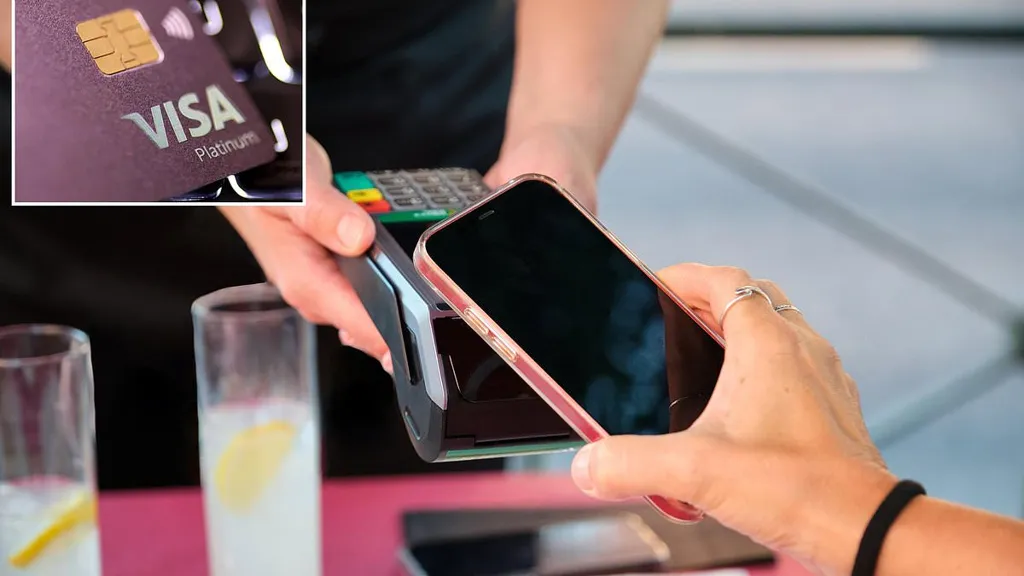
More than half of under 35s struggle to remember their four-digit pin number for their bank card, new data claims.
It follows a trend of people generally becoming worse at recalling numbers in the last five years as the convenience of technology has reduced the need to remember card numbers, pin numbers, phone numbers and postcodes.
A third of people remember fewer numbers now than they did five years ago, research from payments processor Visa shows.
But older generations are better at recalling personal numbers, the data shows.
One in four Generation Z youngsters, born between 1997 and 2012, admit they don't know their own phone number, compared to three in five of the boomer generation who recall not only their own home number but even their childhood landline, which a one in four also remember.
Younger people are forgetting their banking details more in large part because they do not need to remember them with the advent of digital payment methods which allow them to make purchases at the touch of a button on their phone.
These include the likes of Apple Pay, Google Pay and Visa's click to pay, which mean customers do not have to input any card details when making a purchase online or in a shop. They do not even have to leave the webpage they are on to pay.
Mark Wilcocks, VP product & Solutions Visa says: 'As our lives become more digital, the way we interact with numbers has fundamentally changed. We no longer need to memorise long strings of digits.'
Half of all UK adults regularly used Apple Pay and Google Pay to make contactless payments during 2024, rather than their bank cards, according to banking industry body UK Finance. But digital payments have been adopted most rapidly by young shoppers.
Nine in 10 people aged between 16 to 24 were using a digital wallet in 2024, and four in five of those between the ages of 24 to 35.
This compares to 47 per cent of 55 to 64 year olds and 25 per cent of those over the age of 65 who were using digital wallets.
Jana Mackintosh, a director at UK Finance, says: 'Younger people continue to lead the way in this adoption, but we are already seeing significant use among older age groups, and we expect them to catch up with their younger counterparts over the coming decade.'
Debits cards remain the most frequently used payment method in the UK, however, accounting for half of all payments with 26.1 billion payments made in 2024.
The convenience element of digtal payments has hooked people into using them more and more over debit cards.
When shopping online, 41 per cent of people find mistyping their card details at the checkout frustrating and a quarter dislike having to switch apps or devices to find their card information.
This is a problem for retailers; a third of shoppers would abandon or delay an online purchase because they needed to fetch their bank card.
It has led to more online reataillers offering digital methods of payment such as Apple Pay, Google Pay and Visa click to pay on the checkout section of their websites so customers do not have to leave their baskets.
While chip and pin is a secure way to make payments, especially for higher value transactions, contactless payments via mobile wallets are secure because they typically rely on device security and strong biometric authentication such as facial recognition.
The average chip and pin transaction is £93 compared to £17 for a contactless payment.
But chip and pin carry their own risks. Mike Nathan, fraud risk expert at cyber security firm Lexis Nexis risk solutions says: 'Physical cards have just the one security measure - the pin, at the point of transaction.'
'In that sense they are less secure than digital payments, which are backed up with several layers of invisible digital risk intelligence.'
'Pins are more vulnerable to shoulder-surfing type attacks where a fraudster discretely sees the code being entered then steals the physical card or device to access accounts and authorise transactions.'
A UK Finance spokesman says: 'All payment methods have security features, and we wouldn't say one is more or less safe than another.'
'Chip and pin still remains important for higher-value purchases and when contactless limits are reached. A pin is a strong in-person security control if a physical card is lost or stolen.'