HAMDEN -- Due to the town's significant amounts of debt and one of the highest tax rates in the state, some town officials have begun to accept they'll be making difficult choices moving forward.
On Wednesday upon presenting his budget proposal which calls for a 4.92% tax rate increase, Mayor Adam Sendroff said the town must make "an important step toward a more sustainable fiscal path for Hamden" by addressing its liabilities from pensions, medical costs and restructured bond payments.
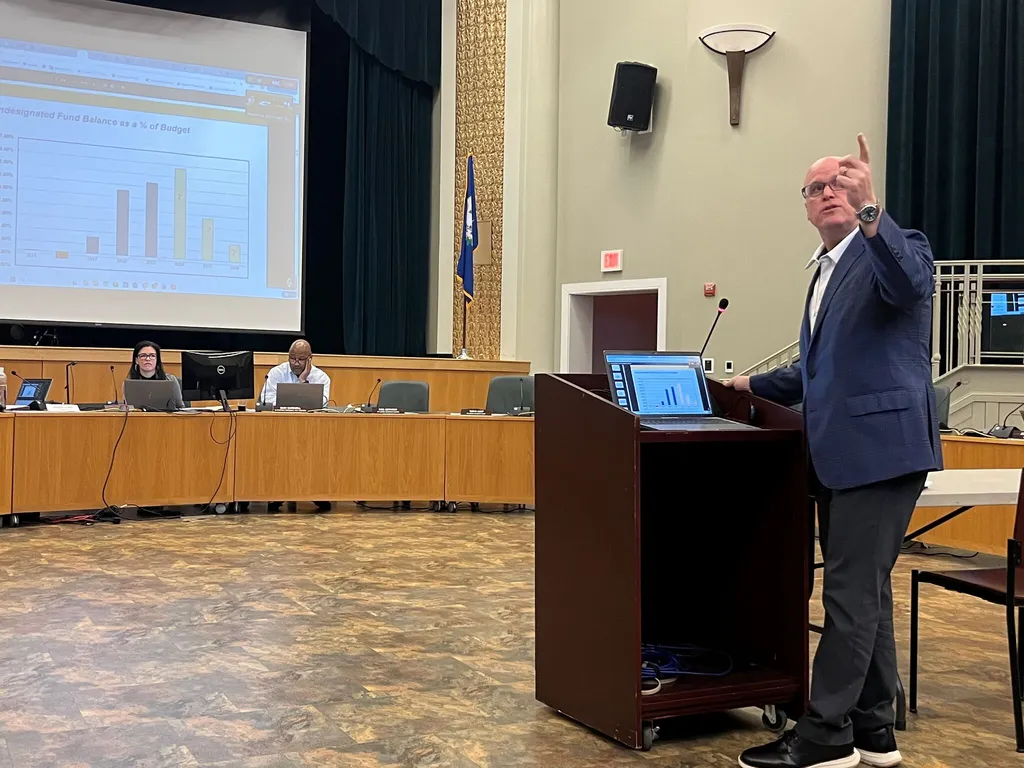
The week prior, the town's Legislative Council heard a presentation from Barry Bernabe, Hamden's financial adviser, highlighting some statistics about the town's debt and borrowing outlook.
According to the most recent available data from the state's Office of Policy and Management, Hamden had the highest debt per capita in Connecticut as of the 2023 fiscal year and the second-highest equalized tax rate in Connecticut, yet had the 132nd highest per capita income of 169 municipalities.
Grace Teodosio, a council member elected to her first term last year, said she found the presentation eye-opening and alarming.
"What I'm hearing you say, essentially, is we're not technically backed in a corner yet, but if we want to remain solvent, we're probably going to have to make some unpopular decisions," she said to Bernabe.
For years, Hamden has been plagued by fiscal concerns because of how it has historically underfunded its liabilities. The town has had the highest debt per capita for a while.
In 2021, a state report showed that Hamden's debt of $19,021 per person in the 2019 fiscal year made it the highest debt per capita municipality in Connecticut. As of the most recent data from fiscal year 2023, Hamden's debt per person had increased to $20,972.
Bernabe said some of the main drivers are prior debt restructuring maneuvers -- which eased pressure on the town's operating budget by putting off debt payments for future years -- and overly optimistic revenue assumptions that have created significant holes for the town to plug to produce balanced budgets.
"Historically, the town of Hamden has just not had the revenue discipline," he said.
Adding to the town's problems is that the bond rating agency Moody's withdrew its rating for Hamden last year because the town has yet to produce an audit of the 2023-2024 fiscal year. Bernabe warned that it could threaten the town's market access as it prepares to pay off roughly $32 million in debt in the 2027 fiscal year.
That includes bonding for a new roof for Hamden High School and $9.9 million in additional capital projects, he said.
"There are lots of liabilities in the past the town is trying to get ahead of," Bernabe said.
Sendroff said in an emailed comment last week that he had met with Bernabe prior to the council meeting and came away with similar conclusions about the state of the town's finances.
"We are in a very challenging position considering Hamden's incredibly high long-term liabilities and having the highest debt per capita in the state, the 2024 state-mandated revaluation and our heavy reliance on residential property taxes, combined with ranking 81 out of 169 municipalities for the percentage of its budget from state aid," Sendroff said.
Bernabe told the council that it had the option to refinance three of its 13 outstanding bonds, two of which he said it could be financially advisable to do so. He said refinancing those two bonds might realize about $800,000 in savings through 2038, or about $66,000 annually. He said he believes the town is also in a position to pressure the state for more aid.
According to state data, state aid comprises 21.3% of Hamden's budget—a significant amount less than area towns like New Haven—with 44.3% of its budget comprising state aid—and West Haven—with state aid making up 39% of its budget.
"I get the sense Hamden doesn't get the same degree of help," Bernabe said, urging the council to speak with Hamden's state delegation about the numbers.
State Rep. Steve Winter, D-New Haven, said he and others in Hamden's delegation are "eager to look for opportunities to try to increase support for the town."
"In general, there's a lot of momentum this session for increasing the foundation amount for the Education Cost Sharing grant, which is a large proportion of state aid to municipalities," he said.
He said the delegation has also recently been successful in advocating for state Community Investment Fund money to fund some or all of significant capital projects in Hamden, including $8 million to repair sinking foundations in the Newhall neighborhood and $1.5 million for a new fire station, which is pending approval from the state's bond commission. Those funds ultimately offset the town's borrowing, easing the debt burden, he said.
Winter also said he finds the statistic about the overall percentage of state aid within state municipalities' budgets to be a "challenging" comparison to make, as a lot of state aid is formula based and towns set the size of their own budgets based on revenue and expenditures.
According to the General Assembly's Office of Fiscal Analysis, the amount of aid Hamden receives from the state has increased significantly. From the 2021 fiscal year to the estimated total for the 2027 fiscal year, Hamden’s state aid has increased from $38 million to $67 million, driven largely by changes in state aid formulas, such as an increase of $12.8 million in ECS grant funding over seven budget cycles; $5.1 million in payment in lieu of taxes from state for tax-exempt properties; and $10.6 million from motor vehicle tax reimbursement.
At a recent special meeting of the Hamden Legislative Council, members voted to approve Myron Hul as the town's finance director. Council President Katie Kiely said that although Hul had been introduced as a candidate for interim finance director, the town charter does not allow for someone to hold office on an interim basis. The council voted to approve Hul as finance director for a finite term.