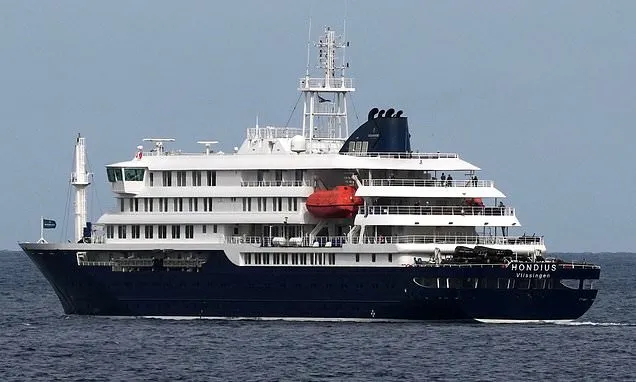
British passengers on board a hantavirus-hit cruise ship will be asked to self-isolate in the UK for 45 days, a health official has suggested, as two Britons who already returned from the vessel continue to isolate at home.
Professor Robin May, chief scientific officer at the UK Health Security Agency (UKHSA), said "for the broader public, not directly involved in this cruise ship, the risk here is really negligible".
But he told the BBC's Radio 4 Today programme that those British passengers on the ship who are now on their way to Tenerife will be flown home and asked to self-isolate, most likely at home, for a period of 45 days.
Some 19 British nationals were listed as passengers on the MV Hondius, which was sailing from Argentina to Cape Verde, with four British crew members.
Two of the Britons left the cruise ship at St Helena in late April and flew back to the UK via Johannesburg.
The pair contacted health officials when they heard about the cases on the ship and are now voluntarily self-isolating in the UK. They do not have symptoms.
The Foreign Office is arranging a charter flight so the remaining Britons on board the ship who are not displaying symptoms can be repatriated once they dock in Tenerife in the next few days.
According to the UKHSA, none of the British citizens on board are currently reporting symptoms, but are being closely monitored.
Prof May said the "most extreme case of incubation" of hantavirus "may be up to eight weeks" but general consensus is people need to isolate for "probably six weeks, and so that's the period of isolation, 45 days that we're likely to be recommending".
He added: "For the individuals that are on the ship at the moment, we're working, obviously, to repatriate them as soon as we possibly can.
"The Foreign Office is leading on that, and once they're back, they're going to be asked to self-isolate.
"We'll continue to support them and their families whilst they self isolate, probably at home, but obviously depends very much on the individual circumstances, depending on where they live and who they live with, as to what the most appropriate mechanism is for them to self-isolate for the next 45 days."
Prof May added that contact tracing is happening for anyone who may have sat next to the two Britons on their flight home.
He stressed that hantavirus "is actually not that easy to transmit between individuals so a quick pass in an airport, for example, is not going to put you at risk".
He added: "We focus our attention on people who might, for example, have been sat next to a passenger for a long time, several hours on the flight. Those are the people that we're contacting."
British crew member Martin Anstee, 56, was among those who were evacuated from the ship after developing symptoms.
The expedition guide and former police officer was flown to receive specialist medical care in the Netherlands after being airlifted off the vessel.
Speaking from hospital, Mr Anstee told Sky News: "I'm doing OK. I'm not feeling too bad. There are still lots of tests to be done.
"I have no idea how long I'll be in the hospital for. I'm in isolation at the moment."
His wife Nicola told the Telegraph it had been "a very traumatic few days".
She added: "He's relieved to be off the ship. He had it quite mild then it got a bit more serious and now he’s stable again.
"The fear with this virus is it can deteriorate very quickly so it’s been a bit up and down for him.
"I don’t believe he’s in imminent danger now but it was horrible."
The outbreak, which has been linked to three deaths, has been connected to a birdwatching expedition in Argentina which two of the passengers went on before boarding the ship.
Asked about Mr Anstee, Prof May said it was a "good sign" he was able to communicate with family.
He said: "Our understanding is that he's doing well, which is good.
"He is going to be under investigation for some time, obviously, but I'm very pleased that he's now in hospital and receiving the treatment he needs."
Prof May explained that hantaviruses as a group are widespread around the world.
"This one, in particular, the Andean strain, is the only one for which there is some evidence in the past of human to human transmission, and so that's obviously our primary focus here," he said.
He added it has been studied intently because it is "such a severe disease" and there are efforts globally to try to develop vaccines against it.
Foreign Secretary Yvette Cooper said on Wednesday the Foreign Office is "working urgently" to help get Britons "safely home with proper protection for public health".
Health Secretary Wes Streeting added: "The outbreak of hantavirus on the MV Hondius will be worrying many.
"The Government are taking this incredibly seriously and are working urgently to support the British nationals involved."
Three passengers have died on the MV Hondius following the hantavirus outbreak.
Despite concerns from locals and officials, Spanish authorities have given permission for the ship to dock in the Canary Islands.
About 150 people are still on the cruise ship under "strict precautionary measures", according to Oceanwide Expeditions.
Three people were evacuated from the ship on Wednesday to the Netherlands for treatment, including Mr Anstee.
On Monday, health officials in South Africa confirmed a British man, understood to be aged 69, is in a critical condition with hantavirus and is receiving care at a private health facility in Sandton, Johannesburg.
The Associated Press reported the Argentine government's hypothesis is that a Dutch couple contracted the virus during a birdwatching outing in the city of Ushuaia before boarding.
Two Argentine officials told the news agency that the couple visited a landfill during the birdwatching tour where they may have been exposed to rodents carrying the infection.
Passengers have been are confined to their cabins while "disinfection and other public health measures are carried out", the World Health Organisation said on Tuesday.