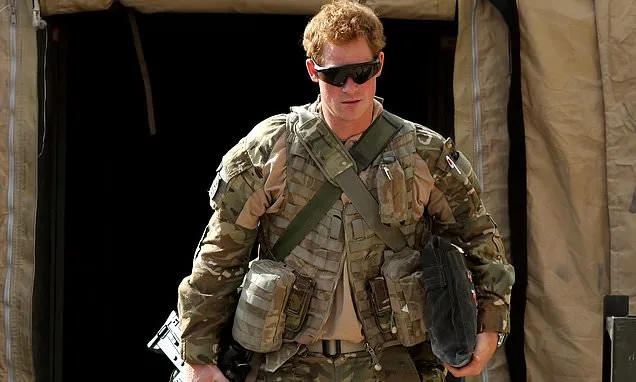
For several years, the details of Prince Harry's deployment to Afghanistan were shrouded in secrecy and dominated by speculative tales.
But when the Duke of Sussex released his tell-all memoir Spare in early 2023, he disclosed striking new information about his two tours of duty in the war-torn nation, including a controversial 'kill count' of 25 Taliban fighters during his second visit.
Known by his fellow combat members as 'Captain Wales', Harry first served in the Helmand Province as a forward air controller in late 2007, before returning to the frontline in December 2012 after retraining as an Apache helicopter pilot.
Yet one lesser-known military operation held particular prominence for the prince - his first ever airstrike on New Year's Eve in 2012, which he believed killed at least ten Taliban fighters.
The plan was executed after Harry had shared a fond moment with a female pilot in the early hours of December 30.
As the pair peered through one of the holes in the walls of their base to gaze at the moon, Harry shared how the other 'guys' had quipped '"get a room"'.
'I felt myself blushing,' Harry recalled. 'I hoped the pilot hadn't thought I was flirting.'
After a moment of 'brief awkwardness', Harry and the unnamed female officer got to work - and soon located what they strongly believed to be a bunker occupied by Taliban fighters.
Known by his fellow combat members as 'Captain Wales', Prince Harry (pictured in Afghanistan in January 2013) first served in the Helmand Province in late 2007, before returning to the frontline in December 2012
One lesser-known military operation held particular prominence for the prince - his first ever airstrike on Taliban fighters on New Year's Eve in 2012 which he believed killed at least ten members of the insurgency
Almost certain they had correctly identified the target, the prince planned a strike for the following day, with the help of two American pilots - known as 'Dude Zero One and Dude Zero Two'.
Harry, now 41, recalled being insistent that the trio use a 2,000-pound JDAM bomb (Joint Direct Attack Munition), a specialist weapon with radar-controlled guidance systems with the weight of a black rhino.
Yet his fellow pilots were sceptical of the prince's plans and saw 'no need' for the use of a bomb of such magnitude.
'I felt very strongly that I was right, and I wanted to argue, but I was new and lacked self-confidence. 'This was my first airstrike, So I just said: "Roger that"', wrote Harry.
Reluctant to cause a fuss, Harry agreed with the pair to scale back his initial plans, with it settled that the pilots would instead drop two 500-pound bombs.
The operation was scheduled for New Year's Eve - with Harry overseeing the pilots’ actions from a screen as he watched them head cautiously towards the bunker.
Making a quick judgment that the conditions were safe, the prince then summoned the pair to detonate the bombs.
'White flash, Loud bang. The wall of the ops room shuddered. Dust and pieces of stone rained down from the ceiling. Plumes of smoke rose from the desert,' he recalled.
During the operation, Harry oversaw the pilots' actions from a screen as he watched them head cautiously towards the bunker. The prince then summoned the pair to detonate the bombs.
Yet much to Harry's frustration, just 'moments later', several Taliban fighters emerged from the trench and scurried away.
'I groaned at my Rover, then stomped outside,' the prince recalled. 'I could hear the echo of their bombs. Then all was silent.'
However, in a desperate bid to 'console' himself, the prince felt reassured by the fact that 'not all of them got away'. At least 10 Taliban fighters were left unable to 'make it out of the trench'.
'A bigger bomb would've really done the trick,' he regretfully added. 'Next time, I'll trust my gut.'
It remains a longstanding tradition that members of the Firm serve their country by joining the Armed Forces, with then 23-year-old Harry, at that stage third in line to the throne, no exception to the rule.
Yet his choice to share intimate details about his time on the frontline in recent years has often been fraught with controversy.
During Spare, the prince revealed that he had killed at least 25 Taliban fighters during his second tour of duty. It marked the first time he had specified the number of insurgents he had personally killed during his time on the frontline.
Sparking further controversy, he added that he did not think of those killed as people but, rather, 'chess pieces' he had taken off the board and that it was 'not a fact that filled me with satisfaction but I was not ashamed either'.
Harry recalled being insistent that him and the two American pilots enlisted to assist him used a 2,000-pound JDAM bomb (Joint Direct Attack Munition). Yet the pair saw 'no need' for a bomb of such magnitude
During Spare, the prince controversially revealed that he had killed at least 25 Taliban fighters during his second tour of duty. It marked the first time he had specified the number of insurgents he killed
At the time, former British Army commander Colonel Richard Kemp described the Duke's comments as 'ill-judged' and warned that his admissions could cause pro-Taliban sympathizers to be 'provoked to attempt revenge' against him.
Meanwhile, Ben McBean, former Royal Marine commando, also criticised Harry for publicly declaring the figure and even suggested the revelation had broken an 'unwritten rule'.
However, during an interview with The Late Show host Stephen Colbert to promote the book in early 2023, Harry strongly defended his decision to disclose the information.
'I think one of...the most dangerous lies that they have told is that I somehow boasted about the number of people I have killed in Afghanistan,' he told Mr Colbert.
'I would say that if I heard anybody else, anyone, boasting about that kind of thing, I would be angry. But it’s a lie. My words are not dangerous, but the spin of my words are very dangerous to my family.'
Despite being a far cry from the lavish life of a working royal, Harry has spoken fondly on numerous occasions about his time in the Armed Forces.
In April 2006, the prince graduated from his training at Sandhurst Military Academy and was commissioned as an officer in the Household Cavalry's Blues and Royals.
According to royal author Katie Nicholl writing in her biography,The Making of a Royal Romance, Harry was so fond of the 'simplicity and anonymity' of army life that he even appeared to be 'more comfortable being a soldier than a prince'
Despite his royal roots, he was keen to get out on the frontline and declared at the time: 'There's no way I'm going to put myself through Sandhurst and then sit on my a* back home while my boys are out fighting for their country.'
As such, Harry was said to have been overjoyed when he was secretly deployed to Afghanistan, with his location deliberately concealed to protect his privacy.
According to royal author Katie Nicholl writing in her biography,The Making of a Royal Romance,the prince soon settled into life onthe battlefield.
Harrywas so fondofthe 'simplicityandanonymity'ofarmylifethatheevenappearedto be 'morecomfortablebeingasoldierthan aprince,'sheadded.
However,muchtohisdismay,theDuke'stimeinAfghanistanwascutdrasticallyshortinearly2008dueto securityconcernsfollowingmediareportsofhiswhereabouts.
At thetime,hedescribedfeeling'disappointed'tohavebeenforcedtoreturntotheUKasitmeanthecouldn't'seeitthroughtotheendandcomebackwithourguys'.
InMay2008,PrincessAnnepresentedHarrywithanOperationalServiceMedalforAfghanistanforhis10weeksofservice.
ThelatePrincePhilipalsopassedonhisprestigioustitleofCaptainGeneralofRoyalMarinestoHarrywhenheretiredin2017.
However,whenheandMeghanMarklestep downfromtheirseniorroyaldutiesinearly2020,theDukewasstrippedofhismilitarytitlesandbannedfromwearinghisceremonialmilitaryuniform.