Stephen Colbert said this week that CBS network lawyers essentially blocked him from airing an interview with Democratic Texas Representative James Talarico, who is running in a U.S. Senate race, citing concerns about the Federal Communications Commission's (FCC) "equal time" rules regarding political candidates' air time.
CBS said it did not prohibit Colbert from broadcasting the interview but "provided legal guidance" and "presented options for how the equal time for other candidates could be fulfilled."
The interview was posted on the The Late Show's YouTube channel, but it was not broadcast.
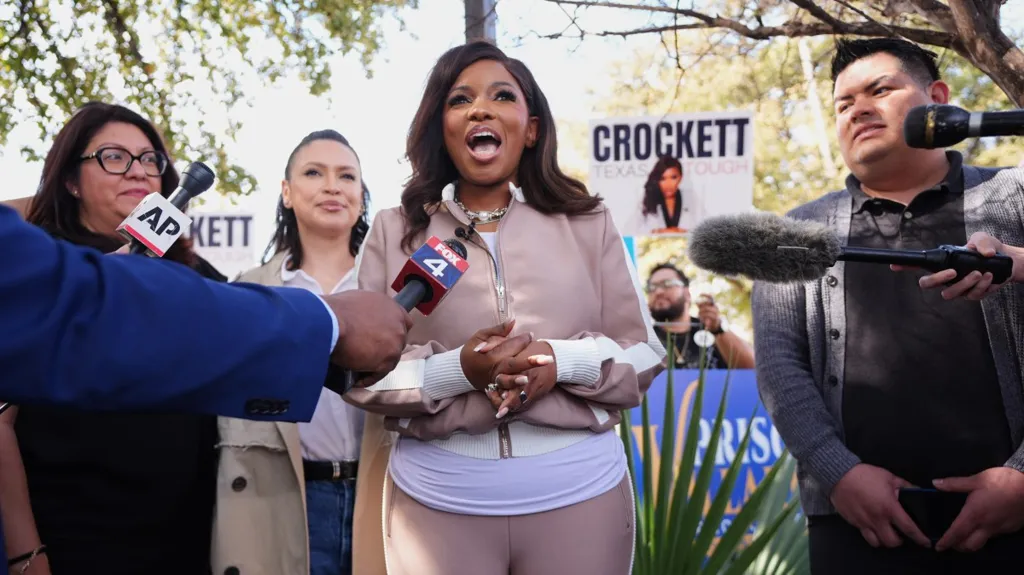
The dispute over the interview has renewed debate about CBS's editorial practices and the Trump administration's political pressures. The incident has also fueled questions about "equal time," including whether Democratic U.S. Representative Jasmine Crockett, another candidate in the race, has appeared on Colbert's show.
Early voting is underway in Texas for primary elections that will determine the Democratic and Republican nominees in the state's U.S. Senate race.
Democrats have not won a statewide Texas race in more than 30 years, so the Lone Star State remains Republicans' to lose -- but the ingredients for an upset are there: near‑even polling, millions cascading into Democratic campaigns and a GOP primary that could leave bruises heading into November.
Crockett has appeared on Colbert's show at least twice, once in 2024, and again in May 2025. In the May episode, she spoke with Colbert about her congressional tenure, including her work on the House Oversight Committee.
The Texas congresswoman announced her Senate candidacy in December, months after her appearance on Colbert's show, and therefore was not a candidate for the race at that time.
The equal time rule originates from Section 18 of the Radio Act of 1927. Three decades later, Congress created exemptions to the matter, including creating the umbrella of "bona fide news interviews." In 2006, the FCC concluded that "the news interview segments of The Tonight Show with Jay Leno qualify for the bona fide news interview exemption under Section 315(a)(2), and that news interviews conducted on that program are exempt from equal opportunities."
The Trump administration, under FCC Chair Brendan Carr, issued recent guidance on the matter, writing in January: "Concerns have been raised that the industry has taken the Media Bureau's 2006 staff-level decision to mean that the interview portion of all arguably similar entertainment programs -- whether late night or daytime -- are exempted from the section 315 equal opportunities requirement under a bona fide news exemption. This is not the case. As noted above, these decisions are fact specific and the exemptions are limited to the program that was the subject of the request."
The statement continued, "Importantly, the FCC has not been presented with any evidence that the interview portion of any late night or daytime television talk show program on air presently would qualify for the bona fide news exemption."
Colbert said the CBS lawyers released the Tuesday statement without informing him.
The dispute comes at a delicate time for the network and Colbert. Last July, CBS announced that it would end The Late Show in May, retiring the entire franchise after more than a decade.
Stephen Colbert said on Monday: "I was told, in some uncertain terms, that not only could I not have him on, I could not mention me not having him on."
U.S. Representative Jasmine Crockett of Texas told reporters on Tuesday: "We did receive information suggesting that the federal government did not shut down the segment. ... It is our understanding that Colbert -- either Mr. Colbert or CBS decided they just didn't want to air it, and this was because of a fear that the FCC may say something to them, and that there may have been advice to just have me on. And then they could clear the issue. It was my understanding that someone somewhere decided -- 'We just don't want to do that, so instead we're just going to do it this way.'"
Texas Representative James Talarico's campaign wrote on X: "It should be troubling to all of us that the most powerful politicians and corporate executives are working together to sell out the First Amendment. They are selling out our freedom of speech in order to protect their own power and their own wealth. An attack on any one of our First Amendment rights is an attack on all of our First Amendment rights -- whether you're a Democrat or a Republican, a progressive or a conservative, this should be concerning to all of us."
Anna Gomez, the sole Democrat on the Federal Communications Commission, said in a Tuesday statement: "This is yet another troubling example of corporate capitulation in the face of this administration's broader campaign to censor and control speech. The FCC has no lawful authority to pressure broadcasters for political purposes or to create a climate that chills free expression. CBS is fully protected under the First Amendment to determine what interviews it airs, which makes its decision to yield to political pressure all the more disappointing."
The candidate who wins a majority of the vote in the March 3 primary will claim the party nomination. If no one receives more than 50 percent, the top two finishers will advance to a runoff election.