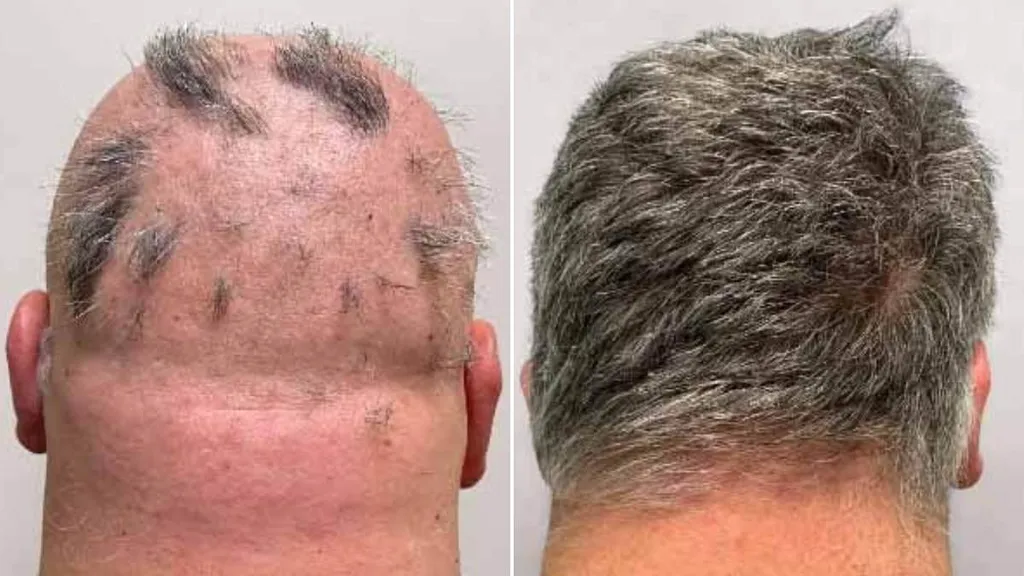
Thousands of adults suffering from severe hair loss could soon regrow their hair thanks to a new pill approved for use in Britain.
The UK's medicines watchdog, the MHRA, has given the green light to deuruxolitinib, also known as Leqselvi, a treatment for people with severe alopecia areata.
In clinical trials, nearly a third of patients taking the drug regrew at least 80 per cent of their scalp hair within six months - offering fresh hope to thousands living with the distressing condition.
Alopecia areata affects around one in 500 people and occurs when the body's immune system mistakenly attacks hair follicles. This triggers hair to fall out in patches on the scalp, face and other parts of the body.
The condition can strike at any age but is most common in early adulthood and can be triggered by factors such as stress, viral infections or underlying health problems.
In recent years celebrities including Jada Pinkett Smith, Louis Theroux and Matt Lucas have spoken publicly about living with alopecia, helping raise awareness of the condition.
The newly approved treatment works by reducing inflammation and stopping the immune system from damaging hair follicles, allowing hair to grow back.
In clinical trials involving more than 1,200 adults with alopecia areata, all participants had lost at least half of their scalp hair for more than six months.
Patients were given either the drug twice a day or a placebo pill for 24 weeks.
After six months, those taking the drug showed significantly more hair regrowth than those taking the dummy pill.
Around three in ten patients regrew at least 80 per cent of their scalp hair, while almost one in four regained 90 per cent or more during the trial.
The treatment is available only with a prescription, with patients advised to take an 8mg dose twice daily.
Julian Beach, executive director for healthcare quality and access at the MHRA, said the approval provides another option for people living with the condition.
He said: 'This approval gives adults with alopecia areata another potential treatment option to help manage their condition.'
'As with any medicine, the MHRA will keep the safety and effectiveness of deuruxolitinib under close review.'
However, the drug won't be available through the NHS until the National Institute for Health and Care Excellence (NICE) has assessed whether it provides good value for money.
Until then, it can be accessed with a private prescription.
For many sufferers, alopecia can have a significant emotional impact, with some experiencing loss of confidence and anxiety about their appearance.
The new treatment could therefore offer hope to thousands of people living with the condition.
However, the drug is not without potential side effects. The most commonly reported problems were headaches and acne, affecting more than one in ten patients in the trials.
Approximately two per cent, or one in fifty, of the population will experience alopecia at some point in their lifetime, with around 1 in every 4,000 developing alopecia areata each year.
It can start at any age but is most common early adulthood and can lead to lack of hair on parts of the body, including eyelashes and eyebrows, nasal hair, and hair on the skin.
This leaves people more vulnerable to infections and reduces a person's ability to regulate body temperature.
Hair follicles are not destroyed but become dormant, making regrowth possible, with the extent and duration of hair loss able to vary widely from person to person.
It's not the only drug that has been licensed to treat the condition in recent years.
In 2024, Ritlecitinib, a once-daily, 50mg oral capsule, was approved for treating severe alopecia areata in adolescents and adults.
It is part of a family of drugs known as janus kinase (JAK) inhibitors, which work by dampening the immune system.
Taken as a daily pill, it works by reducing the enzymes that cause inflammation and subsequent hair loss at the follicle.
Made by Pfizer, it has been recommended by NICE as an option for treating severe alopecia areata in people aged 12 and over.
WHAT IS ALOPECIA AREATA?
Alopecia areata - a patchy version of alopecia - is an autoimmune condition in which the immune system causes hair to fall out.
It can affect hair on any part of the body and can happen to anyone at any age - it can be triggered by stress.
The hair usually begins to fall out in patches and leave bald, smooth areas.
It is not possible for doctors to predict how much hair someone will lose, nor can they tell if the hair will ever grow back.
Alopecia areata cannot be cured but if only patches of hair are lost there is an approximately 60 to 80 per cent chance of it growing back within a year.
However, there is no guarantee it will grow back and doctors cannot predict whether it will, nor how much hair will be lost.
If hair does grow back, it can take months or years and usually starts as sparse white hairs in the bald patches which can eventually thicken and regain their colour.
Regrowth is less likely if all someone's hair falls out.