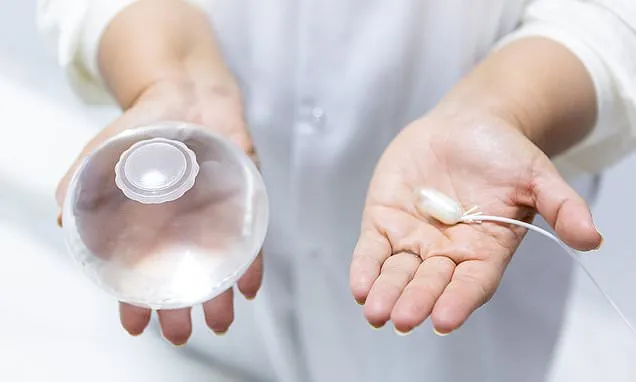
People who have been fitted with gastric balloons have been warned of 'serious complications' connected to the weight-loss procedure.
The treatment, which has surged in popularity in recent years, involves swallowing a capsule that is filled with water when in the stomach, helping patients feel fuller and reducing appetite.
In most cases, the balloon is designed to deflate and pass naturally through the body after around four months, without requiring medical assistance.
However, there have been several reports of the device becoming lodged inside patients as it exits, leading to potentially dangerous consequences and hospitalisation.
Now, a notice by Allurion - which provides gastric balloons to the NHS - has warned physicians of the 'known but serious complications' that can arise from the procedure.
A letter shared by the Medicines and Healthcare products Regulatory Agency (MHRA) reads: 'In rare instances the Allurion Gastric Balloon does not transit through the bowel as designed, leading to patient complications such as gastric outlet obstruction, small bowel obstruction, and gastric perforation.
'These are known but serious complications of intragastric balloons.'
Allurion says it has received eight reports of gastric perforation and small bowel obstruction in Britain, along with a further 13 cases of gastric outlet obstruction linked to the gastric balloon procedure between 2018 and 2024.
A warning has been issued over 'complications' that can arise from gastric balloon procedures.
It adds: 'In all UK reported cases, additional intervention, such as surgery or endoscopic procedure was required. Following intervention, all patients recovered and no further complications were reported.'
Gastric outlet obstruction occurs when the passage between the stomach and the small intestine becomes blocked, leading to symptoms such as nausea, vomiting and abdominal pain.
Small bowel obstruction can cause similar symptoms and is classified by experts as a medical emergency.
Meanwhile, gastric perforation occurs when a hole forms in the gastrointestinal tract - the system of organs that allows food and liquids to pass through the body and supports digestion.
This can result in blood loss, internal bleeding, inflammation of the abdominal lining, and permanent damage. In severe cases, it can also lead to sepsis, which is potentially fatal.
As detailed in official NHS figures released last week, 129 gastric balloon procedures were carried out in 2024-25, though many more are believed to have been done privately.
Somerset NHS Foundation Trust is currently the only NHS trust offering gastric balloons, having announced in January 2024 that it was leading the way with the 'innovative procedure'.
However, there are scores of private clinics specialising in gastric balloon services in the UK - charging around £5,000 - and hundreds of Britons fly abroad to have the surgery for less.
In Turkey, for instance, an Allurion balloon can cost as little as £1,900 including flights and accommodation.
Patients who have experienced complications have previously warned others about the risks.
Alaina Shaw, from Uxbridge, west London, paid £4,500 for the balloon when she was 33-years-old and weighed 21 stone.
The former accountant said it felt like she was going to die after it became stuck inside her when it moved from her stomach to her intestine.
She said: 'I didn't lose any weight and thought I was going to die. I want to warn people about the dangers of getting this done.'
Ms Shaw underwent the procedure in November 2023 at a private hospital after being told she could lose up to 20 per cent of her body weight within four months.
'It was supposed to be a temporary thing - you swallow this pill, they fill it with saline solution, and they check on an X-ray if it's there,' she said.
The pain began straight after the balloon was inserted.
She said: 'I was in a lot of pain - it felt like a foreign body, but I was assured that I would start feeling better.'
As weeks went by, Ms Shaw found that she was losing no weight, and her appetite was exactly the same.
Within a few days she was rushed to hospital while 'literally wailing in pain'.
Doctors performed keyhole surgery and discovered the balloon had failed to dissolve and had instead become lodged in her intestines.
'I ended up in hospital questioning if I was going to survive. I was scared I was going to die.'
After a two week stint in ICU she was discharged from hospital but decided to spealk out to highlight the dangers of the procedure.
According to the NHS, the procedure is generally considered safe. However, as a relatively new treatment, its long-term effects are not yet fully understood.
Describing the programme as a 'world first' in 2024, Somerset NHS Foundation Trust said it was offering the procedure to help patients 'get fit enough for weight loss surgery'.
NHS slimming ops surge: Is YOUR area top of the fat-loss surgery league?
They said: 'We're the first NHS trust in the country and the first non-private sector organisation in the world to introduce this innovative procedure. The exciting partnership builds on our status as a centre for excellence in bariatric surgery, an accolade it has held for the last 15 years.'
'The procedure takes about 15 minutes in total, with the non-invasive approach meaning patients can be in and out of hospital within an hour, rather than needing a long appointment, additional surgery or overnight stay.'
'Before the procedure begins, patients are given a tablet and patch behind their ear to settle their stomach.'
'Then they swallow the balloon capsule, which inflates and remains in their stomach for about four months, after which it self-empties and passes out naturally.'
The trust said it was offering the procedure to patients whose BMIs are between 50 and 60. A BMI of more than 30 is classified as obese by the NHS.
It added: 'These are patients with... severe, complicated obesity, meaning they have conditions related to their weight which can be made better by weight loss, such as type 2 diabetes, sleep apnoea, joint problems, gastro-esophageal reflux, liver disease which all lead to poor quality of life.'