The leader of an Iranian plot to assassinate Donald Trump was killed in recent strikes, the US defence secretary has claimed.
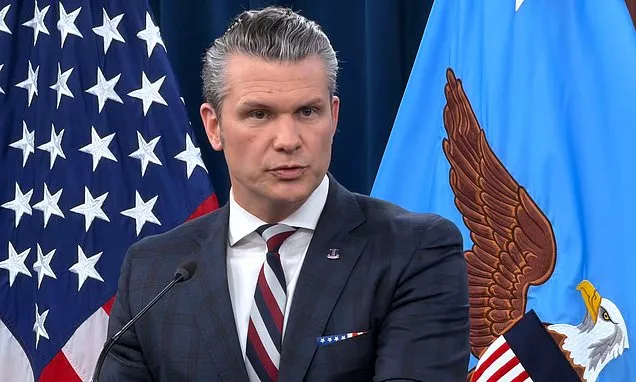
Speaking to reporters today, Pete Hegseth said: 'Iran tried to kill President Trump. And President Trump got the last laugh.'
He did not name the individual killed, saying only that the operation took place on Tuesday.
It is the latest in a series of muddled messages from the White House about why it launched an attack on Iran over the weekend.
During the 2024 presidential race, Mr Trump's campaign was warned by national security officials that Iran was targeting him and had multiple kill teams inside the US.
The aim, the department of justice said, was to take revenge for the killing of Iranian general Qasem Soleimani during Mr Trump's first term in 2020.
The President announced the start of the US and Israel's attack on Iran in a video on social media on Saturday.
'It's a very simple message,' he said. 'They will never have a nuclear weapon.
'Our objective is to defend the American people by eliminating imminent threats from the Iranian regime, a vicious group of very hard, terrible people.'
His claim that Iran is on the verge of developing a nuclear weapon came after he had previously said these capabilities were 'obliterated' by separate US strikes last summer. He also spoke of Iran expanding its long-range ballistic missile programme.
Defence secretary Pete Hegseth said: 'Iran tried to kill President Trump. And President Trump got the last laugh'
The President did not seek Congress's approval for the attack, which has angered lawmakers - particularly Democrats.
And they have only become more incensed by the mixed messaging that has followed.
On Sunday, Mr Trump told CNBC that the attacks were 'ahead of schedule' without saying what that schedule was. He told the Daily Mail the war could grind on for more than four weeks.
And today Mr Hegseth dragged the timeline out even further, saying: 'You can say four weeks, but it could be six, it could be eight, it could be three.'
Senator Mark Warner, the top Democrat on the senate intelligence committee, told reporters the goals for the operation had changed 'four or five times' in the first three days of the conflict.
He said: 'It was about the Iranian nuclear capacity; a few days later it was about taking out the ballistic missiles; it was then about regime change... and now we hear it's about sinking the Iranian fleet.
'I'm not sure which of those goals, if met, means that we're at an endgame.'
Another Democrat, senator Richard Blumenthal, was more blunt: 'The President's been all over the place,' he said.
On Monday, Mr Trump said the US needed to strike Iran 'now', without offering a detailed explanation as to why. 'This was our last best chance,' he said.
By the afternoon, Secretary of State Marco Rubio offered a new rationale: the US attacked Iran 'pre-emptively' after learning Israel was going to strike. This, he said, would have led to retaliation against US forces.
But he was forced to backtrack after the President contradicted him. 'If anything, I might have forced Israel's hand,' Mr Trump said.
Mr Rubio later commented: 'The bottom line is this. We - the President - determined we were not going to get hit first.'
The message about what happens next remains equally unclear. On Saturday, Mr Trump urged Iranians to 'take back your government'.
This was widely interpreted as a call to overthrow the regime led for decades by Supreme Leader Ayatollah Ali Khamenei, who was killed in the initial strikes.
Again, the President was at odds here with his defence secretary. On Sunday Mr Hegseth rejected the idea that the US had attacked Iran with the goal of toppling the government.
'This is not a so-called regime change war, but the regime sure did change,' he said.
The President is yet to indicate who he believes should succeed Khamenei. 'The attack was so successful it knocked out most of the candidates,' he told ABC News on Sunday. 'It's not going to be anybody we were thinking of because they are all dead.'
Sir Keir Starmer suggested this afternoon that Mr Trump had no 'viable' plan for his war in Iran, and that the President may have broken international law.
Addressing the Commons, he said: 'I was not prepared on Saturday for the UK to join a war unless I was satisfied there was a lawful basis and a viable, thought through plan. That remains my position.'