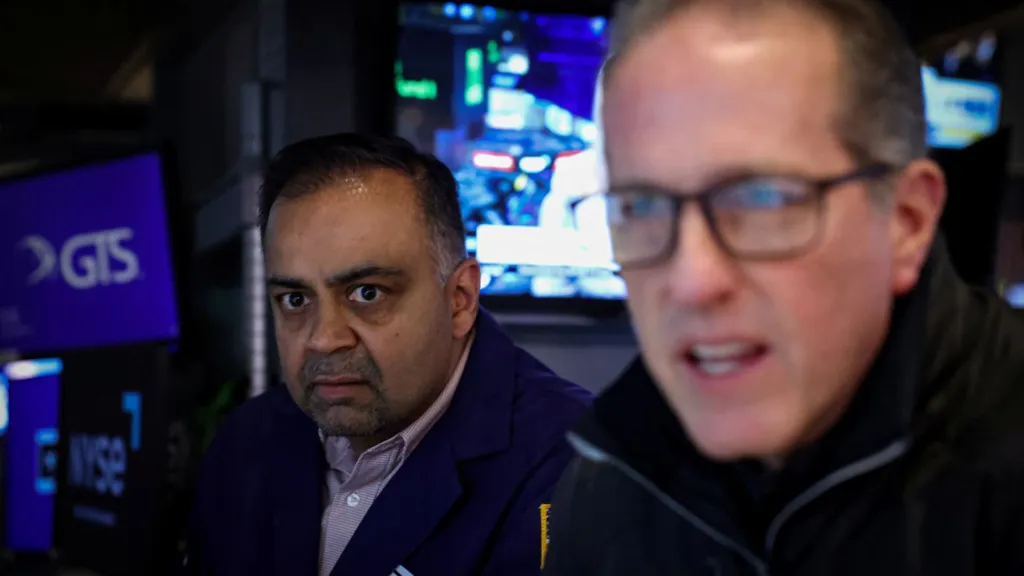
There was no shortage of setbacks for stocks last week. Surprising economic data, another batch of earnings, and an intensifying conflict in the Middle East all combined to move the market, mostly downward. The S & P 500 closed out Friday with a weekly loss of 2% as the broad-market index flipped between the positive and negative sessions over the past five trading days. The Nasdaq fell 1.2% over the same period, while the Dow Jones Industrial Average dropped 3%. It was the second consecutive week of losses for all three major averages. The S & P 500 has had only one winning week in the past five as concerns about AI disruption continue to weigh on the market. The tech-heavy Nasdaq has notched only one positive week out of the past eight. We'll see whether the market can break its losing streak on Monday. Until then, here are three forces that drove Wall Street and the Club's portfolio over the past five sessions.
An escalating war in the Middle East
This was the first week of trading since the U.S. and Israel first started bombing Iran last Saturday, which immediately put pressure on stocks around the globe. The conflict spread across the Middle East, with no clear end to the fighting in sight. President Donald Trump on Friday shared that there wouldn't be an end without an "unconditional surrender" from Iran. Qatar's energy minister, Saad al-Kaabi, also said that the Gulf energy producers may need to shut down production in the coming days due to the situation in the Middle East, which could "bring down the economies of the world," he told The Financial Times in an interview published early Friday. "If this war continues for a few weeks, GDP growth around the world will be impacted," the energy minister said.
In response, oil prices spiked amid worries about disruptions to global fuel supplies. West Texas Intermediate crude oil topped $90 per barrel Friday and closed the week out with a 35% advance. That's its biggest gain since oil futures trading began back in 1983. In an analysis earlier this week, we explained why oil is the key to the stock market during the Iran war. Jim Cramer's advice during this time: Be selective. Don't panic and sell everything. "Those who flee in moments like this can never get back in," he said during Tuesday's Morning Meeting.
This is the exact approach we took when the Club started a position in Cardinal Health , a health-care stock, on Monday. The U.S. medical supplies maker generates almost all of its revenue domestically, so its shares should be less sensitive to developments in the Middle East. The Club has bought Cardinal two more times since then to scale the position. The Club also sold some BlackRock on Monday and then exited the financial name entirely a day later as private credit fears became too much of a distraction . We tapped our then-15% cash pile to scoop up shares of Alphabet on weakness. The Google parent has a clearer path to monetizing its AI spending than its Big Tech peers.
Mixed economic signs
Investors were also dealt a crosscurrent of economic data. Positive news midweek helped stabilize the market. It didn't last long. The S & P 500 jumped nearly 0.8% Wednesday after payroll processor ADP reported that private payrolls in February increased by 63,000, surpassing the Dow Jones consensus estimate of 48,000. That same session, the market got another upbeat economic sign. The Institute for Supply Management's Services PMI last month marked its highest level since July 2022. Prices paid by service organizations for materials and services also declined to 63 from 66.6. This can be seen as an encouraging sign for inflation.
However, a surprisingly weak February jobs report on Friday pushed stocks lower. Nonfarm payrolls last month fell by 92,000, compared to Dow Jones estimates of a 50,000 monthly gain. The unemployment rate ticked up to 4.4% from 4.3% in the prior month as well, according to the Bureau of Labor Statistics on Friday. Jim warned that the weak payroll report showed that AI job losses are here. Overall, the mixed data creates a murky picture of the U.S. economy as the Federal Reserve prepares for its next interest rate decision later in March. The market is pricing in roughly a 96% chance that the central bank will leave the benchmark rate unchanged, according to the CME FedWatch tool.
Earnings impact
Broadcom delivered an earnings and revenue beat for the first quarter on Wednesday evening. Management also issued better-than-expected guidance, painting an increasingly positive picture for the company's custom chip business. Shares of Broadcom surged on the release, ending last week with a 3.4% gain.
The print dinged optics maker Corning . Shares fell almost 7% on Thursday after well-respected Broadcom CEO Hock Tan made remarks that the market saw as a dent in optimism about the growing use of fiber-optic technology in the data center. This was a negative for Corning because many on Wall Street have bet that the company's fiber-related offerings would ultimately replace copper in data centers, making Corning a crucial cog in the AI buildout. Tan's remarks aren't changing our views: the stock's decline was an overreaction.
CrowdStrike , another Club name, beat earnings and revenue expectations on Tuesday. CEO George Kurtz assuaged concerns that artificial intelligence would eat his company's share of the cybersecurity market, describing the technology as "increasingly a massive growth opportunity." Kurtz added that the firm's "technology, team, and ecosystem are well positioned to continue winning." Shares of CrowdStrike surged more than 15% week to date.
In addition, Costco Wholesale released earnings on Thursday and impressed us with another quarter of strong sales momentum. We raised our price target to $1,100 from $1,050 per share, but maintained a hold-equivalent 2 rating on shares.
(See here for a full list of the stocks in Jim Cramer's Charitable Trust.) As a subscriber to the CNBC Investing Club with Jim Cramer, you will receive a trade alert before Jim makes a trade. Jim waits 45 minutes after sending a trade alert before buying or selling a stock in his charitable trust's portfolio. If Jim has talked about a stock on CNBC TV, he waits 72 hours after issuing the trade alert before executing the trade.
THE ABOVE INVESTING CLUB INFORMATION IS SUBJECT TO OUR TERMS AND CONDITIONS AND PRIVACY POLICY , TOGETHER WITH OUR DISCLAIMER . NO FIDUCIARY OBLIGATION OR DUTY EXISTS , OR IS CREATED , BY VIRTUE OF YOUR RECEIPT OF ANY INFORMATION PROVIDED IN CONNECTION WITH THE INVESTING CLUB . NO SPECIFIC OUTCOME OR PROFIT IS GUARANTEED .