My friend had barely sat down before blurting out her terrible news. 'The dentist says I've got this awful thing called pockets,' she told me. 'Several are 6mm deep.'
'Oh dear,' I nodded sympathetically. 'Yes, anything over 4mm is pretty worrying. By the time you get to 8mm or 9mm, your teeth can be really mobile, you might even lose several.'
You may be feeling rather baffled at this point. Yet this dreaded condition affects 54 per cent of the adult population to some degree, even if you don't realise it. And, unfortunately, it hits middle-aged women particularly hard.
As a child of the 1970s - the land that dentistry forgot - I've sadly become an expert and have spent the past 13 years battling periodontal pockets, a symptom of periodontitis, aka gum disease.
If left untreated, it can lead to severe infection, loss of gum and bone and tooth loss.
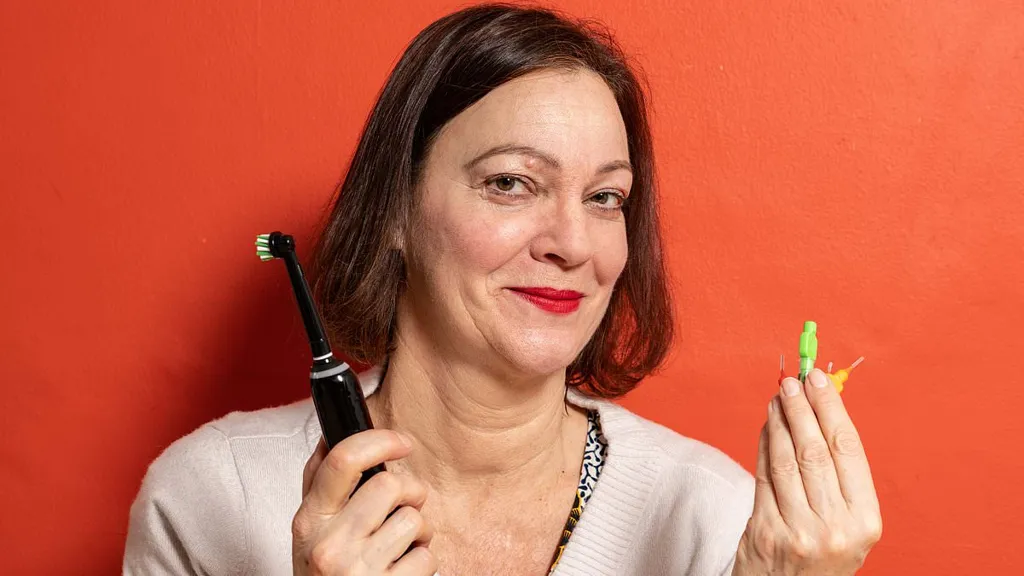
When I open my handbag, a rainbow of interdental brushes falls out. I spend hours brushing and flossing three times a day. My dental kit includes an AI-powered electric toothbrush, water flosser, fluoride and non-fluoride toothpaste.
The good news is I'm proof that dental pockets can be tackled - as long as you dedicate hours to the battle.
Normally, healthy teeth are held in their sockets by gum tissue and bone. But when you have gum disease - a result of poor brushing - tissue breakdown can occur, causing gaps in teeth. These pockets hold bacteria, causing further damage.
My dental kit includes an AI-powered electric toothbrush, water flosser, fluoride and non-fluoride toothpaste
The good news is dental pockets can be tackled - as long as you dedicate hours to the battle
Think of the roots of your teeth as a picket fence. For years, the fence looks fine, but as time goes on and the ground around it is undermined, it becomes looser. And once you hit midlife, the fence really needs some attention if you don't want the whole thing to collapse.
'The same brushing routine that worked perfectly at 35 may not be sufficient at 52,' says periodontist Dr Sonia Joshi, of Harley Street Dental and Implant Clinic. 'Your immune system's response to plaque has changed.'
Early signs include gum redness, sensitivity and bleeding but periodontitis can also spark a harmful chronic inflammatory response, putting you at serious risk of developing dementia, diabetes and cardiovascular diseases.
I first realised my own dental fence was failing aged 50.
Growing up, my generation had shabby dental treatment with no fluoride in drinking water nor electric toothbrushes. I had slightly gappy yellow teeth but whitening and veneers on the front as an adult gave me confidence.
Then one day, I was warned that I had the dreaded pockets. These are measured in millimetres by a dentist's periodontal probe, and you can buy interdental brushes - which cost as little as £3.50 a pack - of a corresponding size.
Anything over 4mm means gum disease is present; 5mm to 7mm is moderate periodontitis; 7mm to 12mm is advanced periodontitis. The higher the number, the worse you're doing - and some of mine were 9mm.
While poor dental hygiene is the main culprit, periodontal disease can be hereditary. Unfortunately for women, gum issues get worse during periods of high hormone activity.
We can sort it out ourselves for free if we brush properly - it's about elbow grease
Dr Joshi explains that as oestrogen and progesterone levels fall, you may see a change in how gum tissues respond to bacteria and how the immune system manages inflammation.
What's more, 40 per cent of post-menopausal women experience dry mouth - and when saliva production falls, teeth become vulnerable.
The good news is small pockets of 4mm or 5mm may be reduced in size with professional cleaning. I have it done every two months now. It costs between £150 and £180 a time but it's worth every penny.
If pockets are really deep, scaling and root planing can help, while surgery allows for even deeper planing.
Of course, this all adds up. If you need implants, it can cost around £7,000 to manage advanced gum disease. Yet we can sort it out ourselves for free if we brush properly. It's about elbow grease.
Now 63, I'm proof there can be progress. My worst 9.3mm pocket shrank to 5.22mm over two years of treatment at my dental practice London Smiling. And there are other simple tweaks you can make to protect your teeth.
Dr Joshi recommends sipping water regularly to avoid dry mouth as well as ignoring alcohol-based mouthwashes and chewing sugar-free gum after meals to stimulate saliva production. Give high-sugar and ultra-processed diets a miss. Mediterranean-style eating patterns, built around vegetables and oily fish, appear to support gum stability.
You may feel embarrassed about being seen as some kind of tooth-brushing bore, but I'd recommend you carry those interdental brushes with you everywhere, and a steady supply of toothpicks. That way, as I do, you can be ready to strike if you feel a fragment of peanut become lodged in an incisor.
It may not always look dignified, but trust me, it's better than the alternative...