Forbes contributors publish independent expert analyses and insights.
Wartski, the prestigious London-based jeweler and antique dealer, is a long-standing exhibitor at TEFAF Maastricht. Its booth at the fair's 2026 edition sparkles with historic jewels and art objects from around the world, including rare works by Carl Fabergé, a specialty of the family-owned firm.
But tucked away in an unassuming corner behind a black curtain is an object of particular historical significance.
Kieran McCarthy, Wartski's co-director, said the concealed work is "the star of the show" -- and for good reason.
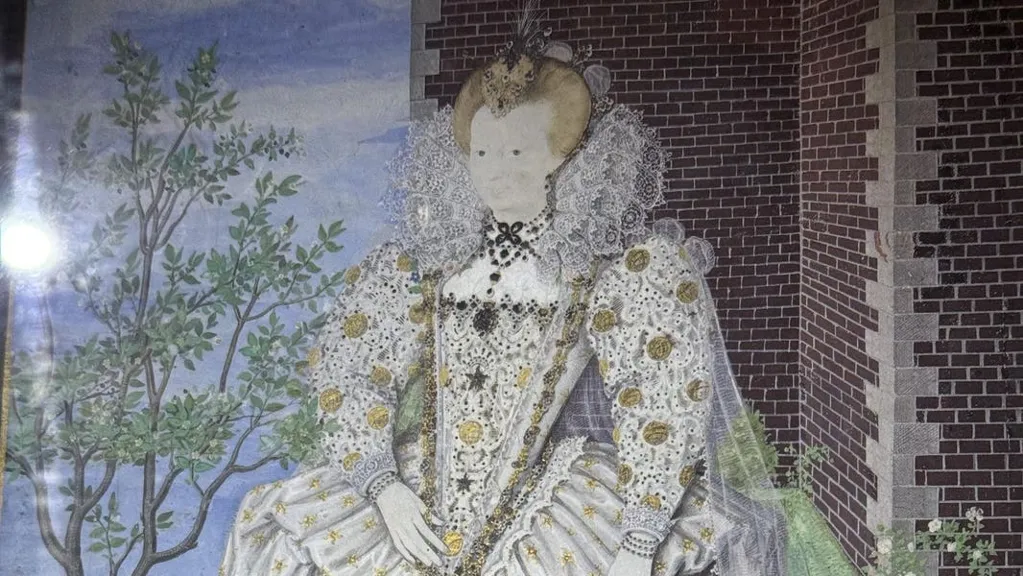
It is a 1592 miniature portrait of Lady Arbella Stuart, cousin of Queen Elizabeth I and once considered a potential heir to the English throne. Often described as the "lost queen," Arbella's life ended tragically after she defied King James I by marrying her chosen husband, William Seymour. The king placed her under house arrest, and after a failed attempt to flee England, she was imprisoned in the Tower of London, where she died in 1615 at age 39.
The portrait was painted by Nicholas Hilliard (1547-1619), the celebrated English miniaturist. It depicts a 16-year-old Lady Arbella standing on the grounds of Greenwich Palace in an elaborate white-and-gold-colored court dress deliberately styled to resemble portraits of Elizabeth I -- reinforcing her image as a potential future queen. The fringe on the bottom of the dress is actually made of gold.
McCarthy noted that the symbolism in the portrait underscores that narrative.
"In her left hand she holds a wreath, which is a sign of virginity," he said. "Beside her on the right is a tree that is both fruiting and flowering, showing her beauty and her ability to continue the dynasty -- a way of the Tudor-Stewart line continuing. But of course, she never made it."
The portrait is not only hidden from general view at TEFAF Maastricht, but was also unannounced by the firm, making it a potential surprise acquisition for the right collector or institution.
However, McCarthy noted that its availability is likely to be limited by the United Kingdom's "Waverley Rules," a set of criteria designed to control the export of culturally important works of art.
"Anyone -- a private person or museum -- could buy it," McCarthy said. "A private person can buy it and keep it in England. Someone could also buy it and apply to export it, but it would likely be stopped by the British government for being nationally important. Then the government must raise the funds to acquire it."
However, there is precedent for buying and exporting an historical and culturally significant artwork. In 2023, the J. Paul Getty Museum and the National Portrait Gallery jointly acquired the famed portrait of Mai, known in England as "Omai," and now share its display between the two institutions. But McCarthy noted that the process can be complicated, particularly for private collectors.
As a result, whoever ultimately acquires the portrait, it will likely remain in England.
Fabergé Egyptian-Themed Cloak Clasp
Also, on display in the Wartski booth is a recent acquisition: an enamel cloak clasp loosely depicting the Egyptian goddess Isis by Fabergé.
The jewel is set with round garnets encircled by diamond-pavé snakes -- an unusual motif for the famed Russian jeweler.
"Fabergé was a sort of historical thief," McCarthy said. "He was plundering contemporary and past cultures for inspiration but rarely went to ancient Egypt. This is one of the rare instances where he takes those Egyptian forms and reinterprets them in a late-19th- or early-20th-century style, and it's just the most dramatic expression of his work."
The piece was purchased in 1908 at Fabergé's London store for £75.50, which McCarthy described as a "king's ransom" at the time.
It was acquired by Walter W. Winans (1852-1920), the son of an American engineer and entrepreneur who built a fortune constructing one of the era’s largest industrial projects: the Moscow-to-St. Petersburg railway.
Winans, an American born in Russia, also spent considerable time in Scotland hunting and living the life of what McCarthy described as a playboy—perhaps explaining his enthusiasm for collecting Fabergé jewels.
He was also an accomplished marksman, winning a gold medal in shooting at the 1908 Olympic Games and a silver medal at the 1912 Games.
The piece did not remain available for long. Later that day, McCarthy said it was sold.