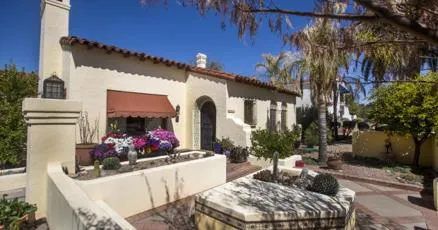
PHOENIX -- A bipartisan group of lawmakers is trying to throw a lifeline to residents of historic neighborhoods in Arizona's large cities and towns, proposing an exemption from a 2024 law mandating that the municipalities allow much higher-density housing in what are now prized old single-family neighborhoods.
Residents belonging to historic neighborhood associations in Phoenix, Tucson and the 14 other cities and towns affected by the zoning preemption law have been pushing for more than a year to protect their areas from developers.
They joined together in a coalition they named Save Historic AZ to seek a remedy for the 2024 law. It forced cities and towns with populations of 75,000 or more to change their local zoning rules to allow construction of duplexes, triplexes, fourplexes and townhomes on all lots zoned for single-family homes within a mile of each city's central business district.
There was no carve out in the law for the dozens of designated historic neighborhoods spread across older areas of Flagstaff, Phoenix, Tucson and the other affected municipalities.
Residents fear developers will buy up older homes in those highly desirable historic districts, tear them down and put in a series of multi-family residences that will forever change the character of their neighborhoods.
Gayle Hartmann, who has lived in her home in the Sam Hughes Historic District just east of the University of Arizona campus in Tucson since 1975, has seen some of the 1930s-era homes in her neighborhood torn down and replaced with expensive "McMansions" in recent years.
"What we are concerned with the middle housing is they would do the same thing -- tear down the perfectly livable, but perhaps not distinguished house and then try to put four smaller units on the property,'' she said. "And I guess you make some money off that, but it would have a devastating impact on a historic neighborhood.''
The proposal by Rep. Matt Gress, R-Phoenix, and co-sponsored by Phoenix Democrats Rep. Aaron Marquez and Sen. Lela Alston, is far from a slam dunk for proponents who are putting on a full-court press to garner support. Scheduled for its first hearing last week , it was pulled from the committee agenda at the very last minute.
Gress, who had given a lengthy telephone interview explaining the merits and structure of his proposal less than an hour before the scheduled hearing, would only say via text message that "we need a few more details ironed out.''
Generally, in the Legislature, holding a bill means it may not have enough support to pass, although Gress said Wednesday that he had the votes to get the bill out of committee and believed they were there to pass the House.
Despite the delay, Gress said the bill, HB 2375, would be on the House Government Committee agenda this coming Wednesday.
Builders, housing advocacy groups and the Free Enterprise Club, a conservative pro-growth, limited government group that lobbies at the Legislature, are opposed to the carve out.
Spencer Kamps, the lobbyist for the Home Builders Association of Central Arizona, is opposed to the new exemption for historic districts. He and his group pushed hard for the 2024 law, arguing cities were limiting needed development and the change would spur construction of smaller and more affordable housing options during a time of historically high home prices.
"We don't believe there's a threat to historic neighborhoods with that (2024) bill. I know the neighborhoods would disagree,'' he told Capitol Media Services.
"But you know, there are existing duplexes and triplexes and all these housing types in these historic neighborhoods. And there's no reason to exempt them from the ability to construct that type of housing product that's sorely needed."
Gress thinks residents of historic districts are right to be wary of builders.
"I've never met a developer who didn't want to make money,'' he said.
"And these are highly desirable parcels of land in highly desirable part of town, especially when you're looking at like the Willo District'' in central Phoenix," he said. "So this is about protecting the historic nature of these communities.''
Even if Gress' new proposal passes the Republican-controlled House and Senate and is signed by Democratic Gov. Katie Hobbs, the protections it will afford to historic neighborhoods aren't automatic.
City Councils in each city or town that had spent much of last year revising their zoning laws to comply with the new law will have to revisit the issue and vote on whether to exempt some or all of their historically-designated neighborhoods from the "middle housing'' provisions.
In Phoenix, Mayor Kate Gallego and several council members are backing the new measure. But support isn't unanimous among the council.
Democratic Councilwoman Anna Hernandez, who was in the state Senate in 2024 and championed the "middle housing'' law, said there are some historic neighborhoods in her southwest Phoenix district whose residents support middle housing.
"I really feel like any carve out or any exception really is defeating the purpose of what we're trying to achieve, which is deliver more housing options for all of our residents,'' Hernandez said.
"So, these carve outs, I think it's just a misguided step,'' she said. "I actually would think that the best way to support our historic neighborhoods is to expand this city-wide, and then look at the preservation process itself to see where we can make improvements.''
While the Phoenix council created a new zoning map allowing middle housing in a mile-wide zone outside the central city as the 2024 law required, other cities went much farther.
Leaders in Tucson and Flagstaff embraced the Legislature's new mandate, with councils in both cities voting in December to allow the duplexes, triplexes, fourplexes and townhomes identified in the 2024 law across all areas of the city zoned for single-family homes.
Tucson Mayor Regina Romero declined to comment on the new proposal to exempt historic districts from the law. She initially supported a smaller version of the middle housing zoning change but eventually voted for the city-wide plan.
Councilman Kevin Dahl, the lone no vote on the council for the vastly expanded plan approved in December, also declined to comment. Meanwhile, Councilwoman Miranda Schubert, a vocal proponent, did not respond to repeated requests for comment.
Hartmann believes the Tucson council is unlikely to vote to exempt historic districts like hers from the new law.
"I don't think they would do that, to be honest with you,'' she said.
"I mean, it's possible, it's possible,'' Hartmann said. "It would certainly be worth a try.''
Gress said local councils should make those decisions.
"That's how zoning should be decided -- it's a local decision," he said. "And in fact, the cities in large part are in agreement with the bill and how it was structured to give flexibility for the cities to go back through and, in conversations with community members, revise their ordinances accordingly to account for historic properties.''
The 16 Arizona cities and towns with populations of 75,000 or more had their hands tied on whether to allow denser housing despite pleas from some residents. The Legislature and Hobbs agreed that local zoning laws needed to be overridden to boost new home construction, forcing municipalities to change their zoning and development rules by Jan. 1, 2026.
If they did not comply, cities and towns could be penalized under a 2016 law that requires the state treasurer to withhold tax revenue from cities that don't comply with state laws.
The middle housing law was one of several passed that year as part of the Legislature's push to spur construction of more affordable housing. In addition to downtown areas, the law required those larger cities and towns to allow higher-density new home construction on at least 20% of any new development of 10 acres or greater anywhere.
Other "preemption'' bills enacted that year included ones limiting time periods for city review of proposals, an "adaptive reuse'' law mandating that cities approve conversion of land occupied by old retail, office and industrial buildings into apartments, and a "casita'' bill allowing homeowners to build at least two small rental units on their single-family home lot. One "accessory dwelling unit'' had to be attached to the main homed and the second detached; homes on larger lots could construct three ADUs.
The Legislature's push to "preempt'' city rules has become more common in recent years.
It has extended to bans on items as diverse as housing, regulating short-term rentals and what kinds of taxes cities and towns can levy to pay for police, fire, libraries, roads and other city responsibilities. Lawmakers barred cities from changing taxes on home or apartment rents in 2023, and last year adopted a ballot referral that will limit cities' ability to charge sales tax on food. Voters will weigh in on that measure in November.
The League of Arizona Cities and Towns, which negotiated a compromise agreement on the 2024 middle housing zoning law, is backing the new exemption measure.
Two mayors who sit on the League's executive committee said they support it in part to help preserve historic parts of the state's municipalities.
But both Robyn Prud'homme-Bauer of Clarkdale and Kevin Budge of Bisbee said they and the League's 91 member cities believe the Legislature needs to stop overriding local control over items such as zoning and taxes. Neither city is affected by the 2024 law, but both champion local decision-making over state mandates.
"Part of it is bringing back a little bit of local control when the legislature dramatically changes laws that you know are preemptive and overreach into local control,'' Prud'homme-Bauer said of her support for Gress' measure. "Also, Clarkdale has a historic district; as oftentimes happens with legislation yes it might be for a certain population threshold and above but eventually it kind of trickles down to all of us.''
Budge echoed those thoughts.
"Anytime they can give us more local control which this does it's a good thing,'' Budge said of the historic district exemption.
But he also embraces the new proposal because he believes historic districts are the heart of many cities and towns. Budge said Bisbee’s historic feel is one reason he moved there 25 years ago then spent seven years rebuilding his 1906 home after years neglect.
"Historic districts are very important especially to towns like ours but also in Phoenix and Tucson,'' Budge said.
"That history is kind of the soul of the city,'' he said. ''We should have ability control those local districts decide what can put into them size-wise look-wise etc., order keep history our town.''