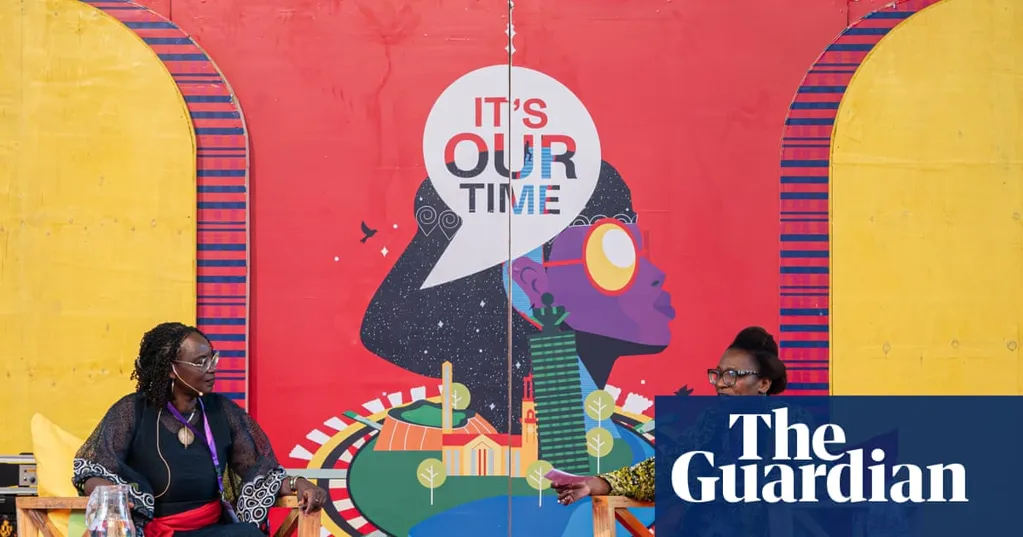
At a festival in Kenya, artists and writers discussed the role arts can play in the continent's growing push for redress over colonial crimes. One afternoon last October, at a hotel in a forest in a Nairobi suburb, a few dozen people sat quietly in a room watching the 2020 documentary If Objects Could Speak, which explores restitution by tracing the roots of a Kenyan artefact stored in a German museum.
The people were at the two-day Wakati Wetu ("Our Time" in Swahili) festival, aimed at sparking global conversations on reparative justice.
Last month, the African Union adopted a motion put forward by Ghana to label slavery and colonialism as crimes against humanity. This month, the motion will be tabled at the United Nations, with demands made for redress.
The motion, which was first announced at the UN general assembly last September, is the latest move in a strategic push by the African continent to seek reparative justice.
The AU declared 2025 the year of reparations, with a theme of Justice for Africans and People of African Descent Through Reparations, marking the first time the 55-country bloc had put the issue at the centre of its agenda. By July, the AU had extended the timeline by declaring 2026 to 2036 the Decade of Reparations to mobilise support for justice.
For decades, African countries suffered numerous injustices by the west, including colonialism and the forced enslavement of its people. Efforts to redress these injustices and their lasting economic, social and psychological impacts have been few and far between, and largely confined to academia and nonprofit spaces. Progress has also been hindered by a lack of resources and coordinated strategy among activists, and reluctance by European governments to reopen old wounds.
With the Nairobi event, organisers hoped to get reparative justice movements on the continent to utilise arts and culture in their campaign. Liliane Umubyeyi, the co-founder and executive director of African Futures Lab, one of the organisers, said the arts could help make reparation discussions more accessible.
"The arts ... can speak to each one of us as Africans," she said. "Art is a universal way to experience things. You don't have to have a degree to learn music."
In her keynote speech, the Kenyan author Yvonne Adhiambo Owuor said the festival offered "the hope of a sharp - often painful, yet healing - recognition" of the "cosmological scale" of the suffering that Africans had endured.
"I cannot overstate the overwhelming meaning of a space like this - a sliver of light in the long tunnel of the self we have silenced, buried and suffocated for so long," she said. "Trauma aches for redemption. History longs to heal."
She warned against what she termed "an unseemly rush" into restitution, and called for a historical audit of crimes and wrongs first to give the reparative movement a firm ideological foundation. "Reparation is first an act of moral autopsy and then moral exorcism," she said.
Analysts such as Adekeye Adebajo, the author of The Black Atlantic's Triple Burden: Slavery, Colonialism and Reparations, say the AU's strategic pivot on reparations might be the result of challenges posed by the current geopolitical climate.
"The AU knows this is a long-term struggle," said Adebajo, who is also professor of international relations at the University of Pretoria, South Africa. "The current geopolitical environment is one in which [Donald] Trump is basically, in my view, a racist president."
He was echoing the thoughts of the Cape Verdean president, José Maria Neves.
"We see extremist, xenophobic, anti-immigration groups growing in former colonising powers," Neves told the news site Brasil Já in June 2024. "There are no political conditions to publicly discuss these questions at the moment."
The AU's moves to address historical injustices go as far back as the early 1990s at the first Pan-African Conference on Reparations, which produced the Abuja Proclamation of 1993 that demanded reparations for colonialism and the transatlantic slave trade.
However, despite multiple summits and policy-level institutional progress, former colonial powers are yet to make amends. In 2024, France signalled a willingness to discuss reparations over the 1899 massacre of an estimated 400 people in Niger but refused to acknowledge responsibility.
In one of the rare cases, Germany in 2011 recognised for the first time the colonial-era genocide of more than 70,000 Herero and Nama peoples in Namibia and promised €1.1bn in development aid to the southern African country. But Germany explicitly refused to call it "reparations", fearing that it could set a legal precedent for such claims.
Descendants of those killed in the genocide said they were excluded from negotiations and the amount was insufficient to cover the loss of life, land and livestock. They are also demanding the return of their ancestral land.
The conversation has evolved into a "Black Atlantic" movement: in September 2025, a month before Wakati Wetu, a landmark head-of-state summit took place in Addis Ababa. While Caribbean leaders such as the Barbados prime minister, Mia Mottley, attended there was a low turnout of African heads of state, sparking concerns about priorities.
However, Ghana has emerged at the forefront of the AU's latest efforts. The country, which marked 2019 as the Year of Return to commemorate the 400th anniversary of the first enslaved Africans arriving in Virginia, has positioned the diaspora as its "13th ethnic group".
Ghana's president John Mahama, the AU's champion for reparations, has established an Office for Global Reparations to institutionalise the fight and called for a united continental push.
"The transatlantic slave trade ... is not merely a dark chapter of history; it is the greatest crime against humanity ever perpetrated," Mahama said during his speech at the UN general assembly last September.
At Wakati Wetu festival, 300 attenders participated in a mix of activities focusing on reparative justice, including documentary screenings, a standup comedy performance and panel discussions on topics such as reparation through litigation and the role of storytelling in seeking redress over past violations.
Keith Vries, a Namibian writer, activist and playwright whose work addresses and seeks to increase awareness of the Herero and Nama genocide, said art can play a huge role in delivering reparative justice.
"People must never, ever, underestimate the power of the arts and the culture in the delivery of justice," said Vries, a descendant of the Nama genocide victims. "Sometimes it bypasses race, age, culture, ideology and goes straight to the heart.
"I have an undying belief that artists could do a lot more for our people than politicians ever could."
Njahîra Wangarî, a Kenyan scholar and educator, noted that the reparation debate is more talked about in the Caribbean than in African countries and said the conversation was "ripe" but ought to be sensitive. "And it's not about revenge," she added. "It's about truth-telling and unravelling what's there."
There are plans for similar art and culture themed festivals to be held in different parts of the continent every two years, organisers said.
Kyeretwie Osei, the head of programmes at the Economic, Social and Cultural Council, the AU's civil society policy organ, said arts and culture would make more people care about the reparation debate and their involvement would help build momentum for the movement.
"You need pressure points from both sides," he said. "We need everyone on board so people in creative sector are really important in constructing necessary narrative and building story that will resonate among people. We deal with policy but really you need to combine policy with storytelling."