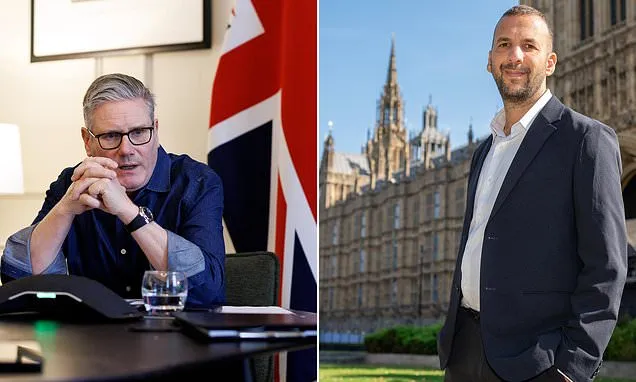
The day after Labour's crushing defeat in the Gorton and Denton by-election last week, I was speaking to a Labour MP.
'We need to forget Farage', he told me. 'Our enemy is Zack Polanski. We've got to make the voters see what the country would be like if he was their Prime Minister.'
After three days of the widest and most intense conflict in the Middle East for almost a century, Britain no longer needs to conjure up that nightmarish vision.
We have witnessed first-hand exactly what it is like to have a globally immature pacifist, who is in hock to radical Left-wing and Islamist elements, occupying No.10 Downing Street. Keir Starmer has seen to that.
When the conflict began, Starmer and Polanski were in perfect political alignment. The Green leader wanted Britain to have no part in the US and Israeli attacks on Iran, and demanded the US be refused the right to fly active missions from UK bases. Sir Keir swiftly agreed.
Though, to Polanski's credit, he at least had the courage to set out his stance unequivocally.
'I'm worried the UK is going to be pulled into another illegal war,' he said. 'Air strikes for regime change has never led to an example where a country is better off afterwards.'
Starmer, in contrast, pointedly refused to spell out whether he supported air strikes or not.
Instead, he hurriedly despatched his hapless Defence Secretary John Healey, and equally hapless Foreign Secretary Yvette Cooper, to bluster and obfuscate their way through the unfolding mayhem on his behalf.
Then, on Sunday, the situation changed. Throughout the day it became clear that the Iranian response was placing British civilians, bases and personnel at risk. So Starmer began to wobble.
The US would be allowed to use British bases to help destroy Iranian missiles and drones, he announced. But - and here he made sure to stay in lockstep with Polanski - he insisted 'we are not joining these strikes'.
But the Iranians were in no mood to reward Britain's Conscientious-Objector-In-Chief.
Late on Sunday, an Iranian attack drone slammed into the runway of RAF Akrotiri on the island of Cyprus, causing damage but no casualties. The war Starmer had sought to avoid had been brought directly to British sovereign territory. A military response seemed inevitable.
Except again Starmer vacillated. Britain would still not be joining air strikes, No.10 announced. Instead, the Prime Minister was focusing on 'de-escalation'. A briefing that was immediately greeted by the news that Iran and its proxies had launched two more attack drones at RAF Akrotiri.
From the beginning, Sir Keir's stance on military action has been built around three pillars. Each of which has rapidly crumbled. The first was legality. It would not be right to use British bases in pursuit of potentially unlawful war aims in the Middle East, he said, pointing to the dark shadow thrown by Iraq.
But, as he finally admitted, by Sunday the legal impediments to striking Iran had been removed, given British interests were being directly targeted by the regime.
In the Iraq war, we were infamously lied to when we were told that Cyprus was 45 minutes from attack. In the current conflict this threat has become all too real.
The second pillar was diplomacy. The Prime Minister was trying to maintain a fiendishly complex series of global alliances, the most important being our 'special relationship' with the United States, we were told at the weekend.
He could not stand up and give complete clarity on Britain's position, his allies insisted, because Donald Trump's fragile ego had to be massaged.
And how did that work out? With Trump taking to British media to specifically condemn what he saw as Starmer’s perfidy. His initial veto of the use of British bases had 'never happened to our country before', Trump chided.
He was swiftly followed by US 'War Secretary' Pete Hegseth, who publicly mocked Britain and other European nations for 'wringing their hands, and clutching their pearls, and hemming and hawing about the use of force'.
Starmer's final pillar of support was built around what he claimed was his moral imperative to protect British national interest.
The Prime Minister has cynically calculated overtly aligning himself with Trump and Netanyahu is a vote loser. And that after Gorton and Denton, he has precious few votes left to lose
Why Green Party leader Zack Polanski is the biggest creep in British politics, writes SARAH VINE
He would not join 'regime change from the skies', he vowed to the House of Commons, insisting that his decision to hold back our Armed Forces was 'the best way to protect British interests and British lives'.
However, as we have seen, it is not regime change that is stalking the skies, but deadly Iranian munitions. And they have begun to rain down on British servicemen and women and civilians across the Middle East and the Mediterranean.
Yet the Prime Minister continues to sit with his tail tucked meekly between his legs while he asks US and Israeli pilots to risk their lives on our behalf.
Not to mention Greek sailors who have been forced to sail to the defence of Cyprus while the Royal Navy sits impotently in Portsmouth harbour watching the crisis unfold from afar.
Let's be honest. Keir Starmer's priority isn't the UK's national interest but his own political interest. Because that is what his response to the Iran strikes is primarily about. Not safeguarding British nationals from a marauding terror state but safeguarding his MPs from Zack Polanski and his marauding Green Party.
A legitimate case could be constructed at the start of the conflict for British neutrality.
The legality of the initial strikes is contested. The war aims are unclear. The economic aftershocks could be seismic.
But once British sovereign territory came under direct attack, those concerns became moot. We did not seek war, but war had come to us. And at that moment the Prime Minister's responsibility was to defend his citizens with a singular, uncompromising, unshakeable purpose.
Instead, he has been cowed. Cowed, primarily, by the voters who turned their backs on his party in last week's by-election.
That is why Starmer has bent over backwards to mirror the stance of Zack Polanski, a man whose friend and deputy leader Mothin Ali attended a pro-Iranian rally on Saturday in which the crowd chanted 'Death to the USA!' and 'Death to Israel!'
The Prime Minister has cynically calculated that overtly aligning himself with Trump and Netanyahu is a vote loser. And that after Gorton and Denton, he has precious few votes left to lose.
This is the reason that his attempts to ingratiate himself with Donald Trump have so suddenly been ditched.
It is why his entreaties to the nation to embrace a 'war footing' last year have been rapidly discarded in favour of a policy of appeasement towards one of the globe's most vile and most despotic regimes.
It is why his strategy of recasting his party as strong on national defence has hastily been jettisoned for one in which Britain's Armed Forces are specifically prohibited from taking the fight across the border of their enemies.
A few days ago, one of Keir Starmer’s more sycophantic cheerleaders took to print to claim: ‘Keir would not have been able to live with himself if he had been forced out of office early without showing the country who he really is and what he’s about.’
Now we can all see. Want to know what Zack Polanski would be like as Prime Minister? Keir Starmer is doing a remarkably good impression of him.