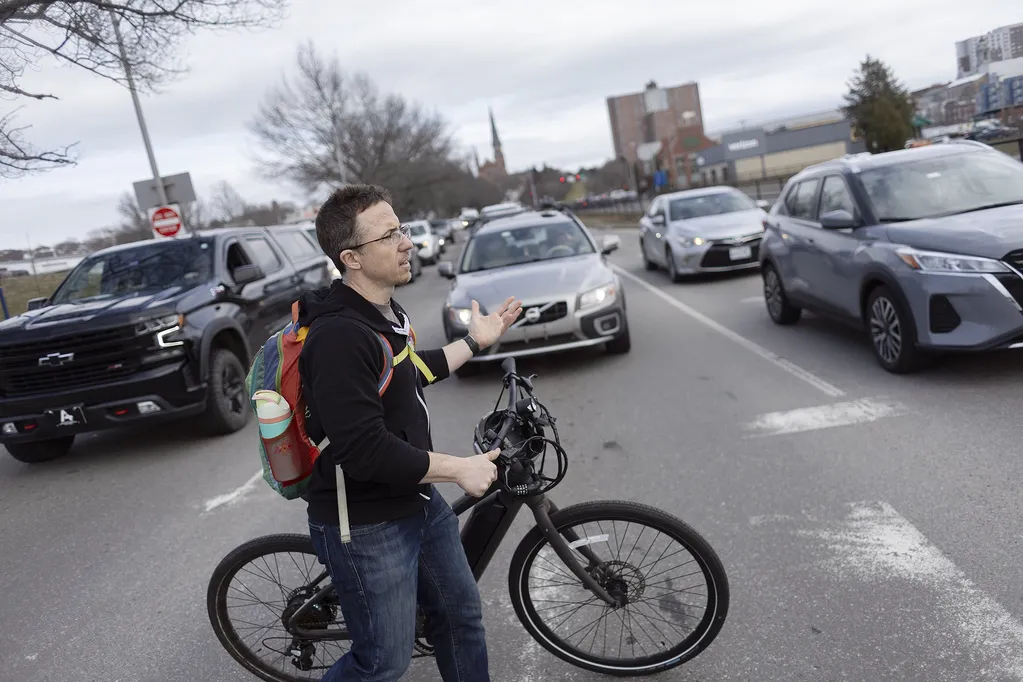
PORTLAND -- After waiting nearly three minutes for the walk signal, Myles Smith made it to the island that separates Franklin Street.
Standing beside his bicycle, his heavy sigh was muffled by the sound of rushing cars as he waited to cross along Marginal Way.
"Portland's purgatory," he said.
Smith, chair of the city's bicycle and pedestrian advisory committee, waited another 3 minutes to make it to the other side. He said many others aren't as patient. Some hit the button to cross, but after waiting for awhile, see an opening and go for it. Most make it through unscathed, but they do so at great risk.
Within about a half hour on an April weekday rush hour, Smith witnessed more than a dozen vehicles either run a red light or speed up to make it.
A state crash report and witnesses say that's exactly what happened when 75-year-old Diane Bell was hit and killed in November while running with a group on the Bayside trail, which forces users through the Franklin and Marginal way intersection.
The driver, coming off the Interstate 295 ramp, went through a yellow light and hit Bell in the crosswalk. Witnesses told her daughter, Jaime Bell Fairfield, that her mother was thrown several feet in the air and landed near the median. She later died at the hospital.
Smith said based on the intersection's design, it was inevitable that someone would be killed.
Bell was one of five people killed in motor vehicle crashes on Portland streets last year, four of them pedestrians, and her death added to increased pressure on city officials to treat the issue as an emergency.
There are clear signs that Portland is prioritizing the problem -- it was the only goal that all nine councilors agreed on to start the year -- but advocates say results are not coming fast enough and bold action is needed.
The advisory committee noted that Portland is more dangerous for pedestrians than Boston and New York City based on per capita deaths. The number of pedestrians seriously injured or killed in Portland in 2025 was a five-year high.
"I think the city wants to take this stuff seriously, but we need a lot of urgency if we're going to make some changes," Smith said.
Portland adopted a Vision Zero resolution and action plan last year, committing the city to a goal of eliminating pedestrian deaths.
Greg Jordan, an assistant city manager in Portland who oversees the effort, said the trends from 2025 were alarming, and that it's driving the city to make meaningful improvements. The list of projects in the queue, including upgrades at the Franklin Street and Marginal Way intersection, is growing.
"But those do take some time," he said. "We often say it took 100 years to build the transportation system we have, which we all know heavily prioritizes automobile traffic, but I think slowly, as a nation, we're trying to build our way to a safer system for pedestrians and transit users."
While Portland police said Bell "crossed against the signal," her family and fellow runners said she did everything right.
She was wearing reflective clothing and LED lights, and, after completing her run, had doubled back to help other members of the group cross the intersection.
"You can be the safest person on the planet," her daughter said, "but if the intersection isn't suitable for pedestrians, then these things are going to happen."
The initial crash report states the driver, who was working for a ridesharing company, was not distracted and there were no other contributing factors. Fairfield, however, said passengers who were in the car later reached out and told her they thought the driver was going too fast, trying to make the light.
The Portland Press Herald attempted to obtain an updated police report on the crash through a Freedom of Access Act request, but was denied by the city.
The advisory committee has taken issue with how police reports are often quick to place blame on the pedestrian and give deference to the driver. Almost exactly one year earlier, Cynthia Karst was killed at the intersection of Franklin and Congress streets. The report said Karst, 69, crossed against the signal.
Police are now preparing new guidelines on how to write initial crash reports.
Following Bell's death, the committee sent a letter to officials describing the Franklin Arterial and Marginal Way intersection as one of the most dangerous in the city and state, and "totally inappropriate for an urban context."
Smith believes it's particularly dangerous because the series of traffic lights in close proximity encourage higher speeds. When drivers come off 295 and see a green light, they see an opportunity to make it through both signals.
It also features slip lanes, curved corners that allow right turns on red, and other "design failures" that are prevalent across multiple high-crash areas in the city, he said.
"The intersection is so complicated people aren't paying attention to pedestrians," he said. "I think a big piece of the problem is the choices we make about moving cars through as quickly as possible, and that puts people at risk."
Fairfield said that since a vigil for her mother was held in November outside City Hall, it's been difficult to gauge how much the issue is being prioritized. No city councilors have reached out to her, and visually, Franklin Arterial remains the same as it did when Bell and Karst were killed on the busy thoroughfare.
That could soon change. The City Council recently gave the OK for the Maine Department of Transportation to make a series of upgrades at the Franklin Street and Marginal Way intersection, including "blankout" signage that activates when pedestrians are at crosswalks, which MDOT says "generally improves driver yield rates."
The work, scheduled for next year, will occur as the city continues to pursue a complete redesign of Franklin Arterial, which has been years in the making.
Jordan, the assistant city manager, said a final conceptual plan will be made public this spring. The redesign, he said, will "completely change the character and transportation system along Franklin Street."
Councilor Anna Bullett, who serves on the sustainability and transportation committee, has said she'd likethe public to be able to see a difference on Portland streets within three years.
Smith and the advisory committee, however, see the need for more urgent fixes while residents wait for the big projects down the road. Some could be temporary, he said, like installing flex posts, orbollards used for traffic calming.
The city's Vision Zero action plan includes long-term projects like a comprehensive transportation plan and citywide lighting study, as well as$1.1 million next year for more immediate bicycle-pedestrian improvements. Officials just have to decide how to spend it.
Jordan, a former directorof Portland Metro, said creatinga new transportation plan --the city's firstin 30 years -- will be"vitally important in advancingthe kinds of projects that are going to make the most difference."
When asked what he believes are the biggest factors in gaining momentum on traffic safety, Jordansaid,"funding and attention."
"It's one of those issues you need to attack from all angles. That's the tough part," he said.
The city's capital plan for next year includes $5.62 million for bicycle and pedestrian transportation projects, an increase from $3.85 million this year.
Next year's budget also proposes nearly doubling "multimodal" transportation spending, to just under $3 million.
Andrew Zarro, executive directorof the Bicycle Coalition of Maine, has seenthe issue from both sides. He was alsoa city councilor from 2021-2023 before losing a bid for mayor.
He said Maine's infrastructure -- and Portland as its largest city --is failing its people. And while he credits Portland officials for prioritizing road safety, he said now "we've got to put a pep in our step here."
The bicycle coalition, along with Greater Portland Council of Governments, is working with various neighborhood organizations on traffic calming demonstrations, ranging from road painting to speed humps. While the projects are temporary, data produced can show how certain designs reduce speed or crashes.
They have fielded some 50 requests for projects, which Zarro said is indicative of how much people are thinking about the issue.
But, for each projectthe city requires permitting and for the neighborhood groups to acquire insurance, the latter of which Zarro said is a "big ask."
"There's a long road and we need to continue to take it seriously," Zarro said,"and those immediate projects don't need to be caught up in bureaucracy."
Portland also continues to pursue state and federal funding to address other "high-injury networks," like Forest Avenue,Brighton Avenueand Libbytown.
Staff are also going after more federal funding for a Libbytown redesign after losing previously awarded grant funds.The project would convert Congress Streetand Park Avenuewest of St.John Streetto two-way trafficand installa roundaboutatthe intersectionof Congress Streetand Park Avenue.
There are several other projects in the pipeline along Forest Avenue, including at Morrill's and Woodford's corners, which feature notoriously dangerous intersections.
A series of new crosswalks were installed across the city last year along Riverside Street where a pedestrian was killed near the Homeless Services Center.
Ben Culver,a cyclist who commutes most days from East Bayside to Rock Row in Westbrook,said he avoids Brighton Avenue and Forest Avenue as much as possible.Instead,he mostly uses the Portland Trails system to cut through the city.
Culver,43,speculated that designing roads for everybody ultimately leads to one conclusion:“cars always win.”
"The safest solution is to have separate, prioritized infrastructure for pedestrians and bicycles that aren't roads," he said.
Going forward,the bicycle and pedestrian advisory committee has urged officials to pursue several changes this year,many in direct response to last year's pedestrian deaths.
They'd like the city to create a crash response protocol that could implement low-cost safety fixes and more permanent solutions for unsafe street designs,and to clearly designate who at City Hall is accountable for Vision Zero results.
Other recommendations are a bit more ambitious like a "20 is plenty" effort to lower speed limits to 20 mph on all city-controlled streets.
Last year,Portland police increased traffic stops by 25% and issued 110% more citations compared to 2024.The city also plans to conduct a policy analysis on the introduction of controversial red light cameras as an enforcement tool,but will have to pitch the idea to the Legislature since state law currently prohibits them.
At "Portland's purgatory," Smith said speed is the biggest factor in determining whether a pedestrian survives. While he talked,a woman paced the median with a cardboard sign asking for help. A man on a bike weaved through the traffic holding onto a second bike.
With a 35 mph speed limit,many cars there are going 40-45. At 40 mph,it takes about 120 feet to come to a complete stop,inclusive of reaction time,according to U.S. Department of Transportation.
He has a long list of ideas for how to increase safety,but each of them reduces car speeds which often goes against MDOT's goal of moving cars efficiently through a busy area. One is pinching the corners of the intersection,s o that when vehicles turn,they have to slow down and turn 90 degrees.
The committee has also called for automatic walk cycles at all signalized intersections.On Franklin,a pedestrian has to push the walk button in order to cross—which Smith calls a “beg button.”
At one point,a mother and her three children approached the intersection,heading west toward Trader Joe’s.The mother took her crying toddler out of a stroller;put him on her shoulder;prepared to cross.Smith offered to carry the stroller once the walk signal lit.
When he got back on the median,he said it was like being a castaway.
He could stand there forever,and it would never let him get off the island.