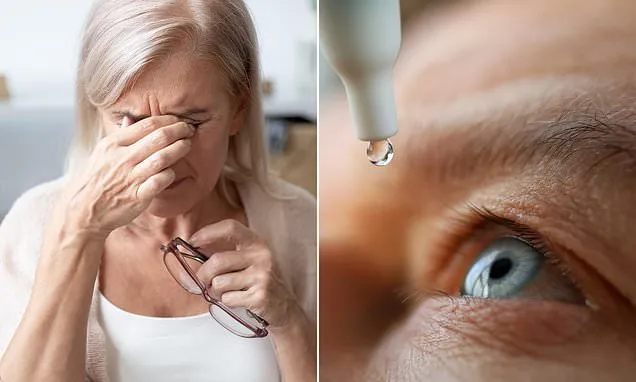
Julie* was on holiday on the Gold Coast when the spots in front of her eyes first began to appear.
'I remember thinking it might be an effect of the sun because I had been spending a lot of time at the beach,' the 60-year-old told the Daily Mail.
But when the spots, dark in colour and appearing to 'float' across her eyes, got worse, Julie grew worried.
'I wear reading glasses so I know what blurry vision looks like, but this was something else,' she added.
Julie found it hard to focus on words and, in addition to her 'regular' floaters, she had some that resembled spiderwebs.
'I remember going to my doctor and she said I needed to go to the emergency room because I was 60 and she couldn't rule out a stroke,' she said.
'I was very worried at this point. If it wasn't a stroke, or even if it was, I was scared I was going blind.'
Julie and her husband, Brian*, rushed to the emergency room for tests.
'I was very worried at this point. If it wasn't a stroke, or even if it was, I was scared I was going blind,' 60-year-old Julie* told the Daily Mail (stock image posed by model)
After eye tests ruled out glaucoma, cataracts and age-related macular degeneration, Julie was desperate for answers. She was later prescribed HRT for stress, and soon found that her eye 'floaters' disappeared (stock image)
'They ruled out a stroke quite quickly, which was a relief, but everyone [on the medical team] was curious about my eyes,' Julie said.
After further eye tests ruled out glaucoma, cataracts and age-related macular degeneration, Julie was at a loss.
'I went back to see my doctor and I was talking about how stressed I was about it all when she asked me if I was on hormone replacement therapy. I said no because when I went through menopause, I was told HRT was dangerous.'
After a 2002 study reported that synthetic estrogen and progesterone use could lead to an increased risk of heart disease, stroke, blood clots and even cancer, many women and their doctors opted against using HRT to manage menopause symptoms.
But advances in women's health since then have proven that those risks are low in comparison to the benefits of hormone therapy. Furthermore, the hormone that was used in that particular study is no longer prescribed.
In November this year, America's drug watchdog, the FDA, removed the black box warning on hormone replacement therapy.
'My doctor said it might be worth trying because HRT can help with management of stress. I was taking it for a week or so, maybe a bit longer, when I noticed the floaters had disappeared,' Julie said.
Thrilled at this unexpected development, Julie began to wonder if a lack of estrogen had impacted her vision in the first place.
How you can get rid of painful dry eyes WITHOUT drugs or surgery - and the everyday habit to blame
'Maybe it was stress or the sun really did some damage, but all I can say is that after I started taking it, the floaters pretty much disappeared,' she said.
Dr Rick Liu, an associate professor at the University of Melbourne who leads the Genetic Engineering Research Unit at the Centre for Eye Research Australia (CERA), says it's possible.
'There is growing research evidence indicating that hormones such as estrogen have neuroprotective effects by modulating oxidative stress and supporting retinal cell survival,' he explains.
In other words, hormones like oestrogen may help keep the cells in your eyes healthy and protect them from damage.
'These mechanisms have been implicated in retinal diseases, including age-related macular degeneration and glaucoma. So it's not surprising that estrogen can influence visual function,' Dr Liu adds.
It sounds far-fetched, but estrogen has been known to improve not just hot flushes and brain fog, but almost every function in the body, including bones, heart and even eyesight.
Dry eyes and lack of tears have been documented, but a recent study found a lack of estrogen can even increase the ageing of the optic nerve.
Dr Liu says the interplay of estrogen and eyesight needs further study, but reiterates the connection is still there: 'Estrogen has well-established effects on the vasculature [which causes hot flushes and night sweats] which may further contribute to its impact on ocular and visual health.'
Still, others are not convinced.
Professor Susan Davis, a clinical researcher who specialises in the role of sex hormones in women at Monash University Women's Health Research Program, remains cynical.
'I would be very cautious linking any of the visual symptoms Julie describes to "lack of estrogen",' she says. 'To my knowledge, floaters in the eye don't just disappear.'
But for Julie, the results speak for themselves. 'Maybe it is the placebo effect, but I don't see how. My doctor is happy and so am I.'