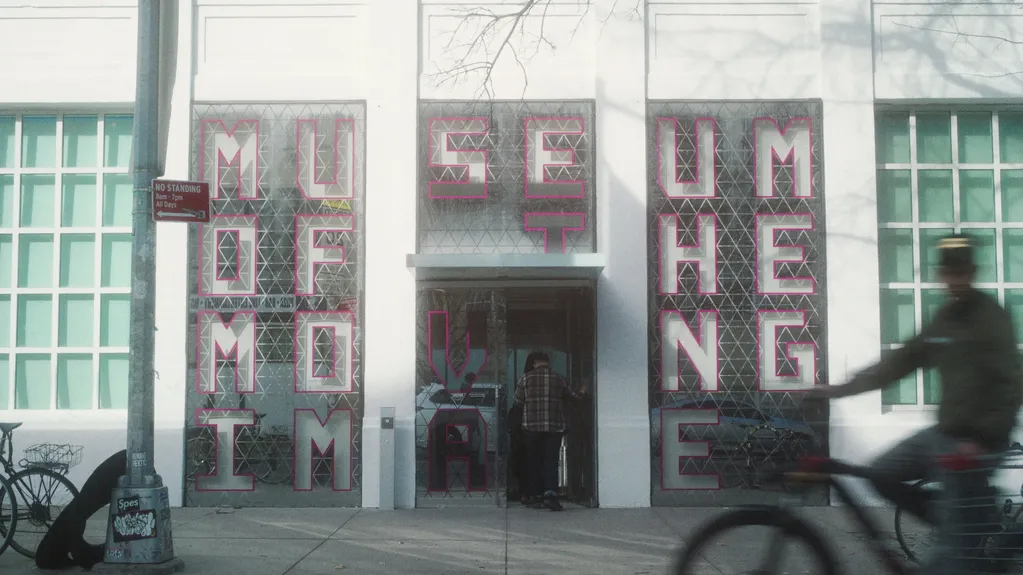
One recent Saturday, nearly 2,000 people turned up at the Museum of the Moving Image in Queens to experience the transformational wonders of a picture on a screen.
They were not just there for movies, though rapt cinephiles packed the theater -- on one of the first glorious days of spring -- for a 35-millimeter print of "In Praise of Love," a brooding Jean-Luc Godard film. Nor were they merely spellbound by TV, although they flocked to hear Dean Taucher, the production designer of "The Sopranos," who was giving a talk.
Visitors also took in vintage camera gear and wore virtual reality headsets; adorned their own Muppets as they marveled at the career of Jim Henson; and gawked and grimaced through a new exhibition, "Overexposed: Art, Technology and the Body," which explores the relationship between medical imaging, like X-rays, and cinema. (Both technologies, it turns out, made their public debut on the same day: Dec. 28, 1895.)
Regulars at MoMI -- and there are more and more of them these days, according to the museum -- could experience all of this in one visit, and plenty of it for free. "You can just show up, and there will be something going on," promised Aziz Isham, the museum's executive director.
The museum, on a low-key block in the Astoria neighborhood, is a success story at a moment when many cultural institutions are struggling to attract audiences and retain funding. A jewel box of a space -- at less than 100,000 square feet, it's one-seventh the size of the Museum of Modern Art -- MoMI has more than doubled its visitors in the last two years, to over 300,000, and increased membership by nearly 50 percent since 2024, according to museum leaders.
When it hosted its first Oscar-viewing party last month, Mayor Zohran Mamdani, an avowed MoMI fan, texted that he wanted to stop by, Isham said. (He couldn't, but has hosted notable events there.)
A booster in the mayor's office may be good luck. But the museum's upward trajectory, after being battered by the pandemic and the Hollywood strikes, which affected its donor base, is a result of a campaign to reposition it as a community hub.
That kind of pivot is playing out "at museums of all types and sizes across the country," said Marilyn Jackson, president and chief executive of the American Alliance of Museums. Its survey of museum directors last year found a "troubling reversal" of some post-pandemic gains, with both museum-going and money backsliding. Still, she said, institutions "that lean into being community anchors are building stronger, more sustainable relationships that go beyond driving one-time visits."
- Rocky, Reconsidered: The sculpture is at the center of a show by the Philadelphia Museum of Art that explores the meaning of monuments.
- Route 66 Turns 100: Exhibitions recall the history of the neon corridor that helped define the American road trip.
- A New Museum Comes With a D.J.: The space in Indianapolis, housed in a former dairy barn, aims to upend expectations of what an art museum can be.
- The Fisher Collection in a New Light: A Bay Area family made a deal with SFMOMA that called for exhibitions of the collection's works every 10 years.
- More on Museums: Artists and institutions are adapting to changing times.
The 38-year-old MoMI, in a former 1920s Paramount studio where Marx Brothers movies were once filmed, had long been a destination for fans interested in screen memorabilia. (Most of its 130,000-piece collection is objects, not footage.)
But it had limitations to its reach -- years with no dedicated marketing department, for example. Though most of its visitors come from around the city (and often return), about 40 percent of New Yorkers still haven't heard of it, Isham said.
Its infrastructure was also starting to lag. Across most of its life, the museum did not have much of an endowment, and pandemic-era cuts -- "to the bone," said Ivan Lustig, the co-chairman of its board -- had meant little money for improvements.
Isham, a former film producer who became the museum's director in 2023, speedily set about reframing it. "He's brought a new vitality to the way we look at things," Lustig said, spurring a budget increase from $7.9 million, to over $9 million this year.
Among Isham's earliest orders of business: fixing the museum's air-conditioning -- which allowed for more school groups -- and upgrading the sound system and seating in its movie theater. (He also brought in popcorn.)
And he developed new programming like the Open Worlds series, which began in 2024 with a $50,000 grant from a small family foundation, and turned the lobby into a home for free events on weekends. It was so popular that it recently expanded from summer only to year-round. Pop-ups like an Iftar dinner or a Lunar New Year celebration with puppets, or even a science expo on fermentation, drew fresh audiences.
Open Worlds turned a profit, too; as the museum's cafe—which had been closed for years—reopened and acquired a liquor license and ticket sales ($10 to $20) spiked. "More foot traffic means more, you know, influencers who are posting stuff on Instagram or TikTok," Isham said. "It means more word of mouth; it means more buzz."That spotlight has increased philanthropic funding,Lustig said.
On a sunlit afternoon in March,the bright white lobby cafe was filled with visitors munching concession popcorn and having lunch (some packed from home).In a ground-floor studio,interns set up an interactive production lab,demoing the art of foley mixing:creating sound effects from real-life objects.
Jordyn Holt,24,and Roy Gantz,23,friends and actors from the neighborhood,crumpled paper and raked rocks to soundtrack a war movie.Before that moment,"I didn’t know the word ‘foley’,"Gantz said,but they were all in,adding their own groans to an explosion scene.
Upstairs,parents showed toddlers around a room full of tube TVs with old-fashioned dials ("can you imagine?") and grown-ups grinned with nostalgia as they posed in front of E.T. An animatronic of Linda Blair's possessed head from "The Exorcist" still spooked.
The sizable display on Henson,the Muppets creator and filmmaker who died in 1990,and whose family donated a huge collection of his puppets and props,continues to be a big draw at MoMI.(The Jane Henson Foundation,created by his wife and collaborator,is a major benefactor ,and the Henson creature shop,which collaborates with the museum,is still busily producing felted wonders nearby.)
"This is a bucket-list experience,"said Morgan Pierce,20,a musical theater student from Oklahoma City,as she stood near a wedding-gown-clad Miss Piggy.
The Henson ethos,which married boundary-pushing work with "really goofy stuff about talking frogs,"Isham said,is a good symbol of the museum's curating philosophy:Pop culture and high art coexist here.
The new exhibit on medical imaging and cinema,"Overexposed: Art,Technology and the Body,"was inspired by "Sanctus,"an experimental artwork by Barbara Hammer.It was the one of the first films that the curator Sonia Epstein programmed after she arrived at MoMI a decade ago.For "Sanctus"(1990),Hammer spliced together archival X-rays of people doing everyday things—putting on lipstick,shaking hands—bathed the images in color and set them to music,h highlighting a sense of beauty in a surreal circumstance.
Hammer died in 2019,after a long battle with cancer,Epstien said."She knew about the dangers of radiation,but also its curative powers."
"Overexposed,"which runs through January 2027,reveals the peculiar history of X-rays;in the 1950s shoppers could get them at shoe stores (for the most precise fit,went the gimmick).As a technology,"they were immediately taken as sort of truth-telling devices,or tools of objectivity,"Epstein said,in a way that paralleled the history of film.Multimedia artists like Ana Mendieta and Liz Magic Laser,among the 16 (mostly female) artists in the exhibit,added their own vision.Laser’s dissection of her handbag via a robotic surgical arm is mesmerizing and oddly intimate,even a little funny。
For Alice Zhang,23,a Brooklynite who came for the movie material,“Overexposed”was thought-provoking。“The intertwining themes——technologies of knowing,being able to record reality,”she said,as she sat with a friend discussing it。X-ray vision in a superhero film suddenly took on a new dimension,she said。
A broadening perspective is what drew Memuna Epemolu,24,a devoted MoMI member from Queens。She has seen nearly 100 movies there——sometimes several in one weekend;the museum “has really expanded the type of films I watch,”she said。而 being among a crowd in a screening room mattered。“People gasping all together just gives me goose-bumps,”she said。“Sometimes I’ll leave a theater and feel changed。”
The institution,Isham said,是“非常专注于面对面体验,模拟体验,人们通过材料彼此之间建立联系”
The museum has found great value in discovering new ways to see together. And there's delight too. “Oh my God,” one boy gleefully exclaimed to his sister as he spun a zoetrope—a rudimentary motion picture device. “Look,Kelly!Look!”
Museum of the Moving Image,36-01 35th Avenue,
Astoria,
Queens;
718-777-6800,
movingimage.org.