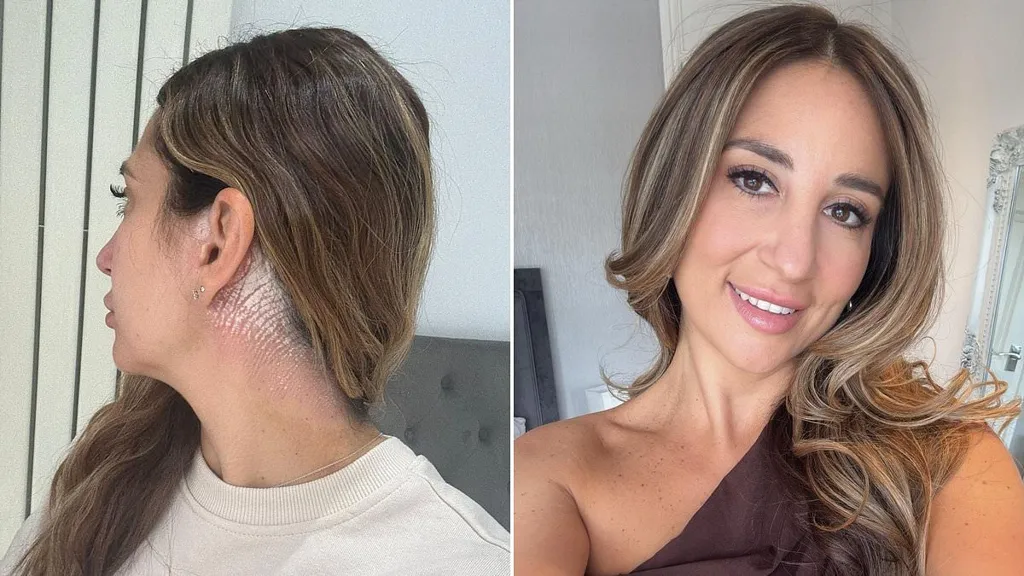
I first noticed something was wrong with my scalp when I was around 10 years old, in year six at school. My head was itching, and I remember looking down and seeing white flakes on my jumper.
I didn't really understand what was happening, but I felt really embarrassed. At the time I was being bullied and, given my mum and dad had separated when I was seven, I'd moved around to a few different schools. I never really felt like I fitted in. I'll always wonder if the psoriasis breakout was triggered by this bullying, or the stress I experienced as a child.
I was diagnosed with scalp psoriasis when I was 11. From that point on, I started trying different treatments. I began with creams and lotions, then medicated shampoos and scalp applications such as Betacap, a steroid treatment designed to reduce inflammation and itching, and Dovobet, a prescription ointment that combines a vitamin D treatment with a steroid to slow the skin's rapid cell growth.
I had so many medications over the years that I used to joke with my mum that I literally had a pharmacy at home.
Living with scalp psoriasis has affected me in ways I couldn't have imagined as a child. It's not just a skin condition: it's constant pain, discomfort and self-consciousness.
I never went to the gym or went swimming because sweating and dampness worsened the condition; I cancelled plans with friends out of embarrassment; I avoided wearing my hair back in case you could see my scalp. I even avoided wearing black clothing because the dry, shredding flakes would show. I was always trying to hide my condition.
I never went to a hairdresser either because I was worried they'd judge my scalp. By the time I left school, I decided to study hairdressing because I wanted to be able to do my own hair and have the choice 'normal' people do. Psoriasis affected me so much that it influenced my career choices.
By my mid-teens, my confidence had really taken a hit. When I was about 15 or 16, people at school had called me 'flaky' or 'snake', and some even moved away from me, asking if they could catch it. Thankfully when I started dating my husband, he was completely understanding and never treated me like I was different.
Over the years I continued trying different treatments as doctors tried to get my psoriasis under control. When I was due to get married, I was prescribed ciclosporin, a powerful immunosuppressant drug that calms the overactive immune response that causes psoriasis.
Psoriasis: What are the facts? Around 1 in 50 people in the UK - roughly 1.3 million - live with psoriasis, making it one of the most common chronic skin conditions. About 50% of people with psoriasis get it on the scalp, where it can cause flaking, itching and visible scaling along the hairline. Most cases are mild: around 4 in 5 people have mild psoriasis, while only a small proportion develop severe disease. Treatments are available on the NHS, ranging from medicated creams and vitamin-D treatments to light therapy (phototherapy) and immune-targeting medicines for more severe cases. Psoriasis is a long-term inflammatory condition linked to the immune system, but it's not contagious and cannot be passed from person to person.
The hope was that it would clear my scalp enough for me to wear my hair up on my wedding day. Unfortunately it didn't work well enough, so I ended up wearing my hair down instead.
I also invested £300 in a UV lamp so I could try phototherapy at home: a treatment that uses ultraviolet light to slow down the overproduction of skin cells. But it didn't work very well for me because most of my psoriasis sits under my hair, so the UV struggles to penetrate it.
Even now, the lifestyle changes I have to make are constant. I still avoid wearing black because flakes show so easily. Every single morning I have to clean my pillow and to hoover, and I do the same every night without fail. Another difficulty came while breastfeeding my children because certain treatments weren't safe to use.
Now I'm 37 and a mum to three little girls aged four, five and seven, and they sometimes ask if they will get psoriasis or if they can catch it. I've been lucky to be able to teach them all about it: that it's common, it's not contagious and it's nothing to be ashamed of.
My treatment has been made trickier after discovering I have psoriatic arthritis, a condition which can develop after suffering from psoriasis for many years. It means the immune system begins attacking the joints, causing frequent pain and inflammation.
Over the years I've also tried several biologic medications (drugs derived from living cells), which are advanced treatments that target specific parts of the immune system responsible for psoriasis. I previously used Cimzia and Skyrizi, which are injectable biologic drugs designed to block inflammatory signals in the body. Unfortunately neither worked for my scalp.
Recently I started a newer biologic injection called Bimzelx, which targets two inflammatory proteins involved in psoriasis. I'm hopeful this treatment will finally help manage my condition better and help prevent the flare-ups psoriasis sufferers like me struggle with multiple times a year.
Even though psoriasis has impacted my life so hugely, I still believe there are positives that can come from it. Sharing my journey on TikTok has helped me, and hopefully others, feel less alone. I now share my life and experiences with more than 56,000 followers on my account @girliemum, focusing on motherhood, psoriasis and supporting others with chronic skin conditions.
There's still lots of work to be done when it comes to raising awareness of the condition. I wish people wouldn't stare or comment in ways that make us feel different because of our skin. I also wish I had known more about psoriasis as a child, which is why I'm planning to write a children's book to educate kids in schools and raise awareness about psoriasis.
In the coming months, I plan on creating my own soothing scalp serum for those suffering with similar issues because all the products I've tried either make my hair greasy or don't work. We shouldn't have to struggle or look worse because of a real medical condition. I'm determined to help others like me find something gentle and effective and use my experience with psoriasis for good.