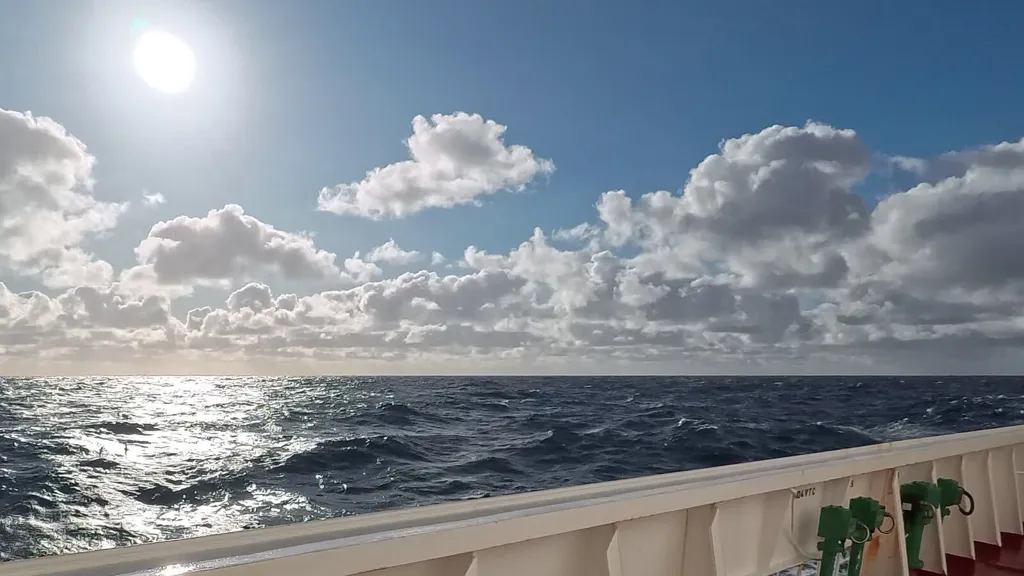
The clocks aboard our icebreaker will be changed several times en route to Antarctica. It's one of many things that make the expedition feel otherworldly.
It was Sunday afternoon, our second day at sea on an expedition to Antarctica, when the announcement came over the public address system: At 9 p.m. that evening, our ship would become a time machine.
We were moving one hour forward and one day back. It was the first of several jumps we'd need to make as our icebreaker passed through time zones during our 10-day transit to the frozen continent.
It's a little head-spinning, but the time zone situation on this voyage breaks down like this: When we set sail from New Zealand on Saturday, we were 13 hours ahead of Coordinated Universal Time, which is the time at 0 degrees longitude, the prime meridian. (Universal Time is the successor to Greenwich Mean Time.)
As we head southeast, we are aiming to end up in Antarctica on Mountain Standard Time, which is seven hours behind Universal Time.
So, basically, we will need to go back in time 20 hours over the next few days. We'll accomplish that by moving ahead four hours and back by 24 hours, though not necessarily in that order, and definitely not all at once.
When moving the clocks forward, though, why not jump ahead by several hours instead of just one? And why carry out the time changes at 9 p.m.? I went up to the wheelhouse to ask the officer on duty, Chaeho Lim.
The ship was trying to stay as close as possible to the time zone of its current location, Mr. Lim told me.
We had already sailed far enough east as to be approaching the international date line. That's the imaginary line running through the Pacific Ocean, roughly along 180 degrees longitude, that somewhat arbitrarily marks where days on Earth begin and end. By traveling east across the date line, we needed to fall back a day.
As for why the ship chose to adjust its clocks in the evening, Mr. Lim said doing it this way minimized the disruption to the crew's daytime work schedule.
It all makes sense, yet there's still something uncanny about it. It's just one more thing that makes this journey feel so otherworldly, so divorced from our normal experience of space and time.
When the announcement was made over the ship's speakers, several of the nearly 40 scientists aboard were meeting in the conference room to discuss their projects. Our ship is headed for Antarctica's fastest-melting glaciers, where the researchers hope to get a better handle on how soon the melt might accelerate and raise sea levels worldwide.
Even the Antarctic veterans in the room couldn't help but chuckle at the time change announcement. Several of them joked about whether a meeting scheduled for tomorrow (that is, Monday) would indeed go ahead tomorrow (now Sunday) or whether it would be pushed to the day after (now Monday). They decided on the latter.
Maybe Albert Einstein was onto something when he mused that the distinction between past, present and future was "only a stubbornly persistent illusion."
At 9 p.m. sharp on Sunday evening -- that is, the first Sunday evening -- Soyeon Sim, the ship's third officer, went around the bridge manually adjusting each piece of equipment to show the new time and date.
The clocks in our cabins and in the hallways are controlled from the bridge, so once Ms. Sim made her adjustments, clock hands around the ship began spinning into their new positions. It was up to us to adjust our phones and watches.
The next morning, we all woke up one day younger, ready to relive Sunday the 28th once more.