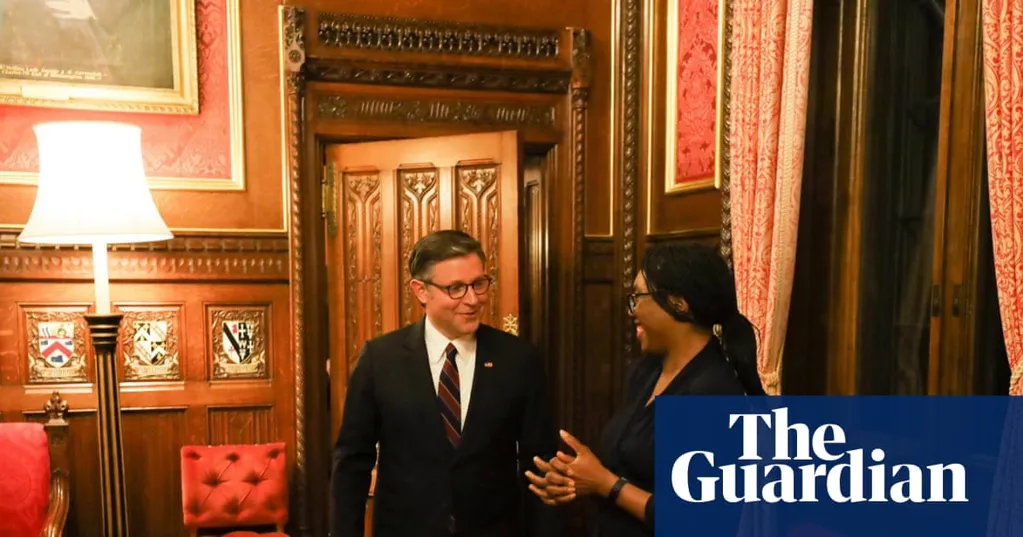
When Kemi Badenoch met Mike Johnson, the Republican speaker of the House of Representatives, on Monday evening, she pressed him on two issues: the Chagos Islands deal and North Sea oil drilling.
Neither participant was part of their respective executive branch, and neither issue was at the centre of the crisis that has engulfed transatlantic politics. But before long, the meeting had some very real political consequences.
The brief encounter set off a chain of events including a call from Johnson to Donald Trump, a social media blast from the US president against the Chagos deal, and on Wednesday, an unprecedented public rebuff to Trump from Keir Starmer.
"President Trump deployed words on Chagos yesterday that were different to his previous words of welcome and support. He deployed those words for the express purpose of putting pressure on me and Britain," the prime minister told the Commons.
"He wants me to yield on my position, and I'm not going to do so ... I will not yield. Britain will not yield on our principles and values about the future of Greenland and the threats of tariffs."
The developments of the past 48 hours initially blindsided Downing Street but have resulted in a new, more combative stance from the prime minister. One which, some believe, could fundamentally alter the dynamic in his relationship with Trump and redraw US-UK relations for the foreseeable future.
"The future of Greenland is for people of Greenland and Kingdom of Denmark alone, and tariffs to pressure allies is completely wrong," a spokesperson for the prime minister said afterwards. "This is a significant moment, a national moment."
The Labour government agreed in October 2024 to hand over sovereignty of Chagos to Mauritius. Under the terms of the deal, the UK will maintain an initial 99-year lease of Diego Garcia, where it runs a military base jointly with the US, at a cost projected officially to be £3.4bn.
The deal was agreed under pressure from Washington, British officials say, adding that their American counterparts were worried about what would happen to the base if Mauritius won a case at the international court of justice over its sovereignty.
Almost immediately, the Reform leader Nigel Farage started warning that the incoming Trump administration did not like the deal, telling the Commons it had been an "enormous mistake" to sign it before the election.
Farage's warnings prompted an intensive lobbying operation from Downing Street.
Officials, led by the then ambassador to the US, Peter Mandelson, hurried to reassure Trump's allies the deal was in US interests. They believed they had been successful when Marco Rubio, the US secretary of state, signed a statement last May backing the deal.
"Following a comprehensive interagency review, the Trump administration determined that this agreement secures the long-term, stable, and effective operation of the joint US-UK military facility at Diego Garcia," Rubio wrote.
One person involved said persuading Rubio to sign that statement took "a lot of talk, explaining and persuading" from the British side.
But while those talks were taking place, British conservatives also kept pressing their case.
Last September, a group of prominent right-wingers - including the Conservative MP Iain Duncan Smith, the Labour peer Kate Hoey and the television historian David Starkey - wrote a letter to Trump arguing China and Russia could use the deal to work against US military interests. One of those who signed was the British-American commentator Nile Gardiner, a key intermediary between those close to Farage and the Trump administration.
For several months the efforts failed, with no sign of the US administration shifting position. But as Trump has renewed his interest in taking over Greenland in recent days, British right-wingers saw an opportunity to press their case again.
On Monday night, according to Tory sources, Badenoch told Johnson that even though the US had welcomed the deal, it was actually weakening British and American interests.
The message was repeated to the speaker on GB News by Farage himself, who said: "I don't know why America has not been more forthright in saying this is a bad idea." That evening, Johnson was later to tell MPs, he spoke to Trump, where British officials believe he raised the Chagos issue.
Hours later, the president's bombshell dropped on his Truth Social social media platform. "The UK giving away extremely important land is an act of GREAT STUPIDITY, and is another in a very long line of National Security reasons why Greenland has to be acquired," he wrote.
Some Labour figures believe the government's position has not been helped by the fact there is no permanent ambassador in Washington to make the counter argument. Christian Turner, Mandelson's replacement, will not begin until the beginning of February.
Starmer argued on Wednesday that Trump's real purpose was to put pressure on him to acquiesce to the president's plan to buy Greenland, rather than to unravel the Chagos deal itself. His allies point out the fact that they were mentioned in the same sentence, and insist they will continue to pilot the legislation ratifying it through parliament.
While the president's post about Chagos might have prompted Starmer's unusually outspoken criticism of the president, the prime minister's allies say he had been toying with taking a tougher stance since the weekend when Trump began threatening Denmark’s allies with additional tariffs.
One ally said the prime minister regarded the threat of tariffs as "completely unacceptable" and made him rethink his previously cautious approach to criticising the president in public.
Allies also say he feels particularly aggrieved that Trump has criticised the UK despite its military assistance when the US recently seized a Russian oil tanker in the Atlantic.
Starmer was also motivated by domestic political concerns however, hoping to depict Badenoch as supine before the Trump administration, and Ed Davey, the Liberal Democrat leader, as only interested in gesture politics.
"Using the use of tariffs to pressure allies is completely wrong," Starmer's spokesperson said on Wednesday. "But [the prime minister] also set out the importance of the US-UK relationship, not least for Ukraine, in the face of leaders like Ed Davey reaching for gesture politics over a really serious issue."
Despite all the bluster of this week however, the political realities are unchanged. Starmer is pressing ahead with the Chagos deal, while Trump is threatening Greenland but is promising not to use force to take control of the territory.
As Starmer's official spokesperson told reporters on Wednesday: "The situation remains the same."